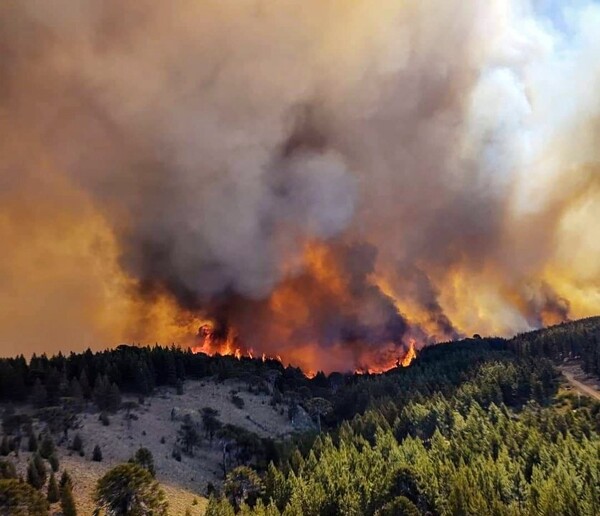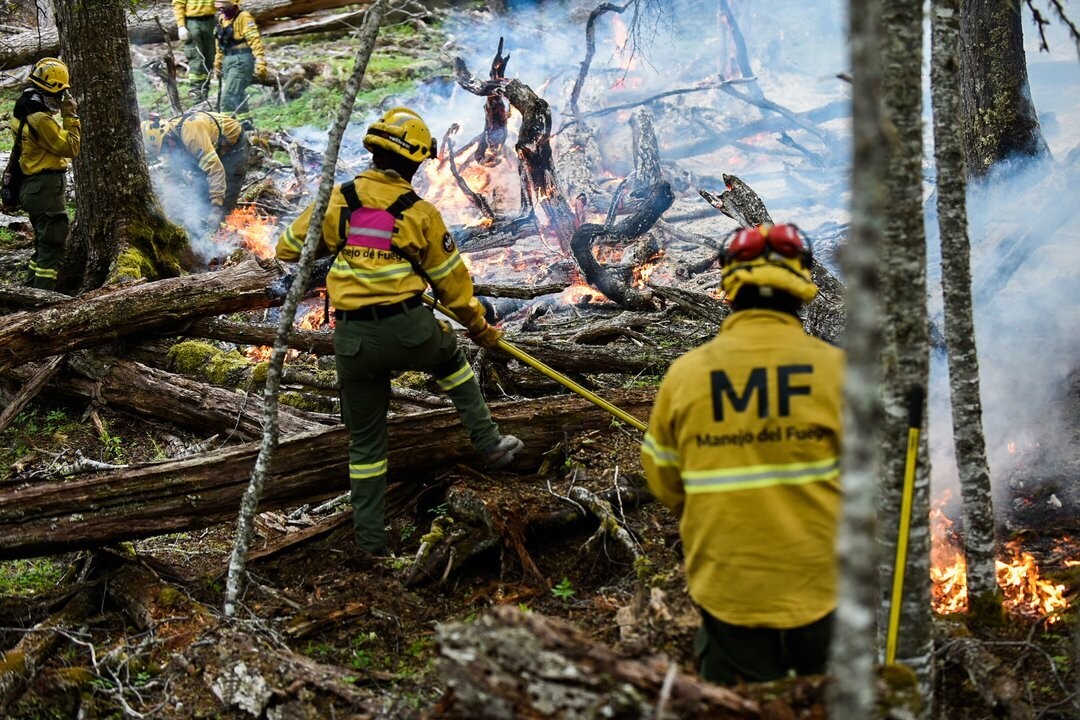
The National Fire Management Service (SNMF) reported that for this Monday, an intense day is expected due to the fire danger alert in almost all of Argentina, so authorities are asking for extreme caution.
The National Weather Service, through the SNMF map, reported that today the provinces of Tucumán, Santiago del Estero, Córdoba, La Rioja, San Luis, Mendoza, Neuquén, Río Negro, Chubut, Santa Cruz, Tierra del Fuego, La Pampa, Buenos Aires, Santa Fe, Entre Ríos, and Corrientes face an "extreme" risk of fires, as confirmed by the Argentine News Agency (NA).
"In our country, the danger of fires is assessed with the FWI (Fire Weather Index), a meteorological fire danger index developed in Canada. It represents the potential behavior that a forest fire could have at the most critical time of the day, which is estimated to be at 4:00 PM," the authorities explain.
The index is calculated based on temperature, relative humidity, wind speed, and accumulated precipitation from the last 24 hours. On this occasion, 16 provinces are painted red, so "the situation should be considered potentially explosive or extremely critical."
Expected conditions for the December-February 2025/26 quarter
For December, January, and February, experts indicated that conditions will be "above normal" over central and northern Patagonia, La Pampa, western Buenos Aires, Córdoba, eastern San Luis, and western Santa Fe. They will be "normal or above normal" in most of Cuyo, eastern Salta, Formosa, Chaco, southern Litoral, eastern Buenos Aires, and southern Patagonia, while "normal" over northern Litoral and the NOA region.
Furthermore, the forecast for above-normal temperatures suggests that although rainfall events that could cause temporary decreases in danger are not ruled out, on average, the danger will remain high.
Finally, it will be important to observe the evolution of the danger in the northeast of the country, an area that has recorded precipitation deficits in the last month and where the quarterly forecasts indicate the probable continuation of this condition.
Photo: Agencia NA (SMN)
To compare the risk throughout the country, statistical thresholds are calculated for each zone, thus giving rise to "danger classes." It is calculated daily from data at 12:00 local time.