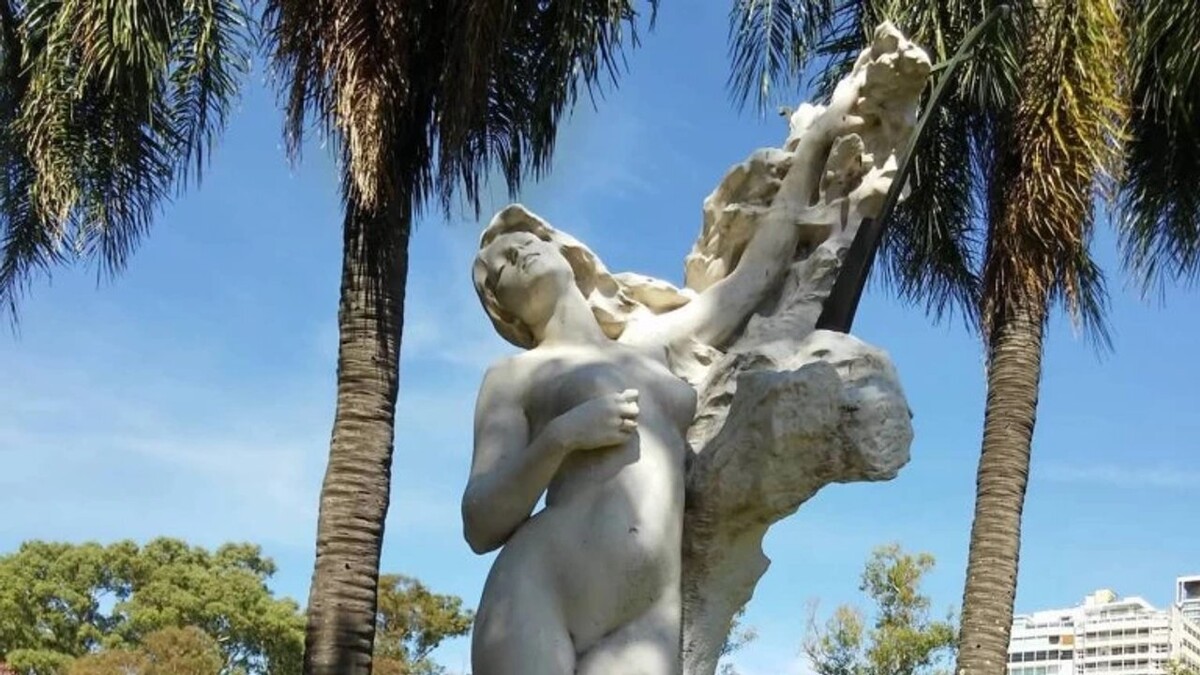
In Buenos Aires, amidst the tree-lined paths of Tres de Febrero Park, at the intersection of Avenida Infanta Isabel and Coronel Marcelino Freyre, near the lake, stands one of the most evocative sculptures of the city's artistic heritage: 'La Cigale'. The piece conveys an intensely sensual and material atmosphere, typical of the European Belle Époque. 'La Cigale' arrived in Buenos Aires, having been acquired in Paris, just like many other sculptures that enriched the public space of the port city at the end of the 19th and beginning of the 20th centuries. Since then, 'La Cigale' has been naturally integrated into the landscape, becoming a landmark for visitors and specialists. Its author, Félix Maurice Charpentier, was one of the most prominent figures in French sculpture of the era. He was named a Knight of the Legion of Honor in 1892 and also led an active civic life as mayor of Chassant, a position he held until his death in 1924. More than a hundred years after its inauguration, the sculpture puts us in direct contact with the aesthetic sensitivity of the Belle Époque, and is irrefutable proof of the influence of European art on the construction of the cultural identity of Buenos Aires. In this context, the figure of the landscaper Carlos Thays was key: trained in France and a protagonist of the urban transformations of the Argentine capital, Thays brought the ideal of the 'City of Light' to Buenos Aires, integrating art, nature, and planning. On January 3, 1949, by means of File 57-P-947 and Decree No. 61, the work was placed in its current location, consolidating itself as a sculptural landmark in the park. Its purchase is linked to the ambitious urban beautification project promoted by the then Municipality of the City of Buenos Aires, in tune with Parisian models. Carved in Carrara marble by the French sculptor Félix Maurice Charpentier (1858–1924), the work was inaugurated in 1908 and since 2019 has held the designation of National Historic Monument. The sculpture depicts a female figure leaning against a tree trunk, with a relaxed body and a lost gaze, as if suspended in a state of ecstasy. The scene evokes sensuality, abandonment, and dreaming, traits that directly allude to the spirit of Art Nouveau, a movement that at the beginning of the 20th century permeated the visual arts with wavy lines, naturalistic symbolism, and an exaltation of the body and emotion. The treatment of the marble reveals a careful contrast: while the female body is modelled with a smooth and delicate surface, the hair and the tree present a more schematic and rhythmic resolution. Born in Bollène, in the south of France, he trained at the École des Beaux-Arts in Avignon and then in Paris, where he studied with masters such as Pierre-Jules Cavelier and Amédée Doublemard. Influenced by Auguste Rodin, Charpentier combined the anatomical precision of the classical tradition with a strong expressive and psychological charge. During the Belle Époque, he achieved wide recognition at the Salon des Artistes Français, with works such as 'Le Repos du Moissonneur', 'Le Jeune Faune', and 'Les Lutteurs', the latter distinguished with the Medal of Honor and acquired by the city of Paris. At its feet, a harp —whose original strings were made of iron— introduces a musical and symbolic element, in addition to evidencing the valuation of industrial materials that characterized Art Nouveau.