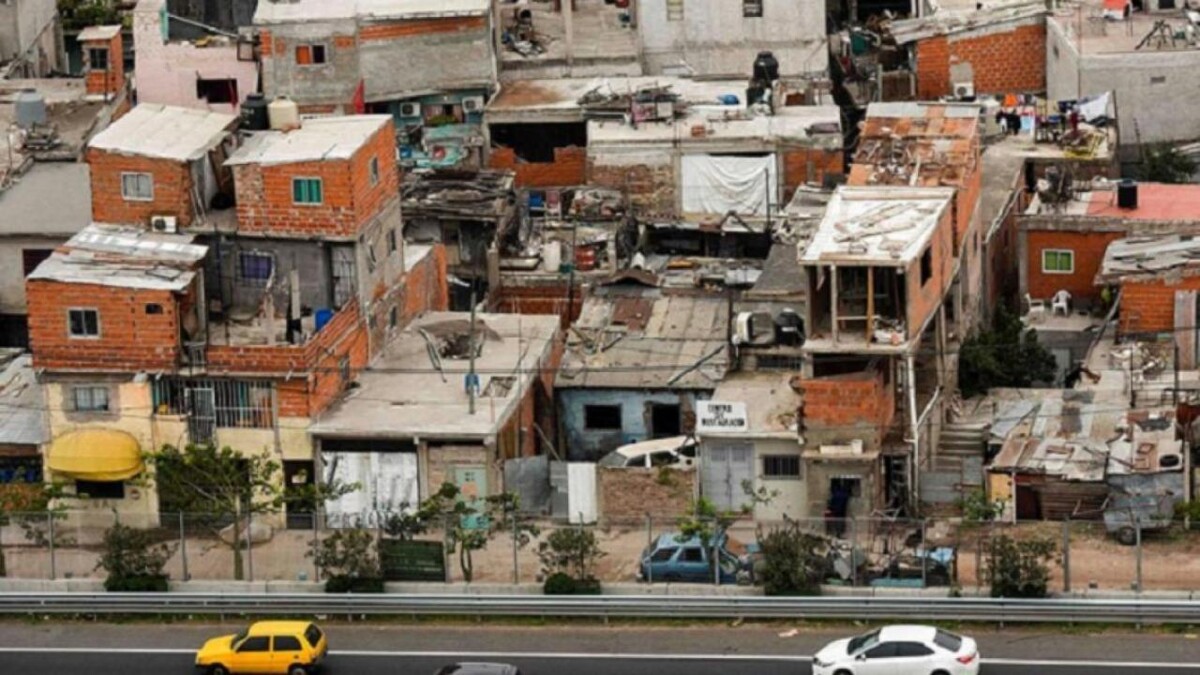
According to the official report, 41.3% of children aged 0 to 14 live in poor households. Among young people aged 15 to 29, the incidence reaches 32.6%; among people aged 30 to 64, it is 24.6%; and among those over 65, it is 9.7%. When looking at urban agglomerations in detail, the Autonomous City of Buenos Aires again showed one of the lowest rates, at 9.6%, while cities in northern Argentina remained among the most affected. The new report from the National Institute of Statistics and Census (INDEC) measured poverty at 28.2% of the population and indigence at 6.3%, an improvement of 3.4 and 0.6 percentage points, respectively, compared to the first half of last year. On the other side were the Pampean region, with 26.2%, and Patagonia, with 25.4%. The data confirms something that has been seen for a long time: poverty is decreasing, but at different speeds depending on the territory, labor structure, and income. Another relevant data point from the report is the gap. In indigent households, the average income was 354,134 pesos, against a basic food basket of 535,991 pesos, with a gap of 33.9%. The Minister of Economy, Luis Caputo, announced that “poverty is at its lowest in over 7 years.” Statistically, the figures show a sustained decrease from the peak of 52.9% recorded in the first half of 2024, when the initial adjustment, inherited inflationary acceleration, and recomposition of relative prices had driven social deterioration. At the regional level, the Northeast again showed the most critical situation, with poverty at 32.7%, followed by Cuyo with 32.3%, the Northwest with 28.4%, and the Greater Buenos Aires area with 28.3%. This combination explains why, even with better aggregate numbers, relief is still not strongly felt in many neighborhoods. The government will surely present this data as one of its most concrete achievements. Extrapolated to the entire country, different estimates place it near 13 million Argentines below the poverty line. Argentina closed the second half of 2025 with a significant drop in poverty and indigence, a figure that the government will seek to capitalize on politically, but which at the same time reveals that the social situation remains delicate, especially among children, in the Northeast, and in large urban belts. The reading is quite clear: the improvement did not erase childhood poverty or the fragility of households with children, which remain at the heart of the Argentine social problem. A very unequal geography was also maintained. In the 31 urban agglomerations surveyed by the Household Survey (EPH), poverty affected 8,474,136 people and indigence affected 1,884,110. INDEC itself reported less than two weeks ago that unemployment in the fourth quarter of 2025 reached 7.5%, above the previous year, and that labor informality remained high, with 43% of workers in informal conditions. That is: the decrease exists, it is concrete, but it does not allow us to speak of a problem solved or social normality recovered. The hardest data again involves children. And it has elements to do so: the decrease is real and breaks a very harsh sequence that had led poverty to alarming levels. The improvement exists; social fragility, too. It is no minor detail: within the official series of 31 urban agglomerations, the current 28.2% is the lowest level since the second half of 2018. But beneath this general improvement lies a much less homogeneous reality. Translated to the streets: even with the statistical improvement, millions of households are still far from covering the essentials. Furthermore, the decrease in poverty coexists with signals that demand caution. Argentina still has millions of poor people, very high childhood poverty, regions that continue to lag, and a labor market that still does not offer a solid way out. The difference was 435,637 pesos, implying a gap of 35.7%. INDEC calculated that an average poor household needed 1,219,130 pesos to cover the total basic basket, but had income of 783,493 pesos. But the other half of the picture is also there, in plain sight. Now, the ruling party is relying on the retreat of inflation, a certain recovery of activity, and a partial recomposition of incomes to show a change in trend.