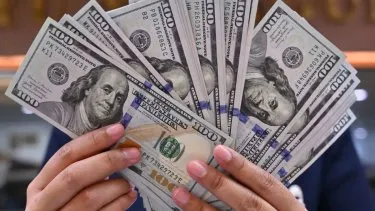
In January, dollar demand from households accelerated again, sending a clear signal about the financial mood on the street: Argentines bought a net of $2.730 billion. In the official market enabled for hoarding and payments, 1.6 million individuals were operating. This was 29% less than in January of the previous year, but the underlying message persists: despite a goods surplus of $2.014 billion—nearly five times more than in January 2025—the country's overall external operations show it consumes more dollars than it generates when adding services, interest, and other flows. For the economic team, the reading is twofold. The relative relief suggests that while tourism continues to drain foreign currency, the effect was less heavy than a year ago, when the exchange rate lag and incentive gap had pushed external expenses harder. On the financial front, the report shows a surplus in the financial account of $3.147 billion, explained by positive contributions from the financial sector, other net movements, and the National Government–BCRA group, with surpluses of $1.668 billion, $1.363 billion, and $584 million, respectively. Some of the currency outflows are also used to pay external liabilities, such as commercial or financial debt, profits, and dividends. The link to tourism appears, bluntly, when looking at the services account: it recorded a deficit of $946 million. And within that deficit, the BCRA details that 87% was explained by net outflows associated with card spending, travel, and tickets (excluding digital services), amounting to $829 million. If we look exclusively at the cash account, the accumulated amount drops to $29.005 billion, and falls to $24.917 billion if it is computed that, in the same period, there were sales of $4.088 billion (of which $410 million were recorded in January). The data, reported in the January Balance of Payments by the Central Bank of the Argentine Republic (BCRA), marks the highest level in the last three months and confirms a recurring pattern every summer: tourism, card spending, hedging against uncertainty, and a small price window that was enough to reactivate purchases. The photo of the month combines very concrete reasons. On the one hand, vacations and expenses abroad, which drive card use and payment of travel-related services. On the other hand, a slight downward correction in the retail exchange rate towards the end of the month: the public dollar ended January around $1.465, after touching a peak close to $1.495 at the beginning of the year. In a market where many decide on small variations, that drop acted as a stimulus: 'if it loosens a bit, I buy,' a simple logic repeated in thousands of homes. Of the total demanded, $2.613 billion corresponded to gross purchases by individuals and $2.203 billion to net purchases, according to official details. In other words, part of the 'dollar that is bought' ends up being a bridge to pay for foreign consumption (or local consumption billed by non-resident suppliers), a phenomenon that tends to intensify in the summer. Even so, the services deficit was 20% lower than in January 2025, when it had been $1.187 billion and net outflows from individuals were around $917 million. Within the financial sector, the surplus was mainly supported by a reduction in the holding of foreign currency assets by entities by $1.742 billion, a movement usually read as a portfolio rebalancing and liquidity adjustment in an environment of regulations and yield changes. But the data that is again turning on yellow lights is in the 'current account,' which reflects the country's total currency flow: it closed January with a deficit for the fourth consecutive month, this time of $919 million. For the average citizen, however, the message is usually more emotional than accounting: the dollar is again a refuge, and every month of strong demand revives the perennial question of how long the external equilibrium can last. These results partially compensated for outflows from the non-financial private sector of $469 million. The improvement in the trade surplus helps and orders, but is not enough to neutralize the seasonal pressure from tourism and retail dollar demand, especially when the economy is trying to normalize payments and rebuild import chains. The technical explanation provided by the BCRA is key to interpreting the data without overreacting: part of those banknotes remains deposited in local accounts and is later used to pay for foreign currency expenses, so not all of it is equivalent to the formation of 'pure' external assets. The figure is below the peaks of the pre-election stage of previous months but remains at high levels: it is comparable to October and is not far from the peak of buyers seen in September, when portfolio dollarization had escalated due to the combination of political uncertainty and asset coverage. Since the partial easing of access to the market for individuals—while the clamp remains for companies—the accumulated demand already amounts to around $35.600 billion, with a monthly average close to $3.560 billion.