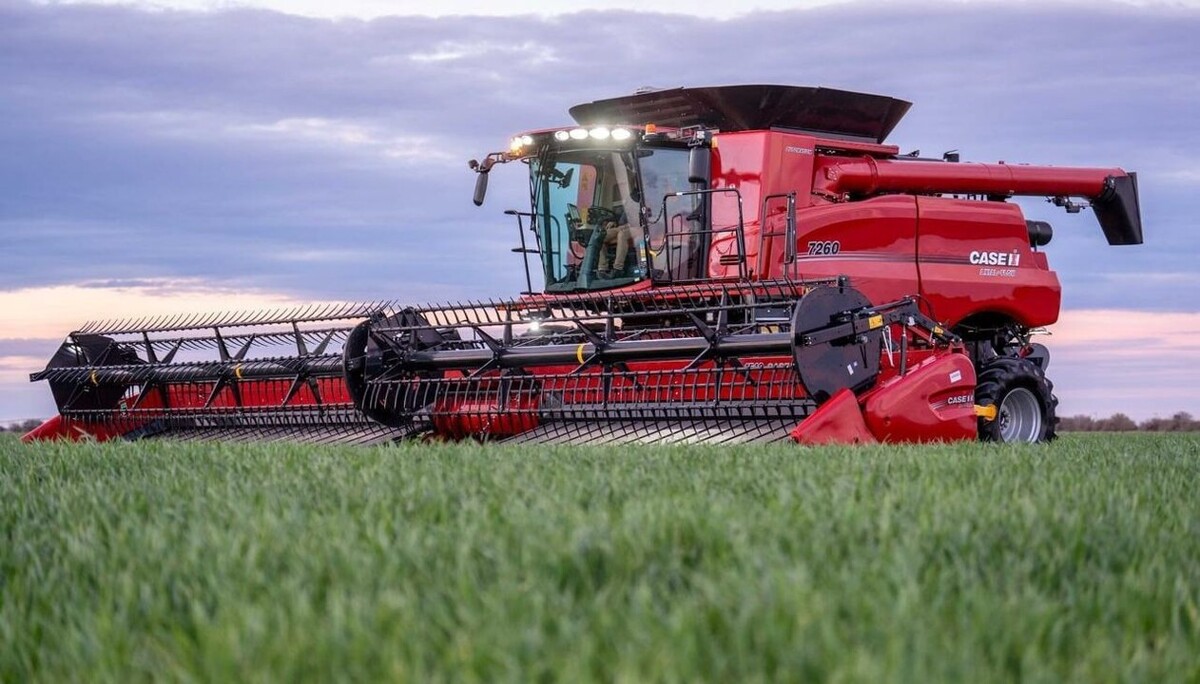
Buenos Aires, December 6 (NA) – According to the Agricultural Machinery Division of the Argentine Automobile Dealers Association (ACARA), patent applications for harvesters, tractors, and sprayers in November 2025 reached 498 units in total, representing a 13.4% year-on-year decrease. The Argentine News Agency reported on the ACARA's findings. The breakdown shows that, in year-on-year comparison, only harvesters saw a 6% increase, despite a drop of 53 units (-18.5%) in the last month compared to the 65 units in October. In November 2024, there were 50 units. As for tractors, 398 were patented in November, a decrease of 6.8% compared to the 427 in October, and a 15.9% decrease year-on-year, as 473 units were registered in November 2024. Regarding sprayers, 47 units were patented in November, a 24.2% decrease compared to the 62 units in October, and a 9.6% decrease year-on-year, as 52 units were registered in November 2024. Currency uncertainty ahead of the legislative elections worked against investment decisions, and the figures suggest the general sentiment was to 'wait and see'. Capital Goods Agricultural machinery in Argentina is a key sector that combines high-tech local production, such as no-till seeding and silo bags, with international brands, boosting the economy, employment, and exports to global markets. It offers equipment for seeding, harvesting (combines, headers), tillage (plows, harrows), spraying, and transportation, both new and used, with financing options. The range includes seeders (pneumatic, for fine/coarse grains), plows, harrows, chisels, subsoilers; combines, corn and sunflower headers, self-unloading hoppers; mixers, cultivators, fertilizers, sprayers, balers, loaders; silo bags (and their bagging machinery), and tractors of various powers and brands (Pauny, Hanomag, Chery, New Holland, Massey Ferguson). National manufacturers stand out (Dolbi, Ombú, Martínez, and Staneck), and there is a strong presence of multinationals, with a high concentration of industry in the central-east of Santa Fe (Armstrong, Las Rosas). A Different Scenario Ahead In this context, looking towards 2026, the report states that 'if a 2026 scenario with lower rates, exchange rate stability, and better climate prospects consolidates, the sector could regain its dynamism'. It clarifies that 'the recovery will depend on whether producer investment levels validate a long-overdue technological renewal'. Additionally, some topics may impact the market in unknown ways. 'The emergence of new players and brands, and the possibility of importing used machinery, add uncertainty to the evolution of industry volumes', the survey concludes. Agricultural Machinery Day The Argentine market is currently navigating a complex and challenging scenario. With greater openness, new supply alternatives, and an increasingly informed and demanding producer, investment decisions have become more rational and strategic. It is no longer just about acquiring a machine, but about evaluating support, availability, service, technical knowledge, and long-term continuity, reflected Sergio Karin, Commercial Director for Massey Ferguson for Latin America, on the eve of December 12, when Agricultural Machinery Day is celebrated. The executive calls for recognizing a sector that is much more than the set of machines that traverse Argentine fields: it is a pillar of national productivity, a constant engine of innovation, and a historical ally of the producer. He takes the opportunity to recall that the evolution of tractors, combines, and implements is closely linked to the advancement of agriculture. It has incorporated precision, efficiency, and sustainability, without losing sight of its deepest essence, which is to respond to the real needs of the producer in each region and at each production scale. Supporting the producer means understanding their logic of risk, their way of working, and the demand for timely solutions. 'It implies being present before, during, and after the purchase, with a network of dealers capable of offering specialized advice and a strong after-sales service that allows each piece of equipment to remain fully operational during critical moments,' he noted. Finally, it should be remembered that the agricultural machinery industry is also a generator of qualified employment, a driver of innovation, and a catalyst for regional economies. Its contribution runs through the entire value chain, from industrial plants to rural workshops, passing through suppliers, technicians, dealers, and professionals who sustain the operation of a sector strategic for the country.