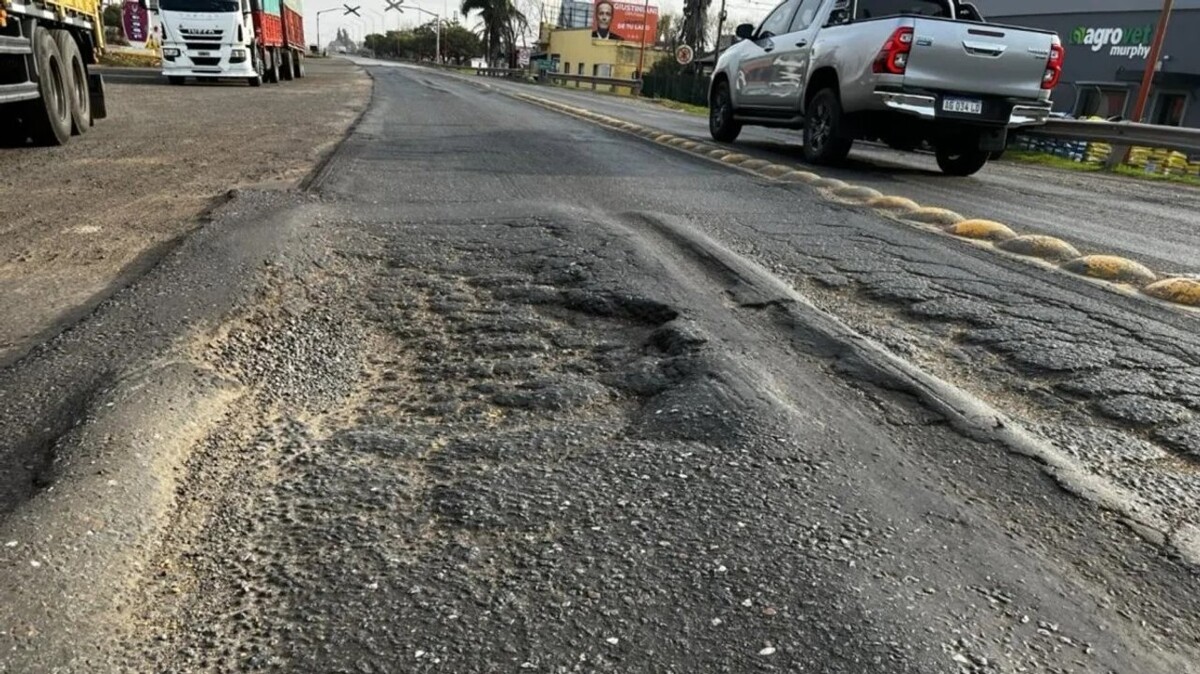
The National Roadway Personnel Federation has sounded the alarm over the state of the country's road network, asserting that 30,000 of the 40,000 kilometers of roads need maintenance, with 65-70% in "fair to poor" condition. The union is "highly critical" of the concession system promoted by the government in its second phase of route privatization, questioning its nature.
The union secretary criticized that, under these conditions, concessionaire companies, such as those on Route 14 and 12, known as the "Mercosur route," will practically do nothing more than "go out to patch roads or do two repavings in 20 years." He believes this scenario "would not contribute to improving the infrastructure's condition."
He stated that the agency is losing "its most qualified resources." Regarding the "political decision to paralyze" the activity, the union representative affirmed that it not only deteriorates the infrastructure but also eliminates the possibility for the National Roads Directorate to demonstrate that public works can be executed at lower costs.
"Cross-cutting complaints and critical routes"
The situation of the road network has generated concern at different levels of government, as Catanzaro confirmed that they maintain "quite a bit of contact with governors, with mayors" who are demanding the completion of paralyzed works and the need for transit. He mentioned that there is a "legal obligation" to keep the infrastructure operational, which has led to a large number of injunctions across the country where the plaintiff usually wins.
Although the problem is widespread, the unionist identified routes such as Route 151 in La Pampa, Route 3 south of Bahía Blanca, Routes 23, 9, and 34 in the NOA region, and Routes 7 and 8 once you leave the Greater Buenos Aires area, as some of the most critical.
This situation seriously compromises road safety and transit. Fabián Catanzaro, the union secretary of the entity, expressed "deep concern" about the state of "paralysis and emptying" that the agency is going through, caused by the government's policy of "zero public works."
Catanzaro, in dialogue with Splendid AM 990, pointed out that although the dissolution of the National Roads Directorate was avoided, "the emptying process continues."
"Impact on personnel and risk of future costs"
Catanzaro also denounced the "total wage freeze for a year" and a disciplinary protocol that strips the right to defense, causing an "expulsive form" that resulted in the loss of almost 20% of the personnel, including resignations, retirements, and dismissals.
In the interview accessed by the Argentine News Agency, Catanzaro argued that this is again a "financial deal" for companies that, despite being tendered as private investments, receive "subsidized state financing" through the BICE bank at a preferential rate of 2%. He argued that attacking the agency is attacking a "mirror agency that can demonstrate that costs, if done without inflation and without entering subcontracting processes, could be cheaper."
Furthermore, he warned about the future financial risk implied by the abandonment of maintenance: "What we are seeing is that we are falling into a bottleneck from which it will cost us a lot to get out because when that investment is not maintained, later rehabilitating the same thing costs three to five times more."
Buenos Aires, November 22 (NA) - The National Roadway Personnel Federation has sounded the alarm over the state of the country's road network, asserting that 30,000 of the 40,000 kilometers of roads need maintenance, with 65-70% in "fair to poor" condition.