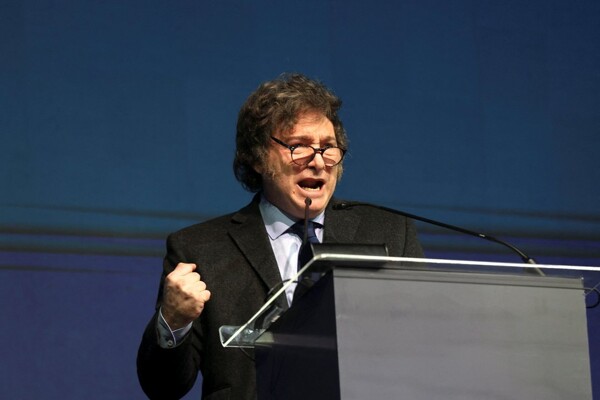
The Argentina Andean Forum, organized by the Federalismo y Libertad (FyL) Foundation at the Hilton Garden Inn in Tucumán, brought together over 200 leaders from the public, private, and academic sectors to analyze the role of Argentina's Northwest region (NOA) as the axis of the new national productive cycle.
The event was opened by Miguel Mitre (h), FyL's vice president and president of Ligreen S.A., a lithium mining company operating in the Salar de Diablillos in Salta. He highlighted the advances driven by President Javier Milei—such as the Bases Law, fiscal order, the RIGI, and the single ballot—that are strengthening the path toward a modern Argentina and allowing regional economies to flourish, especially through mining.
The closing panel, moderated by Florencia Donovan, included Luis Enrique Lucero, Secretary of Mining of the Nation since January 2025 and a lawyer specializing in natural resources. "The Argentine mining sector is still small on a global scale, but it is growing by leaps and bounds: there are already six projects underway, and the country could take second place in the world in a few years," he stated, highlighting a 24% annual compound growth in lithium production over the last decade, higher than any other commodity.
Beside him, Fernando Eleit, an advisor on Natural Resources Law and a board member at multinationals like Rio Tinto and BHP, detailed the accumulated investments: "In recent years, USD 6 billion has been invested in fixed assets and USD 3 billion in exploration, which generates social progress and quality employment."
"The opportunity Argentina has in energy and mining is one it hasn't had in 200 years. With the fiscal surplus of the Milei administration, reserves will grow, and Argentine shares on international stock markets have already risen by 60% since October 2023, according to Bloomberg data," said Juan Manuel Santos, vice president of the Argentine Union of Young Entrepreneurs (UnAJE) and CEO of Tallo Distribuciones, who advocated for an 'inclusive Northern mining region.' Both agreed on the potential of Jujuy, Salta, and Catamarca, where geological resources, institutional stability, and social license converge.
Mitre, citing data from the Ministry of Economy, added that lithium not only boosts exports but also positions the NOA as a key supplier in the global electric vehicle battery supply chain, a market projected to reach USD 400 billion by 2030, according to the International Energy Agency.
The second panel, moderated by Juan Pablo Bustos Thames, director of the Tucumán Research Center (CIT) of FyL and an expert in regional policies, explored the geopolitical dimension of strategic resources. Yau Hon-Min, a doctor in International Politics from Aberystwyth University in the United Kingdom and a professor at the National University of Singapore, warned about the risks of asymmetric interdependence. "Mining requires a 60 to 100-year horizon, and each cycle—from exploration to exploitation—can take between 8 and 15 years, with initial investments of at least USD 40 million just for feasibility studies."
José Ignacio García Hamilton (h), Legal and Technical Secretary of the Ministry of Economy, historian, and management professor at the Di Tella University, explained the Regime for Incentives for Large Investments (RIGI). He emphasized that the RIGI provides concrete guarantees and tax benefits that are already attracting new projects in the metallurgical and energy industries.
Lisandro Catalán, former Minister of the Interior (resigned on November 1 after a brief tenure), a Tucuman lawyer with a career in La Libertad Avanza, reflected on the political direction. He announced that Rio Tinto will hold its first global board meeting in Argentina in December, thanks to institutional predictability.
In the third block, Federico Domínguez, an analyst with a master's in Finance from Torcuato Di Tella University and author of books like 'Hyperaccelerated Argentina,' outlined an optimistic outlook. He highlighted unique factors: "Argentina combines unique factors: a country far from armed conflicts, a food producer, with mineral, oil, and rare earth reserves, projecting a trade surplus of over USD 65 billion by 2033."
"The lithium triangle—Argentina, Bolivia, and Chile—concentrates 50% of the world's resources. Argentina is consolidating itself as a preferred global destination thanks to its resources and the legal security offered by this administration."
"Our production chain integrates the public and private sectors, with 97% being small technology companies, which translates into a sustainable and inclusive structure distributed throughout the country and in several regional centers," he explained. Argentina has 65% of its territory unexplored, and today we are a priority investment destination," he highlighted. However, he warned about the threats from mainland China: "That network is today challenged by mainland China in multiple dimensions: economic, sabotage, and espionage."
The forum's closing was given by Ricardo Ferrer Picado, a fellow researcher at the Center for a Secure Free Society, a think tank focused on hemispheric security based in Washington. "We will double the company in the next two years and triple our investments by 2032," he announced, recalling humble beginnings without a budget.
The forum, broadcast on FyL's YouTube channel, left a consensus: the NOA is moving from promise to a decisive actor, driven by USD 9 billion in announced mining investments and a renewed legal framework that attracts global giants.