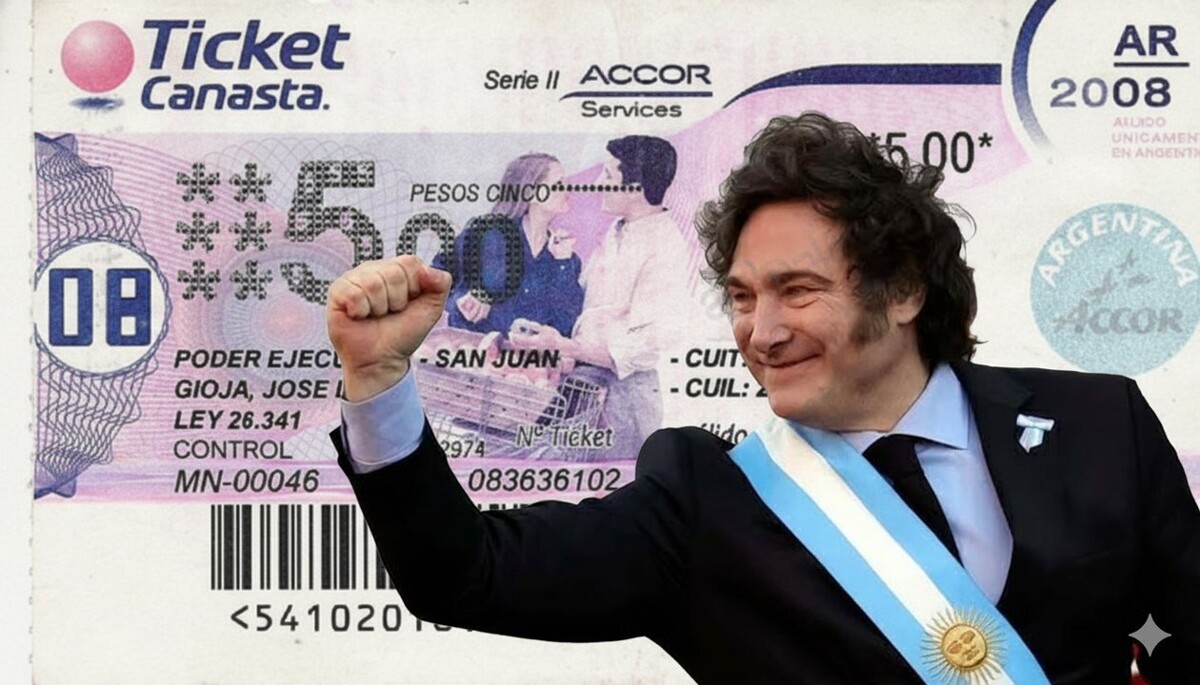
One of the most controversial points of the labor reform project that will enter Congress in December is the inclusion of the food voucher into the salary. Since it is not a retributive payment, it will not be counted to calculate severance pay or contributions to the retirement system. The government of Javier Milei insists on bringing the 'Canasta Voucher' back into action and allowing employers to pay part of the salary with them. In addition to reducing the salary, these vouchers were not counted when calculating retirement contributions or bonuses, and they were also not received during vacations and sick leave. What was a source of profits for businessmen was not reflected in the benefits obtained by workers, who did not receive the vouchers during sick leave, due to accidents, during vacations, did not receive bonuses on vouchers, and in case of being entitled to receive a severance payment (whether for dismissal or incapacity), the value of the vouchers was not taken into account in its calculation. Furthermore, its value was not counted for the payment of extras or overtime hours. Law of Labor Contract The so-called 'Restaurant Ticket', 'Canasta', 'Lunch' or other denominations were common in contracts in the 90s under the umbrella of article 103 bis of the Law of Labor Contract (LCT) that regulates 'non-remunerative social benefits' that employers cover and that do not integrate the workers' salary and severance calculation. Its use was repealed in 2007 by Congress, at the initiative of a bill promoted by labor lawyer and then deputy Héctor Recalde, who in turn had exposed a bribery attempt captured by a hidden camera in which companies in this sector tried to twist the vote. The bad memories remain fresh among workers, which was made manifest in the measurement carried out at the beginning of the year by the Zubán Córdoba consultancy, in that an eventual return of the 'canasta vouchers' as part of the employees' salary was the one that generated the most rejection (81.3%). Only 13.3% of those consulted about the purchase vouchers that circulated in the 90s showed agreement. Antidotes against hyperinflation The 'canasta vouchers' were born in 1989 to, it was argued, avoid the scourges of hyperinflation. They were the dawn of convertibility when its implementation was systematized by Domingo Cavallo. The food vouchers had no discounts for social security contributions and there was a 14 percent employer contribution that went to family allowances. Averaging its validity in 2005, some 5000 companies operating in the country incorporated the tickets as a means of payment, they were received by 15% (one and a half million) of registered workers and represented 13% of the remuneration. While the system was in effect, the State, the workers, their union organizations and social security funds lost 21,000 million dollars, which were transferred to the business sector. The companies that offered the voucher service earned some 125 million dollars in 2007, when it was repealed. Business profits The leader in the voucher sector, Accor, had three sources of income: they charged an additional fee that ranged between 2% and 6% of the total amount when selling the vouchers to the employer company; they retained between 1.5% and 6 percent from the commerce that had received the vouchers and exchanged them for cash to the worker, with a discount rate. In between, the issuing companies generated a mass of cash that they could 'temporarily place in the financial sector for their own benefit', as detailed by CENDA. The business generated by the mass of money that the voucher issuers could place in the financial market, between the issue and the repurchase, is not calculated. According to the information disseminated by the business chamber, the annual profits from the issuance of tickets oscillated between 140 million and 395 million pesos, with a dollar at about 3.15 pesos at the end of 2007. That amount arose from calculating the profits obtained only by the sale and repurchase of the tickets that 1,417,000 workers (more than 15% of the total registered employees) received, according to CEVAS data. The French group Sodexho had become the new leader of the national canasta ticket market that operates under the brand Luncheon Tickets. It got its competitor Ticket Total and in this way came to control nearly half of the business in Argentina. So far, Ticket Total is the third player in the square, while Sodexho disputes the leadership with another French company, Servicios Tickets, belonging to the Accor group. For Ticket Total, it is the second change of owners in the last two years. Until 2004, it was in the hands of the Argencard group, which in turn was controlled by the investment fund The Exxel Group.