American companies and the Western world are on the brink of making unprecedented investments in the sovereign Republic of Argentina, which will make Argentina great again, the diplomat assured.
Technology giant OpenAI—the company behind ChatGPT— kicked things off by announcing a strategic alliance with Sur Energy, an Argentine 'clean energy' firm, to build a massive artificial intelligence data center in Patagonia. The project involves the largest investment to date: $25 billion will flow into the country to position Argentina as the main AI hub in Latin America.
Key Sectors According to Analytica, the stock of U.S. Foreign Direct Investment (FDI) amounts to $31.882 billion, 7.4 times more than China's, and represents 17% of the total registered until March this year, which reached $187.029 billion. U.S. investments stand out in oil and gas extraction, manufacturing, telecommunications, and automotive trade. Sectors such as agriculture, energy, and mining appear as areas of strong potential, driven by the Regime for Large Investments (RIGI) and the strengthening of political ties that foster the arrival of new companies.
Behind the U.S. are Spain ($27.379 billion; 15%), the Netherlands ($24.054 billion; 13%), and Brazil ($13.023 billion; 7%). In contrast, China accounts for 2% of the total, with $4.286 billion, concentrated mainly in mining, oil, and hydroelectric power.
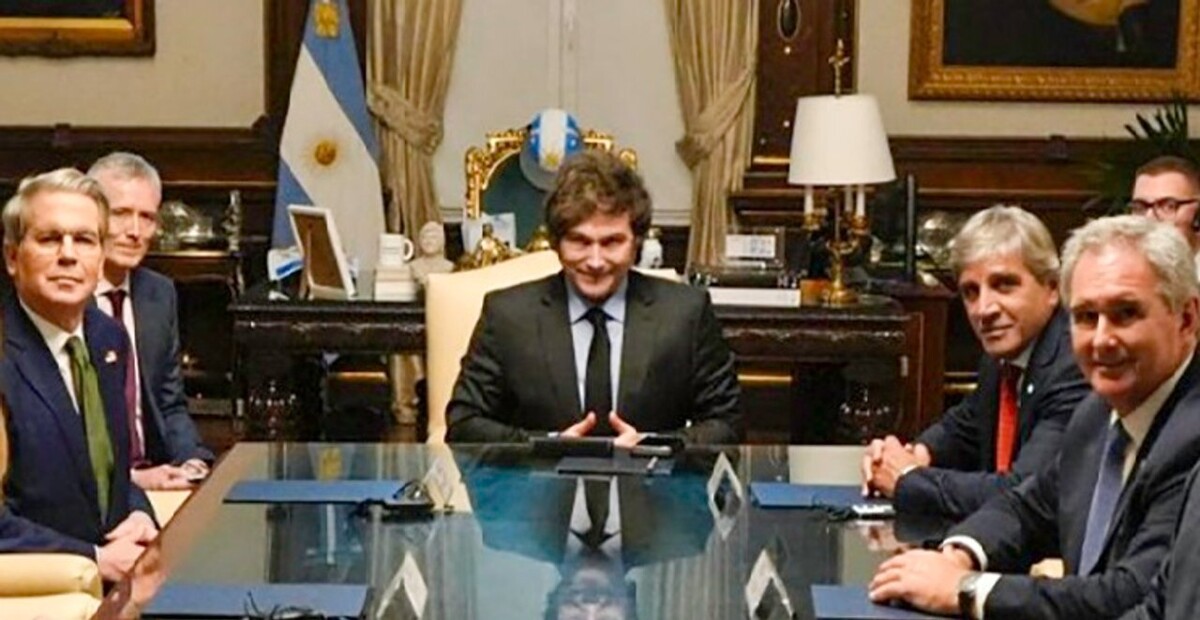
The appointment of Pablo Quirno as Minister of Foreign Relations has a key purpose for the relationship that is opening up, since the Sunday's midterm election, between the government of Javier Milei and that of Donald Trump, in which the activation of the U.S. position in mining investments stands out.
A couple of days before the crucial national midterm election, the President surprised with the replacement of the Foreign Minister, Gerardo Werthein, and his appointment in his place by a trusted official of Dante Caputo, his Secretary of Finance, who since the approval of the Regime of Incentive for Large Investments (RIGI) has specialized in dealing with mining entrepreneurs from the North interested in entering. With strong ties to the international financial community, both for his experience in the private sector and the negotiations carried out with multilateral credit organizations, Quirno cultivated close ties with the economic area of the White House. He played a leading role in the negotiation with the U.S. Treasury, and the Trump Administration celebrated his appointment, as financial support is part of a geopolitical interest where strategic minerals occupy a preponderant place.
His approach to the mining sector is evidenced by his participation in a summit of the London Metal Exchange and the PDAC (Prospectors & Developers Association of Canada), in Toronto, where he contacted the CEO of the Business Council of Canada (the country's most influential business organization with a weight of 50% of the private sector GDP), with the Canadian Council for the Americas (CCA), representatives of the Stock Exchange, and several billion-dollar pension funds.
U.S. interest in Vaca Muerta, lithium, and uranium reflects a combination of geopolitical strategy and economic planning. For Argentina, this attention can translate into new investments, technology transfer, and the consolidation of key sectors, as long as a framework of legal and political certainty can be maintained.
The main mining projects in Argentina currently financed by the U.S. extend from north to south, in the provinces of Jujuy, Salta, Catamarca, and Santa Cruz. Lithium, gold, silver, lead, and zinc are the main minerals to be extracted.
Direct Access The strategic focus on Quirno translated into mining CEOs wanting direct access to him to speed up the approval of their RIGI projects or to get feedback before submitting them. His participation bore fruit only at the end of May, on the eve of Arminera, the country's largest event organized by the CAEM (Argentine Chamber of Mining Entrepreneurs), when the approval of the Rincón lithium project of the Rio Tinto mining company was announced, in the following months, it was the turn of Galán Lithium and Los Azules. Among the three, they account for close to $6 billion, and there are more than $17 billion awaiting approval for Pachón, Agua Rica, phase 1B of Fénix, Gualcamayo, Sal de Oro, and Sal de Vida.
U.S. participation in Argentine mining The mining projects with U.S. participation are: the Puna Operation (Silver, lead, and zinc), belonging to SSR Mining, in the province of Jujuy; in Salta, Salar de Arizaro (Lithium), 40% of Pluspetrol Resources, of the Netherlands, 26% of the U.S. subsidiary Argentum Investments LLC, and the remaining 4% of the Spanish Prado Largo SA.; The Quevar (Silver), joint venture with 26% participation of the Canadian Barrick Gold, and the U.S. Golden Minerals Company, with the remaining 30%; the Fénix (Lithium) in the Salar del Hombre Muerto, in the northwest of the province of Catamarca, from the merger between the U.S. company Livent with Allkem, which gave rise to Arcadium Lithium, the current owner and operator of the project; Kachi (Lithium), which belongs 75% to the Australian company Lake Resources and 25% to the U.S. company Lilac Solutions; Cerro Negro (Gold), in Santa Cruz, of the global leader Newmont Goldcorp.
U.S. Investments in Argentina The United States is Argentina's third trading partner, behind Brazil and China. In the last decade, Argentine exports to the Northern Country averaged $5.700 billion annually, with a peak of $6.464 billion in 2024. Although the trade maintains a chronic deficit for Argentina, which averaged $3.666 billion annually between 2014 and 2023, this could be reversed. Since last April's 'Liberation Day', Argentine products face a base tariff rate of 10%, the lowest in the scheme applied by the Trump Administration. In terms of investment, the U.S. ambassador to Argentina, Peter Lamelas, reiterated the interest of U.S. and Western companies in the country. According to his statements, these investments will be of a magnitude 'unprecedented'. In a message posted on social network X, the ambassador highlighted that this capital movement will mark a before and after for the Argentine economy.