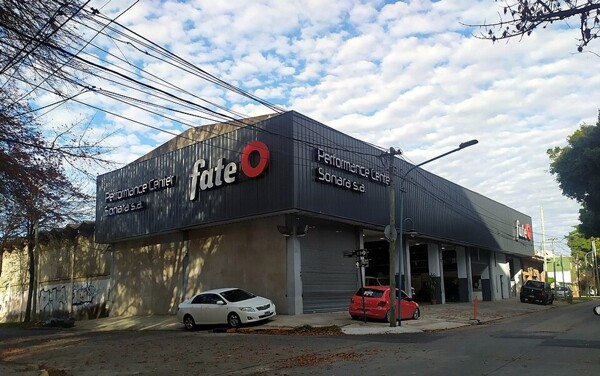
For the Argentine Industrial Union (UIA), the closure of a company of 'national origin' with decades of history not only affects its direct staff but also strains the entire logistics network and network of SMEs orbiting manufacturing: from transport and maintenance to inputs and industrial services. The reaction from the industrial center comes at a time when the government insists that macroeconomic normalization and competition will reduce costs and improve productivity, while the industrial sector warns about the speed of the adjustment and the asymmetry with competitors that produce on a large scale, with financing and active industrial policy. In a statement released after the firm confirmed the immediate cessation of operations and the dismissal of 920 workers, the business entity warned that the industrial sector has accumulated almost 65,000 jobs lost in the last two years, equivalent to a 5.4% drop according to the latest available data as of November 2025, and demanded 'balanced' competition conditions to face external pressure it described as distorted. The UIA's position, led by Martín Rappallini, sought to shift the focus from the specific situation and frame the closure of Fate as a symbol of a systemic problem. On the other hand, it established that the challenge for the industry is to offer international prices and qualities, and that this horizon requires a combined effort: business investment, continuous improvement, training, and modernization, supported by a macroeconomic and regulatory environment that does not penalize local production against external competitors. In the reading of the industrial establishment, the Fate case condenses the risk of an 'opening without convergence' that, if not corrected, can accelerate closures and shrinkages in sensitive branches, with an immediate impact on registered employment and suppliers. 'Behind the closure of a factory there are workers, families, suppliers, transporters, linked SMEs and entire communities that depend on that productive core,' stated the industrial center, and added that each plant that is shut down means a loss of accumulated knowledge, qualified employment, and value chains that take decades to build and can be dismantled in a few months. In parallel, sectoral surveys point out that a majority of the tires marketed today in the domestic market come from abroad, a fact that feeds the manufacturers' argument about the difficulty of sustaining scale and margins in a context of high internal costs. The UIA also tried to balance its message to avoid being trapped in a closed corporate defense. In the tire industry, the rise in imports and the fall in prices accelerated during 2025, with a peak that the sector itself took as a reference: in May of that year, 869,525 imported tires entered the country, a record that forced brands with local production to lower prices to sustain sales. At that point, the UIA appealed to 'international experience' to argue that major economies apply commercial defense measures to protect strategic chains when imbalances of this type are verified. The immediate background again places the debate on trade opening and competitive convergence. With Fate out of operation, the UIA's message seeks to establish that the discussion is not only about the destiny of a plant, but what model of productive insertion is consolidated and how much industrial employment remains standing in the process. The statement highlighted that the phenomenon is not limited to an import 'shock,' but to international competition that, according to the business vision, is affected by dumping, hidden subsidies, and systemic distortions. The message came amid scenes of tension at the plant accesses and a conflict that threatens to escalate in the tire sector. In its diagnosis, the entity placed the tire industry as 'one of the most evident cases' of the combination between global overcapacity and unfair trade practices, with particular emphasis on the Asian origin of part of the imported supply. On the one hand, it demanded 'equality of conditions' to compete: a 'reasonable' tax scheme, accessible financing, efficient infrastructure, and a 'modern' labor framework. Buenos Aires, February 18, 2026 - Total News Agency - TNA - The Argentine Industrial Union (UIA) sounded the alarm after the definitive closure of the Fate tire plant in Virreyes, San Fernando district, and stated that the decision 'cannot be analyzed as an isolated episode' but as the expression of a broader deterioration of the productive fabric.