


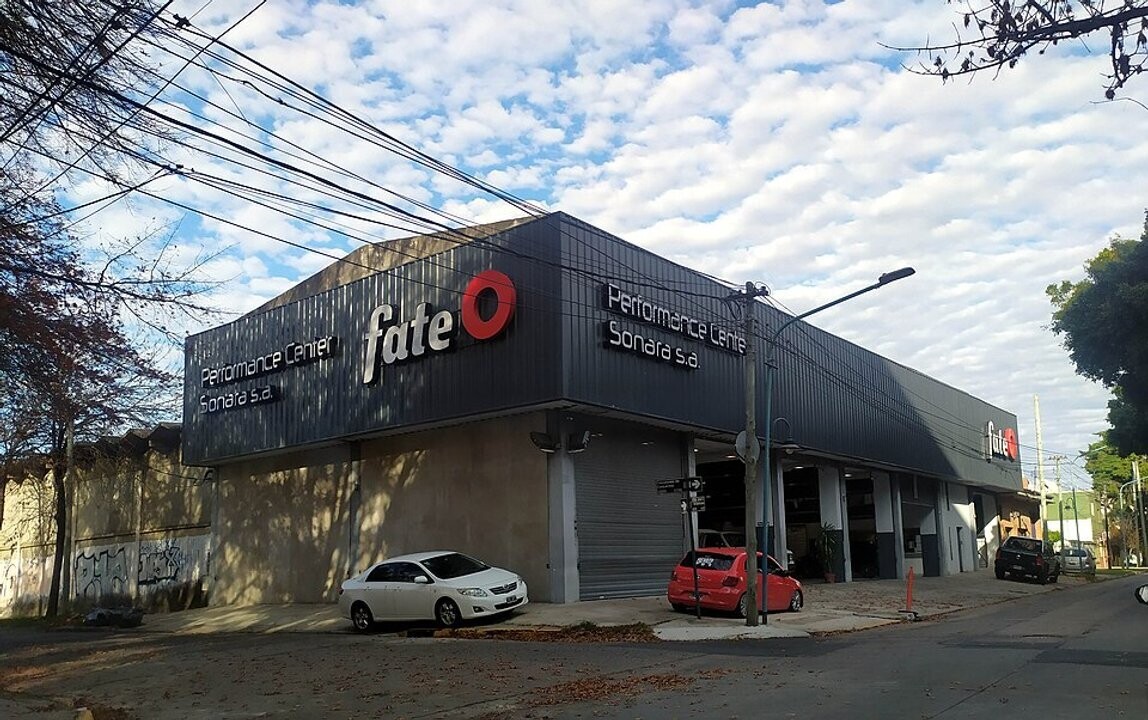
The Argentine tire manufacturer Fate announced on Wednesday the immediate closure of its industrial plant in Virreyes, located in the San Fernando district, and the termination of employment contracts for all 920 employees. The plant, considered the largest in the sector in Argentina, had a capacity to produce over five million tires annually and played a central role in supplying the automotive industry and the replacement market, as well as supporting exports at various times. The announcement did not come as an isolated bolt from the blue but as the culmination of a degradation process that the company itself had been warning about since 2024. "We communicate that, as of today, we cease activity at our industrial plant in Virreyes, San Fernando district, Buenos Aires province," the company's statement, accessed by the Argentine News Agency, indicates. This is the country's largest plant, with a productive capacity exceeding five million tires per year. Why is Fate closing? After announcing the closure decision, the company stated, "changes in market conditions force us to face future challenges with a different approach, without ceasing to value the industrial vocation that has always defined us throughout this time." In its statement, Fate reviewed its history and noted that "over more than eight decades, FATE built an industrial leadership sustained by permanent investment, advanced technological development, and an unwavering commitment to quality." The company emphasized that it is an Argentine capital enterprise that "generated quality employment, developed local suppliers, exported technology, and contributed to the country's productive fabric," and added that "this identity defines us and will accompany us in the challenges that lie ahead." Finally, the company bid farewell, thanking: "we express our deep gratitude to those who accompanied us on this journey: our employees, customers, suppliers, and all those who trusted in our industry." In parallel, in the business world, it is taken for granted that Javier Madanes Quintanilla will concentrate his efforts on the metallurgical conglomerate linked to Aluar, while the industrial chapter of Fate, for now, is closed with a decision that once again exposes the social cost of market changes in the real economy. In this vein, the company and sources close to the group maintained that the closure would be orderly: obligations to workers, suppliers, and financial institutions would be settled, followed by the liquidation of the industrial operation. In the economic background, the breaking point most repeated by industrialists and sector merchants is the acceleration of imports and the collapse of pricing power. The destination of the San Fernando property has not yet been determined, while the sector watches with concern the evolution of the market and its ability to adapt to external competition. With the cessation of activity, a brand that was part of Argentina's productive development for generations and was a symbol of an era when local industry occupied a central place in the national economy is extinguished. According to sources close to the company, the process will be an orderly closure: indemnifications will be paid in accordance with current law, and commitments to suppliers, banks, and creditors will be settled. In a statement signed by the board, the company noted that "changes in market conditions force us to face future challenges with a different approach," alluding to the context of open commercial policy and increasing external competition. An emblematic plant closes its doors. The plant, located on a 40-hectare site with over 157,000 square meters of covered space, had a capacity to produce more than 5 million covers per year. The decision implies the complete liquidation of the business and the closure of a factory that for more than eight decades was an emblem of the local industrial fabric. This is not a creditor's contest nor a preventive crisis procedure. The historic Argentine tire manufacturer Fate announced the definitive closure of its industrial plant in Virreyes, the Buenos Aires district of San Fernando, and the dismissal of all 920 of its employees. However, the recent scenario showed that the "price war" and the opening of trade reordered the board, benefiting the consumer in the short term but putting domestic manufacturing and its supplier network at risk. For now, the closure raises questions about the impact on the autoparts chain, local supply, the fate of the industrial site, and the scope of the union conflict in a sector that was already marked by tough salary negotiations and recurrent strikes. The company, owned by the Madanes Quintanilla family, ruled out that it is a preventive reorganization or a restructuring and instead proposed a definitive closure with asset liquidation and payment of indemnifications in accordance with current regulations, a decision that once again tensions the social climate in the tire industry and deepens the impact of import opening on local production. According to the text released by the board, the company attributed the outcome to "changes in market conditions" that, in its view, force it to face the future "from a different approach," despite vindicating its "industrial vocation" and the journey of more than eight decades in the country. The Argentine Industrial Union (UIA) has warned in recent days about the loss of more than 60,000 industrial jobs since August 2023 and has demanded advancing in reforms that reduce fiscal pressure and improve competitiveness. The Fate case thus becomes one of the most significant industrial closures in recent years, both for its history and the magnitude of its labor impact. In the sector, they recall that Fate had already gone through previous personnel cuts and shift adjustments in previous years, and that in 2024 it had argued for a loss of competitiveness, falling sales, and rising costs to request formal crisis mechanisms. This shock forced manufacturers and commercial chains to adjust prices, with discounts reaching 15% on specific lines, deteriorating margins in a business highly intensive in energy, logistics, and working capital. In this framework, the company described three factors that, combined, ended up "dynamiting" its productive equation: the competition of imported products with entry prices difficult to match for national production; the "maze" of macroeconomic issues associated with tax pressure, restrictions, and financial costs; and a labor front traversed by conflictivity and debates on productivity. More recently, both companies implemented voluntary retirements or preventive crisis procedures. The decision comes amid a broader debate on the course of trade and labor policy. Its closure marks a turning point in a sector that was already going through a phase of contraction. Fate, an acronym for Fábrica Argentina de Telas Engomadas, was born in 1940 and was a pioneer in the production of radial tires in the country. Buenos Aires, February 18 (NA) – The Argentine tire manufacturing company Fate communicated this Wednesday that it will close immediately and will dismiss 920 employees. "Fate S.A.I.C.I." In the same period, employment in the activity was reduced by more than 6,400 positions. In May 2024, the company had already dismissed 97 workers when it warned of a "sustained loss of export competitiveness." At that time, it mentioned factors such as tax pressure, exchange restrictions, labor costs, deficient infrastructure, and union conflict. The sector had gone through a prolonged union conflict in 2022 with the Single Union of Argentine Tire Workers (Sutna), which paralyzed the three main plants in the country, including those of Pirelli and Bridgestone. Its president, Javier Madanes Quintanilla, is also the head of Aluar, the company in which he would now concentrate his efforts. The closure occurs in a context of a strong increase in tire imports, particularly from Asia. It was also distinguished for its insertion in export markets such as Europe, the United States, and Latin America. The group is controlled by the Madanes Quintanilla family. In the private sector, they emphasize that producing locally has become more expensive than importing, especially when the market decelerates and inventory grows in warehouses. The social dimension exploded almost simultaneously with the announcement. Union spokespeople maintain that the closure leaves hundreds of families without immediate support and anticipate measures of force and presentations before the labor authority, while the company emphasized that it will deposit indemnifications and unpaid wages within the legal deadlines. The Fate case also acquires symbolic value on the industrial map: it was the local firm with the greatest "national" identity within a market where multinationals with global supply compete. Virreyes, February 18, 2026 – Total News Agency – TNA – The historic Argentine tire manufacturer Fate S.A.I.C.I. communicated this Wednesday the immediate cessation of activities at its industrial plant in Virreyes, San Fernando district, and announced the extinction of employment contracts for its workforce, estimated at 920 employees. During the morning, protests by workers and delegates were recorded at the San Fernando site, with police presence inside and outside the plant. According to a report by the PxQ consultancy, between 2023 and 2025, sector imports grew by 34.8%, while internal prices fell by 42.6%. In 2025, the jump in imports reached record levels for a single month: 869,525 imported tires were counted in May (adding cars/vans and heavy transport), a volume noted as the highest in more than two decades. The local market was flooded with imported tires—with a strong Chinese presence—in a scenario of tariff reduction and greater supply, which pressured internal values downward. The company recalled that it was a pioneer in the supply of radial tires for the automotive platform and stated that it was the only national producer of radial tires for transport, with an export presence in Europe, the United States, and Latin America. In this context, the arrest of Alejandro Crespo, general secretary of the SUTNA (Single Union of Argentine Tire Workers), was reported amid an episode of maximum tension over access control and the possibility of taking over the establishment.