According to information from the Argentine News Agency, the new species, named in honor of Argentine scientist Bernardo Houssay, belongs to the group of titanosaurs, quadrupedal dinosaurs with a long neck and tail. Researcher Leonardo Filippi conducted field work.
«The discovery of a new species that preserves most of its axial skeleton, that is, the vertebrae, provides valuable anatomical information that allows it to be compared with other titanosaurs. These data, along with the presence of this third species in the area, contribute to formulating new hypotheses that suggest that the remarkable diversity of this group of dinosaurs during the Upper Cretaceous could be due to the acquisition of different feeding strategies or, alternatively, reflect a faunal replacement event within the formation,» explained CONICET in its bulletin.
Fossil remains of Yeneen houssayi.
The distinctive features that allowed the new species to be defined are mainly found in the dorsal vertebrae, which, it should be noted, were all preserved, the sacrum, and the first caudal vertebra,» indicated Leonardo Filippi, lead author of the study and a CONICET researcher at the Municipal Argentine Urquiza Museum (MAU) in Rincón de los Sauces, Neuquén.
CONICET explained that the genus name, Yeneen, was inspired by the Tehuelche culture, also known as Aónikenk, which means "spirit or entity related to winter," due to the La Invernada area, where the new dinosaur was found.
They also detailed that this new sauropod dinosaur, belonging to the group of titanosaurs, joins those already known in the area and those from the Bajo de la Carpa Formation: Overosaurus paradasorum and Inawemtu oslatus.
Photo: NA Agency (CONICET)
The Discovery
Details related to the discovery date back to 2003, when an officer from Squadron No. 30 of the National Gendarmerie, based in the Neuquén town of Chos Malal, reported the finding of fossil remains in the area known as Cerro Overo-La Invernada, near Rincón de los Sauces.
The information made it possible to identify a site with great paleontological potential where bones belonging to several titanosaur sauropod specimens were found.
Buenos Aires, January 14 (NA) – A team of researchers from the National Council for Scientific and Technical Research (CONICET) discovered a new species of sauropod dinosaur that lived about 83 million years ago in what is now the province of Neuquén.
The discovery was published in the journal Historical Biology.
Photo: NA Agency (CONICET)
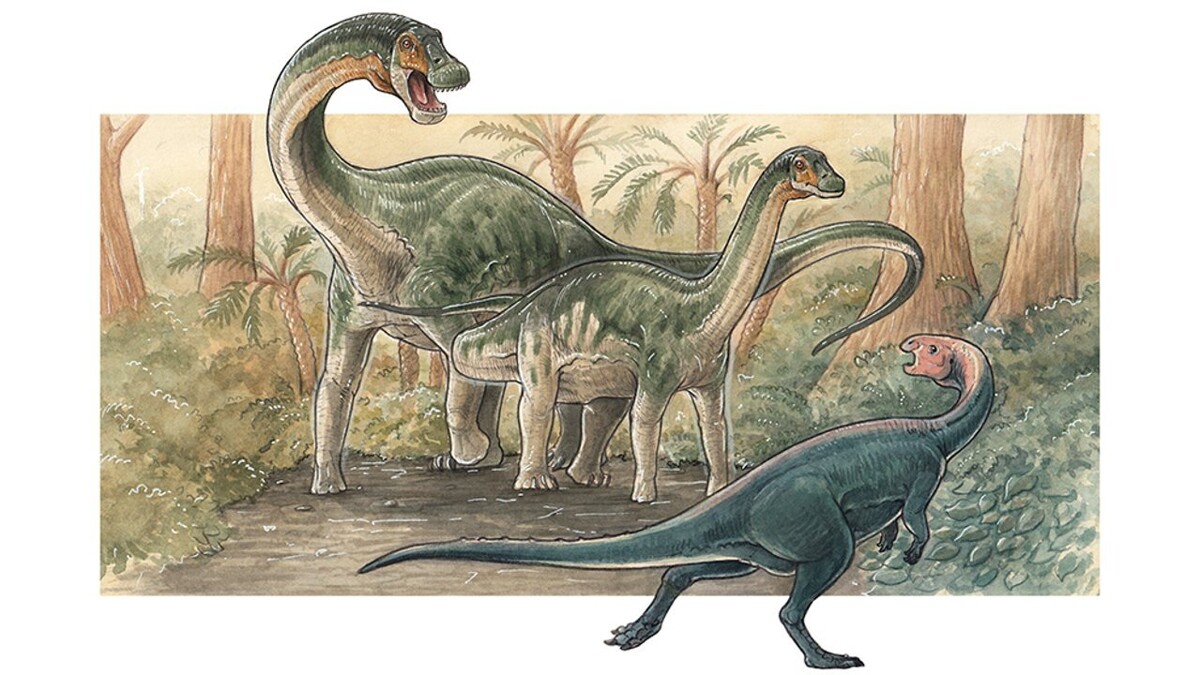
What was Yeneen houssayi like
«Yeneen houssayi had a small head in relation to the rest of its body.
However, due to difficulties of access, the remains could not be rescued at that time and were left in safekeeping.
IP
A decade later, in 2013, after work in the area with an oil company that made it possible to open new roads, the site was rediscovered and became a priority for the Argentine scientific team.
After excavation work and extensive research, the team managed to describe and name a new species of dinosaur, represented by a specimen that
consists of six cervical vertebrae, all ten dorsal vertebrae, several associated ribs, the sacrum, and the first caudal vertebra.
It was between 10 and 12 meters long and weighed between 8 and 10 tons.