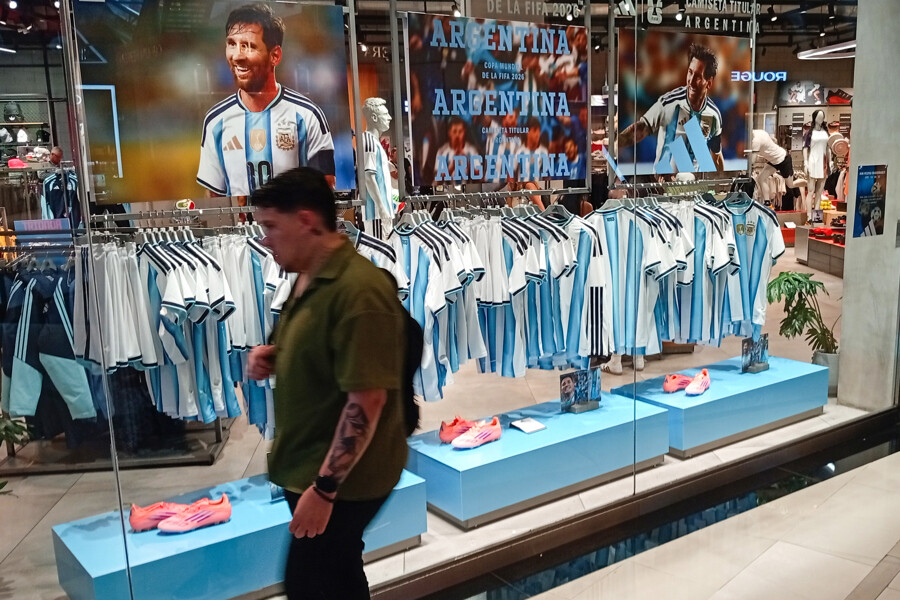
Argentinian fans dreaming of seeing their national team in the stands at the 2026 World Cup face a complex scenario for traveling to the United States, where the team led by Lionel Scaloni will play its three group stage matches. While Argentinians now have easier access to the necessary dollars, real household incomes and high prices for flights, tickets, and accommodation pose a huge challenge for many. The team, led by Lionel Messi, is in Group J, set to play Algeria on June 16 in Kansas City; Austria in Dallas on June 22; and Jordan on June 27 in the same city. According to FIFA, Argentinian fans are among the top ten countries that requested the most tickets for the World Cup. At the World Cup won by Argentina four years ago in Qatar, around 35,000 Argentinians traveled to see at least one of the Albiceleste's matches. The cheapest round-trip flight from Argentina to Dallas, considering layovers and internal connections in the U.S., costs about $1,200. Some agencies sell travel packages that include tickets for one of Argentina's three group stage matches, plus a hotel, transfers to stadiums, and travel assistance for a minimum of $3,150, not including airfare. Other agencies offer more complete 13-day travel packages, including flights and internal transfers, to witness the entire group stage. The minimum monthly wage in Argentina reached 341,000 pesos (about $235) in January 2026, while the average monthly income is around one million pesos ($683). These figures make the World Cup adventure unviable for many. However, due to the unequal distribution of wealth in the country, a small group of Argentinians—but more than enough to fill the stadiums—will not face major difficulties. Compared to the 2022 World Cup in Qatar, economic analyst Damián Di Pace told EFE that traveling to the World Cup in the U.S., Mexico, and Canada will be 'a bit more expensive' for Argentinians because, although there are now fewer currency controls, buying dollars is more expensive than it was then. However, he qualified: 'I don't think the decision to go to the World Cup has to do with the value of our currency, but with the intention and the sacrifice of doing it. Therefore, it can be expected that in the U.S., a closer and more usual destination, there will be a greater influx of fans dreaming of defending the title and adding a fourth conquest. Perhaps a sign of this was the Club World Cup held in several U.S. cities in mid-2025, where the fans of Boca Juniors and River Plate filled the stadiums. According to data provided to EFE by the travel company Despegar, searches from Argentina for flights to the U.S. next June have already increased by 50% compared to 2025. Queries about the cost of traveling from Buenos Aires to Dallas have surged by 3,000%, EFE was told by the travel agency Almundo. 'I don't see complications for Argentinians to be able to travel,' he said. The main difficulty, however, is getting tickets to enter the stadiums. To the challenge of securing a ticket through FIFA's official website are added the high prices of tickets, which cost hundreds of dollars. On resale sites, a ticket for the match between Argentina and Austria is around $700 for the most affordable category. There, the rational economic agent plays less of a role, and the emotional one comes into play.