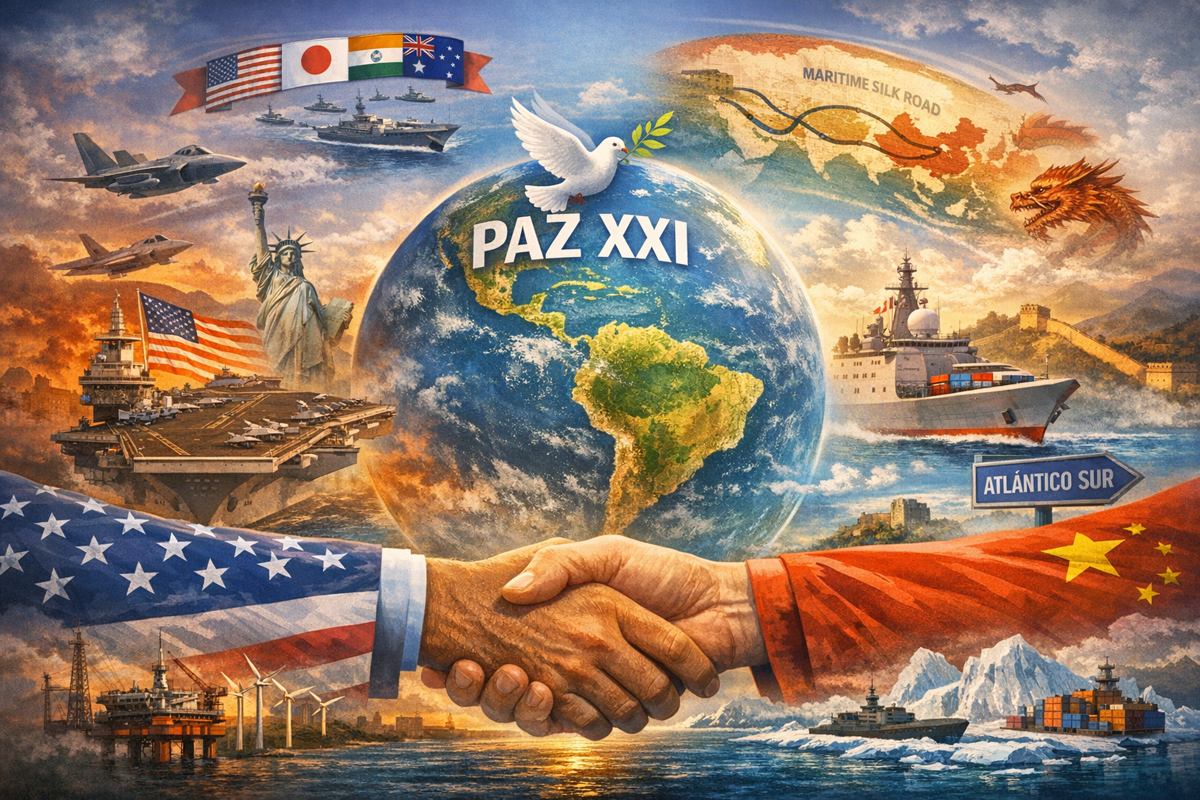
Argentina is at the center of a geopolitical transformation driven by the global rivalry between the USA and China. This situation, affecting the entire American continent, has given rise to a 'cultural battle,' the essence of which is social pacification, particularly in Ibero-America, as part of a larger maneuver to end active wars. The country is undergoing a difficult and accelerated transition from a communist to a capitalist regime, a fact much of society is unaware of. In this context, actors are positioning themselves to negotiate from a position of power. Strategic scenarios for Argentina include a 'prudent balance' scenario, where Argentina balances its 'alliance' with the USA, and an 'alignment' scenario that prioritizes ties with the US while reducing cooperation with China. Despite this, a paradoxical situation exists in today's Argentina, an ally of the USA: our veteran soldiers remain hostages of a failed pseudo-revolution that was once again overthrown by the people. Any Argentine foreign policy must answer three strategic questions: Does this connection increase or reduce our decision-making autonomy? Does it increase our deterrent capacity or expose us to systemic entanglement? Does it strengthen our industrial-technological base or deepen our critical dependency? If the dominant answer leans towards structural dependency without a proportional increase in security, this is not a strategic alliance but a potential vulnerability. In the 21st century, the line between economy and strategy is porous. The challenge for Argentina is not choosing commercial partners, which is inevitable in an interdependent world, but deciding when and under what conditions to assume strategic commitments that could compromise its freedom of action in the event of a major conflict. The Argentine question is not only diplomatic but also about the capacity for territorial, maritime, and logistical control. The 21st century is a transition of power, but also of culture. Strategic competition involves not just resources and markets, but cultural legitimacy, civilizational control, and narrative dominance. In this context, the South Atlantic emerges as a critical space of systemic rivalry and a test of strategic maturity for Argentina. The South Atlantic will cease to be an 'absence' on the global board and become a space of regulated competition or open dispute, depending on the balance of power configured there. The USA-China competition intensifies. Antarctica acquires direct economic value. The Arctic becomes fully navigable, reconfiguring global routes. For Argentina, the issue is not only diplomatic but also its own capacity for territorial, maritime, and logistical control.