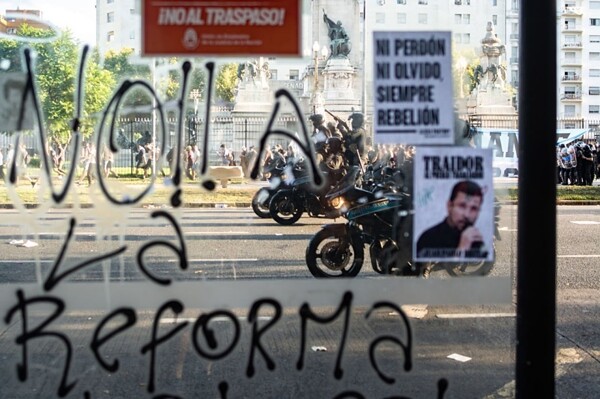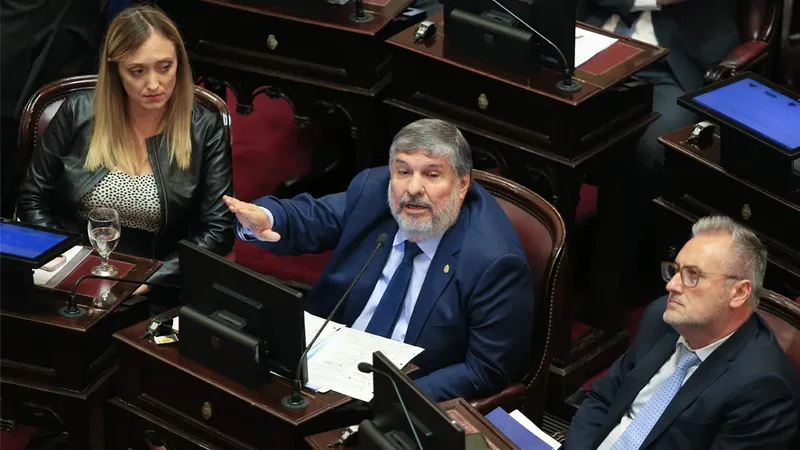
Argentina's political landscape is undergoing significant changes. The exit of three senators from the Peronist bloc in the Senate opens the door to an even more fragmented Peronist bench, where governors negotiate in parallel and the ruling coalition gets closer to key numbers for sensitive laws. Behind this move are three governors with close ties to the national government: Raúl Jalil (Catamarca), Gustavo Sáenz (Salta), and Osvaldo Jaldo (Tucumán). In this negotiation, the Senate—and the behavior of its senators—becomes bargaining chips. The case of Catamarca is illustrative. Jalil seeks to unblock financing for the Albigasta aqueduct, a key shared waterworks project with Santiago del Estero, linked to an Inter-American Development Bank loan that requires national guarantees. For Milei, this break comes as a gift for his institutional show: he can exhibit that the 'wall' of Peronism is cracking and that his government no longer faces a monolithic block but an archipelago. For Peronism, however, the cost is double: it loses its veto power and, worse, it loses its leadership mechanism. In this scheme, the unity of Peronism ceases to be a value and becomes a cost, especially when Kirchnerism insists on a logic of total confrontation that clashes with the urgency of unblocking funds, guarantees, and agreements. The fiscal deficit explains much of the break. Without an undisputed leadership and with governors and legislators prioritizing local agendas, Kirchnerism is beginning to be encapsulated in a hard core that speaks loudly but decides less. The exit of Moisés, Andrada, and Mendoza exhausts the phenomenon: it opens a floodgate. In the recent past, the province received an exceptional transfer from Federal Treasury Contributions, a figure read as the largest individual disbursement of the libertarian administration. The three senators were part of the 'Federal Conviction' bench, which had coexisted with the hard core of Kirchnerism and other provincial allies. In this climate, labor reform was the final catalyst: it touched the symbolic heart of Peronism—labor representation—and exposed that there is no longer a single internal interpretation on how to position itself before the government. In the Senate, the fracture has immediate effects: the PJ loses cohesion, shrinks, and is more exposed to pincer operations from the ruling coalition, which negotiates law by law with provincial allies and satellite forces. In this context, the break in the Senate is not an adventure: it is the legislative counterpart of a governors' strategy that prioritizes governance and the treasury over obedience to a weakened national leadership. The break also uncovers a deeper political problem: the intervention of the PJ in several provinces, the imposition of candidates from Buenos Aires, and the wear and tear on the leadership of Cristina Fernández de Kirchner as a figure capable of ordering everyone around. On the eve of President Javier Milei's opening of ordinary sessions, the Senate is preparing for a political move that, beyond the names, exposes an epochal change within Peronism: three senators from the space that has coexisted within the Justicialist Party's inter-bloc will formalize their exit and deepen a fracture that had been maturing in silence. And today, power does not seem to lie in the pen that once ordered Peronism from the center, but in the ability to negotiate resources, guarantees, and works in a country where the wallet has again become the main language.