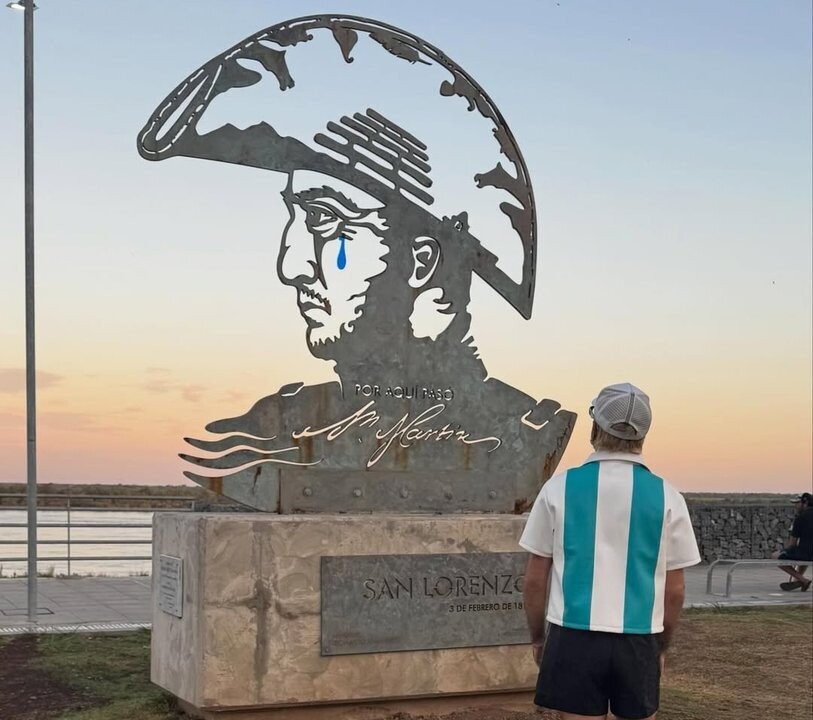
Shortly after the official ceremony, the renowned Rosario artist @joaquines.ar became a trend again by intervening the iconic figure of José de San Martín at the Campo de la Gloria. According to the Argentine News Agency, the artistic action comes at a time of high sensitivity, following the National Government's decision to move the historical relic from the National Historical Museum to the Barracks of Palermo. The intervention is not casual. The trigger was the delivery of the sabre by President Javier Milei to the Grenadier Regiment, which generated diverse positions among historians and political sectors regarding the fate and custody of the piece. Although the work of @joaquines.ar is characterized by its visual ambiguity, its immediate appearance after the official act was interpreted as a stance against the 'officiality' of the event. The image went viral quickly, dividing opinions between those who celebrate the re-signification of monuments and those who question the intervention of historical figures. He added a tear, in a clear message of repudiation of the President's decisions. The artistic intervention in the midst of the controversy with Javier Milei. The artist, famous for his incursions into public space, used his social networks to spread the image in a context where the use of patriotic symbols is at the center of public debate. This type of expression has become habitual in the work of the Rosario native, who seeks to challenge the common citizen in places of high symbolic charge. BUENOS AIRES, Feb 8 (NA)– The commemoration of the 213th anniversary of the Battle of San Lorenzo did not end with the Grenadier parade.