According to official data cited in the report, Javier Milei's administration left the most requests for access to information unanswered, even more so than the governments of Mauricio Macri and Alberto Fernández. For specialists, this paradox further erodes the credibility of the initiative: a state body that coexists with higher levels of opacity in accessing public data cannot present itself as a tool for transparency. The Chequeado report also recalls that this is not a new phenomenon. Opposition leaders agreed that the initiative could become an indirect tool to pressure journalists and critical media under the pretext of combating fake news. The debate opened by the Official Response Office thus poses a central dilemma for Argentine democracy: how to tackle disinformation without violating freedom of expression, the right to information, and the essential role of journalism as a watchdog of power. In Argentina, there are recent precedents of official attempts to influence the control of public discourse, such as the Confiar platform during the pandemic, the Nodio observatory under Alberto Fernández, and the streaming Fake, 7, 8, promoted by the current presidential spokesman Manuel Adorni. In all cases, the initiatives generated controversy due to their official nature and their potential political use. At a regional level, similar experiences are mentioned, such as Brasil Contra Fake during Lula da Silva's government, the Infodemia project in Mexico, and the government account Segcom in Ecuador. While the government maintains that the Response Office aims to combat disinformation 'by providing more information,' it simultaneously modified the regulation of the Public Access to Information Law, introducing new restrictions. According to experts, these precedents show that state fact-checkers rarely achieve social credibility and tend to deepen polarization. The creation of the Response Office also drew rejection from the Argentine Journalism Forum (FOPEA), which warned about the risk of the state arrogating to itself the role of arbiter of truth. 'If the powerful do their own fact-checking, who controls them?'. The document also exposes a structural contradiction of the current administration. From a similar perspective, Clara Jiménez Cruz, executive director of Maldita.es, questioned the logic of official self-auditing and posed a central question: 'Fact-checking exists to force the powerful to be accountable. For specialists, when the state tries to be judge and party, verification ceases to be a mechanism for transparency and becomes an instrument of power.'
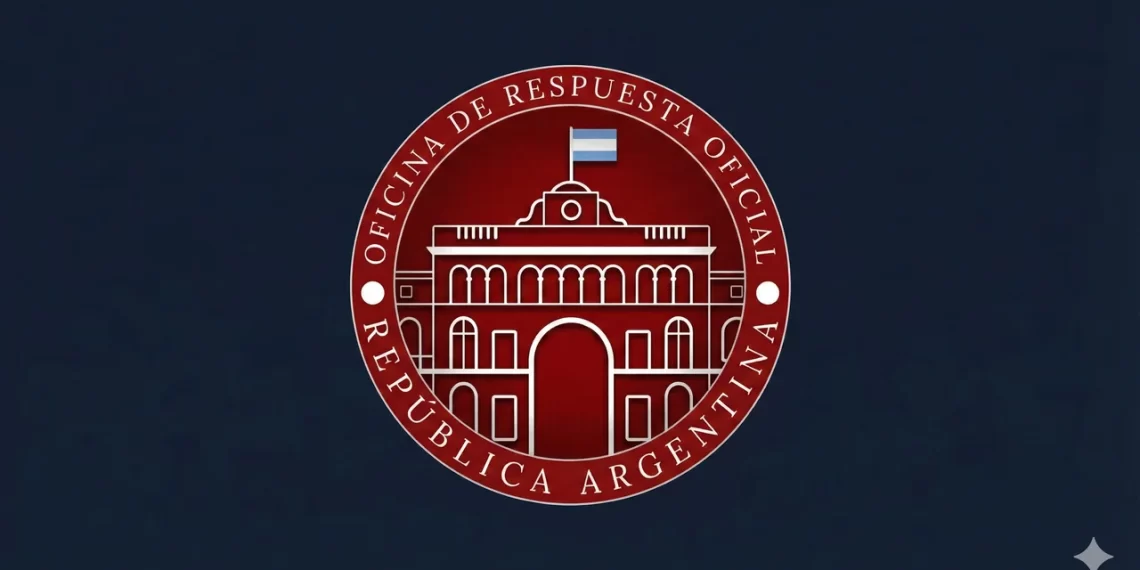
Sources consulted: Chequeado; Noticias Argentinas; FOPEA; La Unión Digital; France24; Buenos Aires Times. Buenos Aires, February 7, 2026 – Total News Agency-TNA – The decision by Javier Milei's government to create the so-called Official Response Office of the Argentine Republic, with the stated objective of 'actively refuting lies' and combating disinformation on social networks and in the media, has raised strong alarm among specialists in discourse verification, journalistic organizations, and defenders of the right to information, who warn that the state cannot audit itself without incurring a serious conflict of interest. A report by the Chequeados team asserts that the official initiative lacks the minimum international standards required for independent fact-checking and that, far from strengthening transparency, it could lead to mechanisms of harassment, public shaming, or indirect persecution against journalists, media, and critical voices of the government. The office against 'operations' and the unseen advertising: the government's dual path towards the media. As this agency was able to find out, although from the ruling party it is argued that the Office seeks 'to expose media and political operations,' experts agree that the state cannot perform verification functions under the rules of data journalism when it is, at the same time, the central subject of public debate and informational scrutiny. The report emphasizes that internationally recognized verification organizations adhere to the International Fact-Checking Network (IFCN) Code of Principles, which demands editorial independence, methodological transparency, clarity in funding, and an open error correction policy. None of those principles, they warn, can be guaranteed when the verification task depends directly on the Executive Branch. In this sense, researcher Lucas Graves, from the University of Wisconsin-Madison, stressed that no state agency 'should confuse itself or present itself as an independent source of information,' as its mere belonging to the state invalidates the basic principle of neutrality.