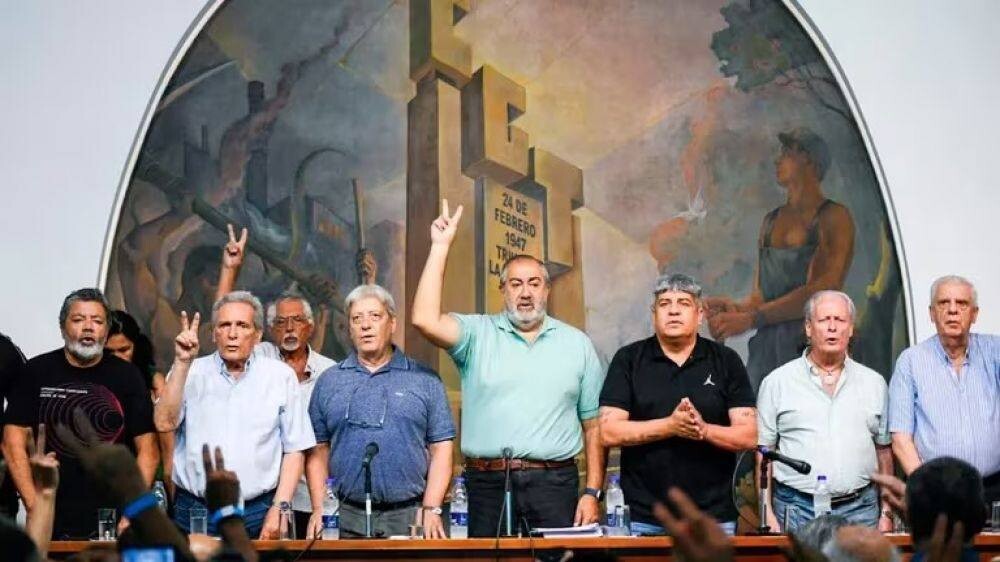
This decision did not arise in a vacuum: it was cultivated for years by union leaders who, in the workplace, preached obedience and disarmed all collective consciousness; and by political operatives who, in the neighborhoods, traded organization for favors and dignity for clientelism. Workers' power is not asked for: it is built. Final words When unions hand out posters that say 'we did not sign this reform,' they are admitting something deeper: that they have given up the fight. We did not sign this reform. The responsibility is no longer on the boss, the government, or the union: the blame is on the worker, who, according to them, must accept their destiny without complaining. The message is clear: the unions are preparing to NOT FIGHT. However, he had materials at his disposal that were basically granted to him by Peronism and union bureaucracy. It is not about absolving the worker of their vote. The enemy is not Milei's reform, but the worker himself – they say – who voted badly. Every election is also a gesture of responsibility, even if sometimes desperate. The blame is on the worker. The publication at FEMSA is not an isolated incident. Between the two, they sowed the individualism that today flourishes in the vote for Milei: the reflection of a working class that no longer expects anything from anyone, not even from itself. For example, when in a factory the attainment of job categories is not the product of a collective claim led by the union organization, but depends on the degree of closeness of the colleague or comrade to members of an internal commission or Delegates' Body or to the union leadership or even to management, we are talking about the construction of an individualistic practice cemented over years by the very union organization, and then they wonder where the selfish individualism in the Working Class comes from. Some of the phrases that different unions are spreading. I. The mirage of voting and real precariousness Over 42% of Argentine work is off the books or precarious. Thus, the oldest union leadership on the continent recycles itself as a containment apparatus, willing to justify the employers' offensive with a moralizing discourse, thus belittling the worker as if the union organizations had led a serious fight against the government of Milei. This Union Cupola is part of the May Pact, and when the government returned to them in the negotiation of the Bases Law the 1% that is compulsorily withheld from the worker in favor of the unions, they abandoned all pretense of struggle. The anguish of those of us who have already seen this story, but now doubled, can also lead us to the temptation of focusing our anger in the wrong place – I must admit that it has happened to me and I have felt that sensation of living through a Zombie Holocaust -, so the issue is not for feelings to guide us but to try a reflection as deep as possible. We are precisely trying to explain how, by using prevailing feelings and media manipulation, the far-right captured the worker vote. The business unionism does not defend workers: it manages businesses. III. What collective bargaining if real wages are plummeting while leaders get rich? The workers' vote for the far-right is not ideological adherence, but a cry of fed-upness. In different unions, they are publishing, in different ways, the following legend, which seems to have become the line for several union organizations: 'don't blame the union or your delegates when they touch your wallet later. You signed it with your vote'. It is public knowledge that the gastronomy union (UTHGRA) has been negotiating to join a 'severance fund' model inspired by the UOCRA model, for the elimination of indemnizations as we know them. Meanwhile, Armando Cavalieri had already communicated to the Government his decision to incorporate into the collective agreement of the activity the new 'severance fund' promoted in the questioned DNU to replace the usual indemnizations. The SMATA (Union of Mechanics and Related Transport Workers) signed a 'productivity' agreement with Toyota Argentina in 2017 that allowed working Saturdays as part of the normal shift, without additional payment for overtime. For the same period in the energy sector, the Oil Workers' Union had agreed with employers that workers would operate on wells with winds of more than 60 km/h, a condition prohibited by basic safety standards. It is the same logic: 'not losing jobs' in exchange for losing rights, 'saving the source of work' at the cost of the worker's life, a situation that over time is revealed as a classic employers' extortion and the union's argument to let pass measures against the working conditions of workers. The language of fear has replaced the language of struggle, today these same union leaders are publishing materials where they blame the worker for voting for someone who comes to destroy rights, rights that they themselves had begun to hand over years ago. Milei comes to destroy the last worker conquests in order to lower labor costs in favor of businessmen, but let's not be mistaken, union bureaucracy is always closer to negotiating with the government and employers than to confronting them. IV. The problem is not the individual error of the voter, but the systematic betrayal of the structures that were supposed to organize the defense of rights instead of delivering them. VI.