Economist Lorenzo Sigaut Gravina warned that the Argentine economy is going through a 'dual' dynamic, with highly competitive sectors that generate foreign currency but without sufficient impact on urban employment and consumption, which could lead to social tensions if imbalances are not corrected.
The Director of Macroeconomic Analysis at the consulting firm Equilibrade described that there are 'two realities' coexisting in the country. On the one hand, he highlighted the positive performance of activities such as energy, mining, and agriculture, which generate exports and genuine dollars. 'The economy dragged by energy, by mining, by agriculture and even with financial intermediation is working. There are dynamic sectors that grow, but a significant part of society is not seeing the fruits,' he stated, referring to the economic context under the management of Javier Milei.
On the other hand, Gravina emphasized that the problem appears in the 'other Argentina', where industry and construction predominate with a weakened internal demand and greater competition from imports. 'Industry faces a quite anemic internal demand and also competes with imported products,' he explained.
The economist also warned about structural factors that aggravate the labor situation, such as automation and artificial intelligence. 'The sectors that grow are capital-intensive and do not generate as many jobs. These are sectors that generate a lot of dollars,' he explained. 'In addition, something disruptive appears like artificial intelligence, which complicates especially for young people,' he added.
Regarding macroeconomic prospects, Sigaut Gravina anticipated that inflation would remain high. 'In March we see that it will start with three and a bit, and what we are observing is that inflation will look more and more like last year's,' he pointed out, estimating an annual level close to 30%.
On activity, he partially agreed with more moderate projections such as those of economist Ricardo Delgado, and forecast a limited growth. 'There will be a positive but limited growth, which will spill little and generate little employment,' he concluded.
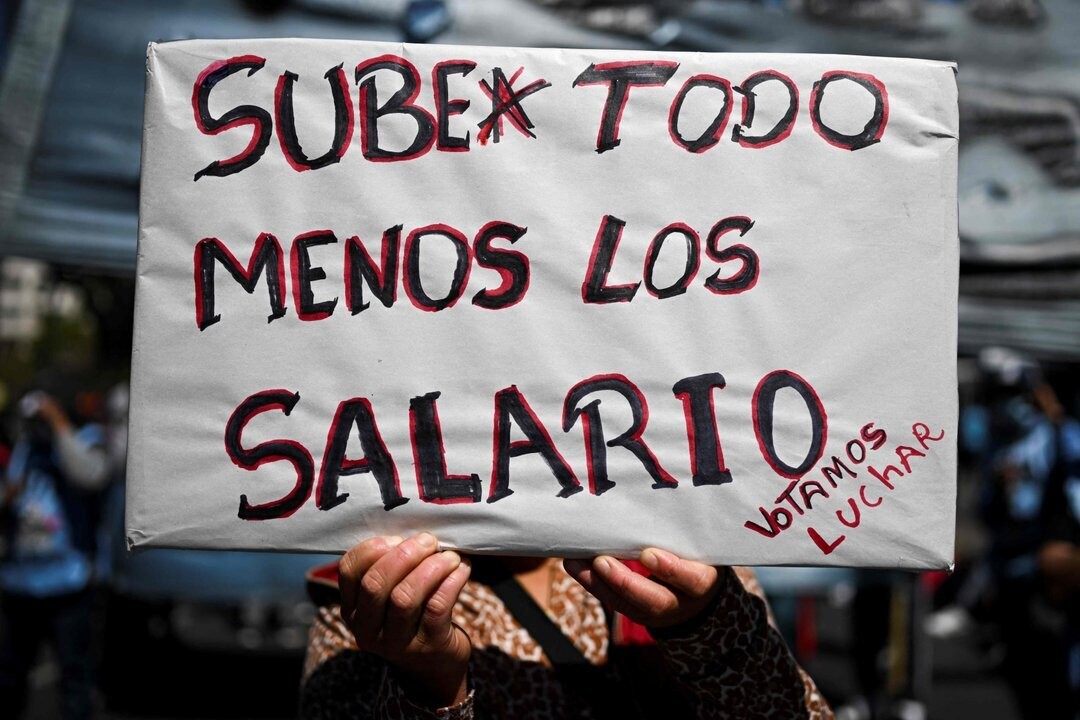
Finally, he warned that the scenario poses a political challenge going forward. 'If the major urban centers do not see improvements, there could be a problem,' he said. 'It is sucking a lot of the income,' he explained, and added that family delinquency 'exceeds 10%, something unprecedented in Argentina'.
Asked about the possibility of a consumption reactivation in the conurbation, in line with proposals by economists such as Miguel Kiguel or Gabriel Rubinstein, Sigaut Gravina considered that the Government prioritizes adjustment and sectoral competitiveness over expansionary measures. 'The Government says very clearly: whoever falls, falls because they are inefficient,' he stated.
Although there are significant disbursements in sectors like Vaca Muerta or mining, Sigaut Gravina maintained that 'at an aggregate level, investment has not been growing for three quarters' and that capital-intensive sectors generate few jobs. 'Despite the economy growing driven by these locomotives, it seems not to be enough: they do not spill over enough in the major urban centers,' he warned.
According to the economist, debt and high interest rates are pressuring consumption. 'The debt service burden reached more than 25% of the formal wage mass. It is sucking a lot of the income,' he explained.
However, Sigaut Gravina relativized that diagnosis and stated that it is a situation limited to certain segments. 'Credit was an ally for families, especially until mid-last year, and there was an expansion of durable goods and imports. When it comes to exporting, with an appreciated dollar, it is very difficult,' he indicated.
This heterogeneity is also reflected in investment and employment.