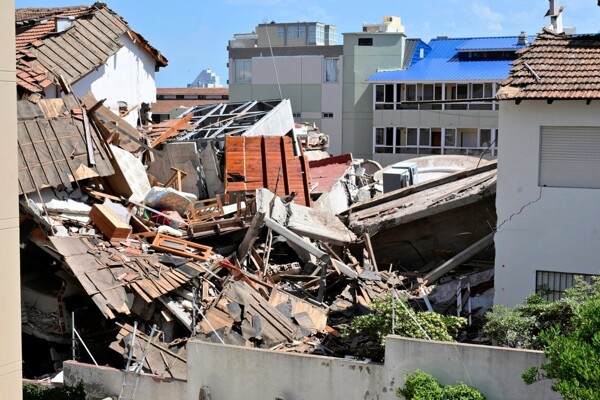
Graciela Bravo, a lawyer representing victims in the case of the collapse of the Apart Hotel Dubrovnik in Villa Gesell, harshly criticized the latest report by the accused architect Enrique Bonavita. She stated that the report contains «multiple internal contradictions, logical dislocations, and overly categorical assertions» that are not consistent with the available evidence. In her extensive response, accessed by the Argentine News Agency, the lawyer affirmed that «inconsistencies are evident from the very argumentative development of the expert report,» and warned that the report has a «methodological tension,» as it acknowledges that the data is limited but still presents conclusions as if they were exact. In this sense, she emphasized that the text admits that the structural survey was «precise but random» and that there was an «inability to determine the accuracy» of the data, yet it later provides «'approximate' degrees of vulnerability as if the adopted model allowed for a robust and stable quantification.» Regarding the methodological aspect, she pointed out as «objectionable» that the opinion relied on «web pages, testimonies, and journalistic publications» without clearly discriminating which conclusions derive from calculations, which from empirical observation, and which from external information. Additionally, she questioned what she defined as an «oscillation in the conceptual plane between indeterminacy and certainty in causal matters,» because the document states that «the triggering situation could not be determined with certainty,» but simultaneously affirms that «the kinematics of the fall allow identifying the origin of the failure» and that the fracture zone was «totally defined.» In another section, she criticized the soil analysis by indicating that the expert report asserts that «no failure of the substrate structure was detected,» although it later considers that said failure «could have occurred very slowly» and that it is «undecipherable at this stage,» which, in her view, prevents «with sufficient solvency excluding the influence of the soil as a relevant causal factor.» Regarding the interventions carried out on the building during 2024, the lawyer pointed out an «unresolved tension,» as the report dismisses them as a triggering factor, but at the same time maintains that the structure lacked a safety margin and that «any variation in loads or natural degradation could inexorably lead to collapse.» Likewise, she considered it an «improper superposition of heterogeneous causal plans,» as it equates administrative irregularities with construction failures, and maintained that the absence of technical documentation «does not, in itself, constitute a structural cause of the collapse.» The lawyer also questioned the use of unverified assumptions about the quality of the materials, by pointing out that the document is based on the hypothesis of «typical concrete for normal use,» although it recognizes that one of the columns «remained standing probably because the quality of the concrete would have been superior to that considered.» Finally, she criticized that the report does not seriously compare its conclusions with those of organizations such as INTI and Firefighters, and maintained that it does not present evidence, simulations, or alternative analyses that would allow demonstrating that those results are wrong, and therefore it does not meet the minimum level of scientific rigor necessary to contradict them.