


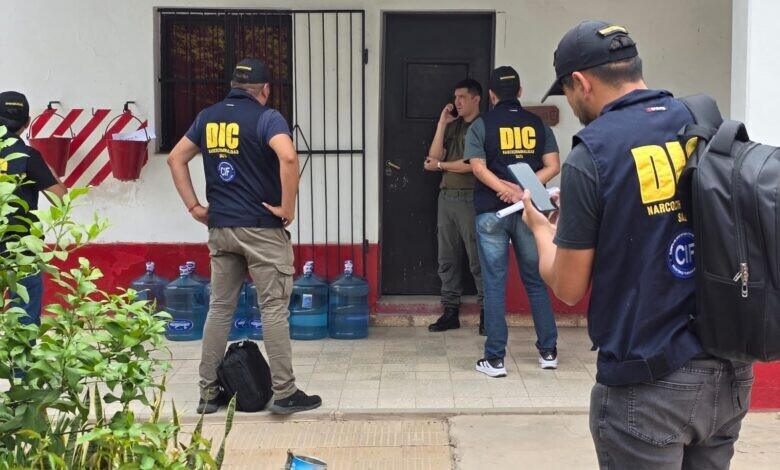
On Monday, November 5, 2025, an unprecedented operation was carried out at the facilities of the National Gendarmerie's Squadron 52 in Tartagal and at the residence of its commander, as part of an investigation into drug trafficking that began in May following the seizure of over 160 kilograms of cocaine. The judicial measure, ordered by Federal Prosecutor Lucía Orsetti and executed by the Tartagal Decentralized Prosecutor's Office along with the Salta Fiscal Investigation Corps (CIF), aimed to seize evidence linked to the case.
This event raises another level of questioning: the strategy for air force deployment, radar coverage, and border security. Meanwhile, the 160 kilograms of cocaine intercepted in May remain the visible link in a network that has flown, landed, been intercepted, and now faces the internal scrutiny of Argentina's own security system.
The exact number of detainees and the full extent of the seized material have not yet been officially announced, keeping the case under a high level of secrecy. This episode opens an uncomfortable institutional dilemma.
On one hand, it reveals the magnitude of drug trafficking operating on Argentina's border with Bolivia and Paraguay; on the other, it raises questions about the integration of federal forces into the control of air and land space, their operational design, their level of autonomy, and the effectiveness of internal audit mechanisms. Among the emerging questions, the late involvement of the Justice system in large-scale operations stands out, as well as why the response is limited to reacting after kidnappings or accidents, instead of intercepting flights, clandestine routes, or intercepting loads before they reach Argentine soil.
In this context, the Gendarmerie operation that intercepted the common vehicle appears to be the tip of a much broader logistics network. The severity of the case is aggravated by the status of the subject of the raid: if the investigation confirms the involvement of a commander in the trafficking network, it would be a turning point in the fight against drug trafficking, which has historically covered up links between security forces, clandestine routes, and transnational organizations.
Operationally, the case could lead to a thorough review of border control protocols, intelligence mechanisms, and inter-institutional coordination—between the Argentine Naval Prefecture, Airport Security Police, Argentine Air Force, and Gendarmeria—and a reassessment of the so-called "administrative war" on drugs.
While the national state has insisted on redoubling efforts through the "Northern Shield" plan and the radar platform along the Chaco and Chaco mountain range, the facts show that the heaviest burden is still seen on the ground and not in the air-ground interception chain. High-level investigation sources indicate that the air and land routes of drug planes are complemented by local complicity, which narrows the trail toward air traffic controllers. Similarly, in northern Salta, planes frequently operate without a flight plan, crossing Argentine airspace at low altitude, dropping cargo in wild areas, and escaping undetected.
The occupants, two adults and a minor, were detained at the scene for aggravated drug trafficking. The subsequent investigation identified links between these detainees and members of the federal force who would have provided logistical support for the operation: insurance policies, vehicles linked to the "lead car," and security cameras allowed connecting the drug transport with personnel from Squadron 52. According to judicial sources, the raid on Squadron 52 and the commander's home was carried out unexpectedly to secure evidence that would determine the extent of the operation, its logistics, the roles of those involved, and the possible implication of command or support personnel.
Among the accused are already an officer and a non-commissioned officer of the federal security force. The case originated on May 5 when, in an operation by the Gendarmerie's "Aguaray" Squadron 54, located at kilometer 1,466 of National Route 34, personnel detected a Ford Ranger with a double bottom transporting 173 packages of cocaine—equivalent to 160 kilograms and 960 grams.
Thus, the Tartagal case becomes an emblem of a struggle in which public visibility does not always coincide with operational effectiveness. The investigation remains ongoing, with protective measures on the seized items and possible implications that could extend to other Gendarmerie units in the north of the country.