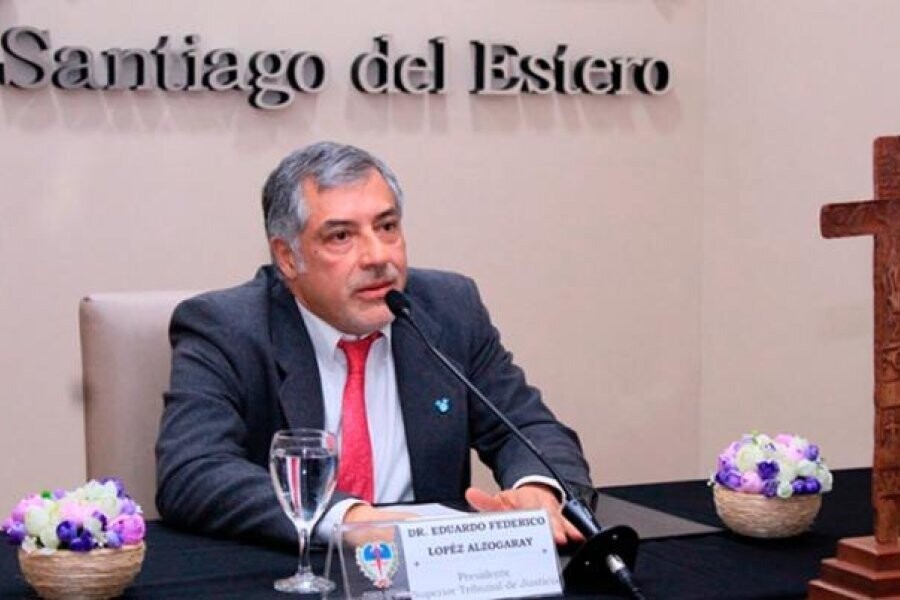
Santiago del Estero, December 22, 2025 - Total News Agency - TNA - A serious complaint filed in the United States against the president of the Superior Court of Justice of Santiago del Estero, Federico López Alzogaray, once again put the provincial judicial system under scrutiny and fueled accusations that in this district, democracy and the Constitution do not fully apply.
The case, which included a precautionary measure issued in favor of López Alzogaray himself within his jurisdiction, led to the forced displacement of a rural family, their extreme impoverishment, and finally, the death of the peasant a few days after being interviewed by an international mission.
According to the IID report, the magistrate would have used his institutional position to promote a lawsuit for the recovery of land ownership, alleging hereditary rights dating back to 1803.
The IID concluded that there were procedural irregularities, conflicts of interest, lack of evidence in the plaintiff's arguments, and a direct violation of the right to defense of third parties who were not even part of the case file.
The international complaint also revived broader criticism of the Argentine judicial system.
However, the courts rejected that argument and proceeded with a ruling that, according to the complainant organization, reviewed a final judgment with res judicata effect and destroyed elementary principles of property law.
The IID's investigation included visits to the site, receipt of testimonies, documentary analysis, and meetings with provincial and national authorities.
The complainants maintain that the judges responsible for these practices must be investigated, both internally and at international levels, to determine political, administrative, and criminal responsibilities.
The IID announced that it will travel to Argentina again to present its report before judicial authorities and demand a thorough investigation, considering that articles of the Universal Declaration of Human Rights and the American Convention on Human Rights were violated.
For these sectors, this is a pattern of systematic violations of due process and constitutional guarantees that should be investigated in depth.
From this perspective, the Ardiles case is presented as a symbol of a Justice system that, far from protecting the most vulnerable citizens, operates as a tool of power.
The accusation was made by the Human Rights Committee of the Inter-American Institute for Democracy (IID) and became public through the US press.
The complaint refers to alleged human rights violations committed against the peasant Manuel Asencio Ardiles, who, according to the IID's investigation, was dispossessed of his lands through the use of the judicial apparatus and forced to abandon his property.
Ardiles's defense, however, claimed that the peasant had inherited rights of acquisitive prescription granted to his father by the courts and registered over half a century ago.
In this context, different voices emphasize that in the country, nearly a thousand military personnel have already died in prison in cases of so-called crimes against humanity, many of them over 70 years old, with serious illnesses, subjected to processes questioned for false testimonies, lengthy pretrial detention, and more than a decade of imprisonment without a final conviction.
In these circumstances, Ardiles was found lying down, with severe physical and emotional deterioration after the loss of his lands, and died on January 23, 2023.
The committee's representatives warned that the most serious aspect of the case is that the events occurred 'under a cloak of legality,' using judicial resolutions to violate fundamental human rights.
The Santiago del Estero case, already exposed abroad, threatens to become a new international focus of criticism regarding the rule of law and the actual functioning of Justice in Argentina.
The report describes an eviction carried out with a massive police deployment, threats, impediments for the family to retrieve basic belongings, and the loss of animals used for subsistence.