A judicial investigation that began in late 2017 and was all but buried over time has resurfaced, revealing a scheme of extreme gravity involving Pablo Toviggino, the treasurer of the Argentine Football Association (AFA), with a suspected organization dedicated to drug trafficking operating in northern Argentina using clandestine airstrips for light aircraft.
The case was opened in the federal justice system based on a brief pushed by the Prosecutor's Office against Narcocriminality, then headed by Diego Iglesias, along with the substitute prosecutor of Campana, Manuel Matilla.
During the proceedings, two men commercially linked to Toviggino were identified: Fernando “Polo” Figueroa and Gabriel Gorosito, the latter also a member of the boards of companies attributed to the AFA treasurer.
The file also included information from the state system of Irregular Air Traffic, which reported at least 37 irregular flights detected in the investigated area between 2012 and 2018.
The case progressed until, due to territorial jurisdiction issues, it was first referred to Zárate and then to the federal justice of Catamarca. In that jurisdiction, a key figure in regional drug trafficking appeared: Eva Portillo de Quiñones, known as “La Tía,” who was identified as a logistical link with neighboring countries and was finally detained in a routine road check.
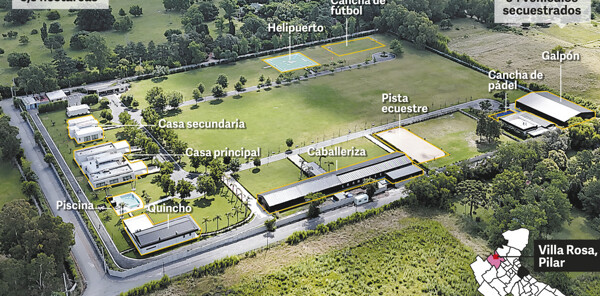
Both testimonies pointed to a farm located in the “Ahí Veremos” area, Alberdi department, where a runway known as “Picada YPF” allegedly operated.
Faced with the seriousness of these allegations, the magistrate ordered the National Gendarmerie to deploy legal intelligence tasks in the area.
In turn, the Gendarmerie's Air Surveillance and Control Group indicated that in 2017 alone, fourteen flights with a destination to the area where the clandestine airstrip was located had been registered.
The prosecutors also requested the cross-referencing of telephone lines of the alleged involved parties, including Toviggino, Figueroa, Gorosito, and other members of the network.
There again appears a complex network of societies—HT SRL, Malte SRL, IMA SRL, SOMA SRL, and BORI SRL—that the justice system is trying to determine if they were used to hide assets and evade state controls.
The case also exposed the provincial political context.
In the Catamarcan proceedings, Fernando “Polo” Figueroa was again mentioned as the operational contact for that network from Santiago del Estero, reinforcing the link between the two investigations.
Although judicial sources indicated that Toviggino no longer formally appears as an accused in those cases, the accumulated documentation remains relevant in more recent investigations for alleged money laundering.
The complainant in the field usurpation case, lawyer Edgardo Taboada, repeatedly stated that Toviggino would have had local political backing and irregular notarial maneuvers, in a province where real power continues to orbit around the historical caudillo Gerardo Zamora.
The case, born in Buenos Aires, derived through different jurisdictions and finally landing in Santiago del Estero, became for many a paradigmatic example of how sensitive files lose momentum when they touch upon heavyweight political interests.
The case was filed in the federal court of Campana, in charge of Judge Adrián González Charvay, who authorized a series of evidentiary measures that ended up strengthening the initial suspicions.
Two protected witnesses testified that Toviggino headed a structure dedicated to the violent usurpation of fields in the province of Santiago del Estero, with the objective of conditioning them as landing points for light planes used for the transport of narcotics.
Without convictions or substantial advances, the “Toviggino case” remains a disturbing precedent that re-emerges every time the Justice reopens the magnifying glass over the businesses and power surrounding the top echelon of Argentine football.