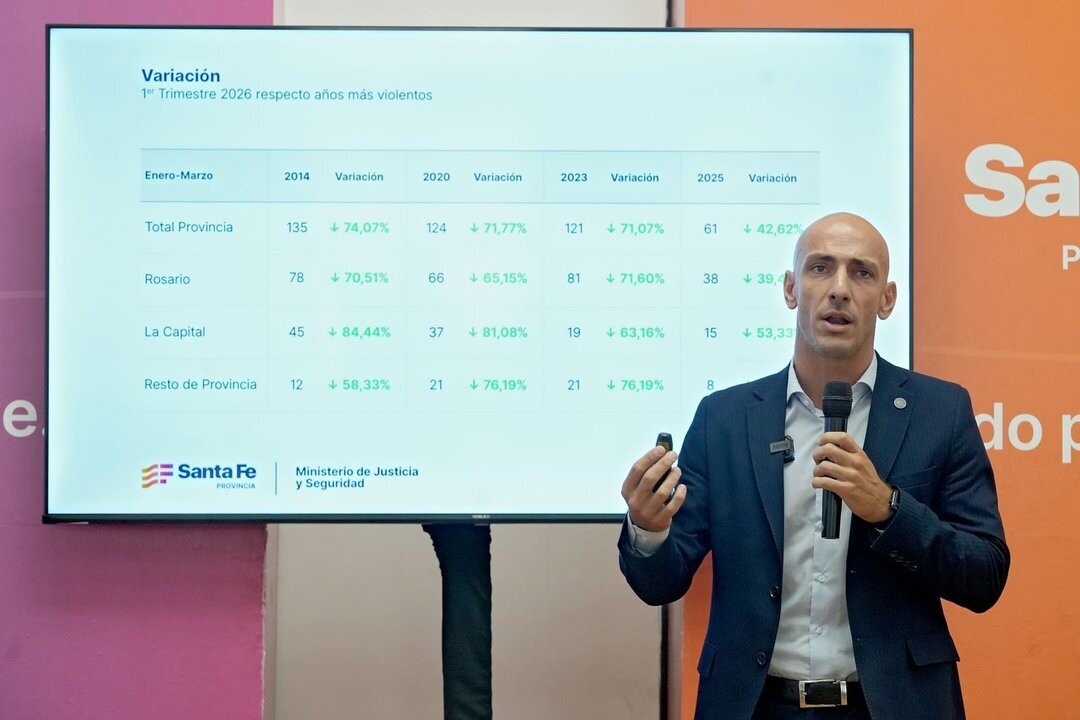
The province of Santa Fe registered 35 intentional homicides during the first quarter of 2026, representing a drop of over 70% compared to years of peak violence and marking the lowest level since official records began. According to the provincial Ministry of Justice and Security, the decline was compared to figures such as 2023, when there were 121 homicides in the same period, and 2020, with 124 cases, whereas in 2022, more than 400 annual crimes were recorded. According to official data, the Rosario department concentrated 23 homicides in the first three months of the year, while La Capital registered 7 and the rest of the province added 5 cases. The Secretary of Analysis and Information Management, Esteban Santantino, pointed out that the decrease also reached over 40% compared to the first quarter of 2025, when 61 homicides were counted, and emphasized that these are "unprecedented" figures for the province. In the analysis of the incidents, authorities indicated that firearms continue to be the main means used in intentional homicides, with an incidence of 77.1% at the provincial level and 82.6% in the Rosario department, while in La Capital, all cases were committed with this type of weapon. The provincial government attributed the results to the implementation of a security plan based on three axes: the control of high-profile prisoners in jails, the reinforcement of police presence on the streets, and improvement in criminal prosecution. In this sense, they highlighted the special regime for high-profile detainees, aimed at preventing crimes from being ordered from prisons, and the expansion of prison infrastructure, which plans to add 1,152 new places in the unit known as "El Infierno", in Piñero. They also stressed the increase in patrols, with a greater number of officers and vehicles, along with the incorporation of technology such as the "Lince" artificial intelligence platform applied to the video surveillance system. Finally, they highlighted the coordinated work with the Ministry of Public Prosecution and the provincial and federal judiciary, as well as reforms such as the federalization of minor drug trafficking, changes to the Criminal Procedure Code, the creation of a provincial intelligence area, and the implementation of a rewards system for the most wanted criminals.