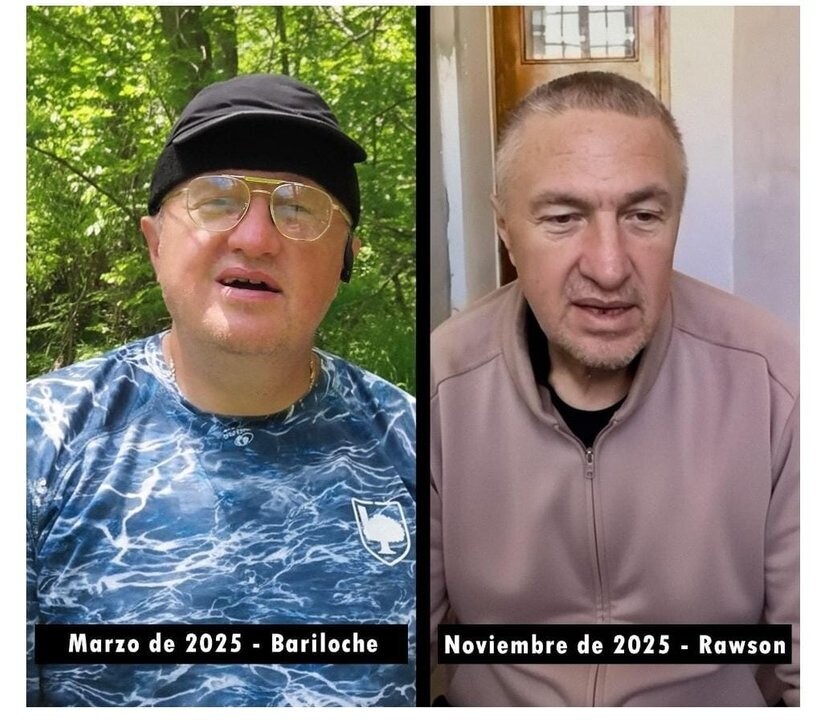
Buenos Aires, January 30 (NA) -- The defense team for Russian citizen Konstantin Rudnev, who is accused of human trafficking and detained in Rawson prison, has filed a review petition against the court's decision that revoked the house arrest granted by Guarantees Judge Gustavo Zapata on January 21 for health reasons. The document, to which the Argentine News Agency had exclusive access, is signed by the defense team led by Carlos Broitman and argues that this is an autonomous remedy to have a decision re-examined that, they claim, worsened the detainee's health conditions. This argument is based on articles 360 and 364 of the Federal Criminal Procedure Code. Rudnev's lawyers stated that any coercive measure is provisional, mutable, and reviewable, and this requirement is reinforced when the right to health of a person deprived of liberty is at stake. The defense emphasized that article 364 provides for the principle of double conformity: if the Public Prosecutor's Office challenges the decision and the outcome worsens the accused's situation, they can request a review. Therefore, they argue that the new examination is not only possible but mandatory. The document reconstructs the events of January 21, when Guarantees Judge Zapata granted house arrest under article 32, i.e., for health reasons. Similarly, the defense stressed that the health debate is based on 'objective and current' data. One of the key points is Rudnev's weight loss of over 50 kilograms, which doctors described as a clinical sign of 'extreme severity.' The professionals cited in the document — heads of service at the Hospital de Clínicas — stated that such a case requires immediate hospitalization for a comprehensive study. The petition mentions the suspicion of severe pathologies, including oncological, digestive, or pulmonary ones, and it was emphasized that outpatient care would be insufficient. Another point the defense raises is the role of the General Directorate of Investigations and Technological Support for Criminal Investigations (DATIP), whose report was incorporated at the initiative of the Public Prosecutor's Office itself. According to the petition, that report recognized a 'clinically significant increased risk' and admitted that the evaluation was incomplete due to the lack of essential studies. For the lawyers, a key idea appears there: article 32 subsection 'A' does not require an imminent risk to life, but rather that prison prevents the adequate treatment or recovery from the illness. They pointed out that the lack of a diagnosis is not an excuse to deny house arrest, but proof that the system failed to address the case in time. The document also points to what they call a 'structural and objective impossibility' of conducting studies within the current circuit. In this sense, it cites a report from the Santa Teresita Hospital in Rawson which reportedly informed that several studies could not be performed due to a lack of specialties and technical means. For the defense, this record disproves the stance that medical care could be guaranteed with routine local transfers. At the same time, they emphasized that after more than six months, the penitentiary system has failed to carry out the indicated studies despite medical recommendations. The main disagreement arises in the challenge to the Prosecutor's Office's argument that Konstantin Rudnev refuses to receive medical care. The defense challenged the 'refusal of care' affidavits. They claimed these are pre-printed forms signed under an 'insurmountable' language barrier and that Rudnev wrote in Russian his willingness to be treated, without translation or understanding by the staff. They even mention that the doctor from Unit 6 would have admitted he does not translate what the accused writes because he has no means to do so. Added to that, they argued there were no updated 'such basic' records as the current weight at the time of the hearing, which — according to the defense — shows concrete limits of health control in Rawson prison. The petition indicated that at the hearing there was a cross-cutting agreement on one point: all doctors, even those linked to the prosecution or the system, agreed on the need for hospitalization to achieve an accurate diagnosis. For the lawyers, this convergence is decisive because it shows the problem was not 'one opinion' against another, but an unresolved clinical case. In its conclusions, the text stated that the review decision 'trivializes' the right to health by subordinating it to a diagnostic certainty that the system itself failed to produce in months. Therefore, the request is concrete: to grant the petition, form a new chamber to hear it, and reverse the revocation that reinstated the internal imprisonment.