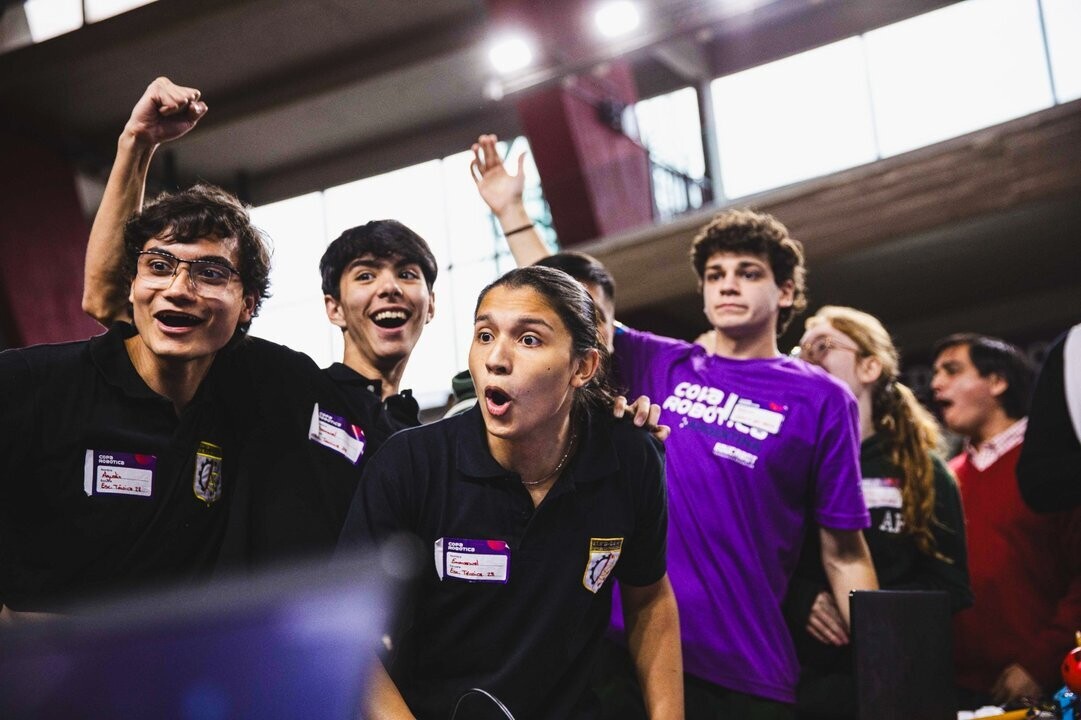
During this period, students and mentor teachers access training modules and materials through the competition's digital platform, with the goal of experimenting with robotics kits, strengthening their technical skills, and preparing for the in-person competition.
From June 23 to July 10, the provincial semi-finals will be held through in-person events organized locally. Additionally, the competition includes $100,000,000 in prizes for the winning teams, while semi-finalist teams will receive robotics kits to continue developing technological projects in their schools.
How will the national competition be developed?
The Educabot Robotics Cup 2026 is held in different stages that combine virtual challenges, remote programming, and in-person competitions in various provinces of the country. Educational institutions interested can register until April 10 through the official competition platform: https://www.coparobotica.com/. Each school can register as many teams as they wish, although only up to two teams per institution will qualify for the provincial semi-finals. The competition promotes diversity and inclusion in participation and encourages the formation of diverse teams and respect for all identities, without establishing gender restrictions.
At the end of this stage, up to 100 teams per province advance to the next phase.
Phase 2 – Remote programming challenges (May 11-22)
In this stage, qualified teams must solve a technical programming challenge related to robotics and artificial intelligence. The challenge will be focused on environmental care and must be resolved collaboratively among team members.
The national competition is aimed at students between 15 and 18 years old from public and private schools, with no need for previous experience in robotics or programming, and seeks to bring the new generations closer to the world of innovation and technology, mentioned by Educabot to the Argentine News Agency.
Throughout the process, students participate in training, mentoring, and training instances, accompanied by mentor teachers and specialists, in a journey that combines technical learning with the development of socio-emotional skills.
One of the main incentives of the competition is its international projection: the winning team of the national final will represent Argentina in the FIRST Global Challenge robotics world championship, to be held in South Korea from October 7 to 10. Educabot reported that since the world championship was created in 2017, this event brings together young people from more than 190 countries every year to develop technological challenges inspired by global problems linked to the United Nations Sustainable Development Goals.
During these days, the teams compete in different matches using the robots developed during the training stage. The dynamics of the competition are based on rotating alliances between teams, where two teams join to compete against another two, promoting cooperation, shared strategy, and collaborative work.
At the end of the semi-finals, the best-positioned teams from each province qualify for the National Final.
Phase 4 – National Final (August 5-6)
The final instance of the competition will bring together in Neuquén the winning teams from each province. During the day, the participants will compete again under the rotating alliances system, facing different robotic challenges that will test their technical, strategic, and collaborative abilities. At the end of the competition, the final ranking will be established and the winning team will represent Argentina in the FIRST Global Challenge robotics world championship in South Korea.
Phase 1 – Online challenges (April 11-30)
The first stage is held completely virtually and functions as an initial evaluation and learning instance. In this instance, teams will work online within a simulation of a wind farm, solving missions that combine technology and sustainability. The dynamic prioritizes coordination, joint decision-making, and effective communication among the participants, fundamental skills in the development of technological projects.
After evaluating the results, up to 50 teams per province advance to the next stage.
Phase 3 – Training and provincial semi-finals (May 25 - July 10)
The third stage is developed in two instances: a training and preparation phase, followed by the in-person provincial semi-finals. The semi-finalist teams will receive the official kit. The challenges include conceptual exercises, group activities, and the creation of audiovisual content in which students must present ideas or technological solutions. The challenges can be resolved asynchronously within the established period, allowing teams to work at their own pace.