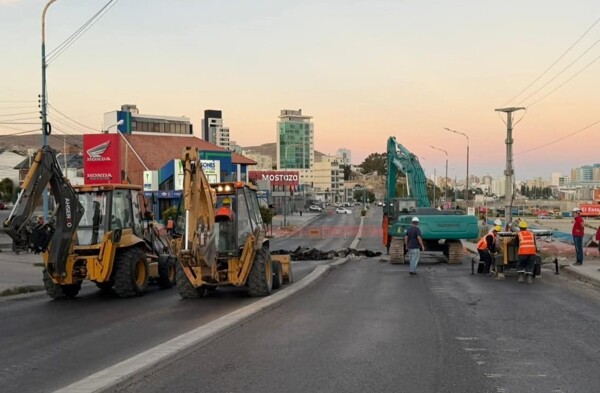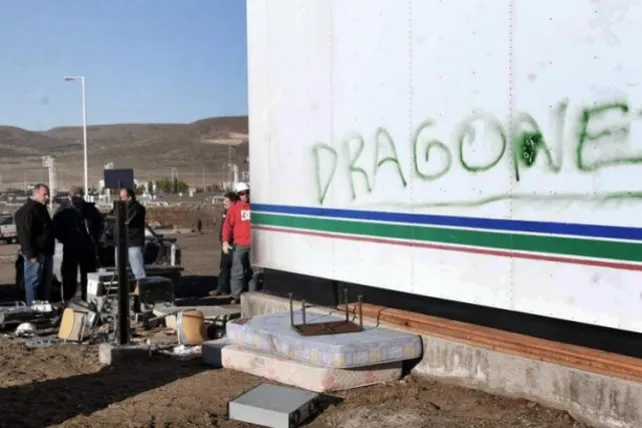
For now, there are no signs of a prompt resolution, and discontent in the sector is growing over the possibility of the conflict prolonging. According to documentation accessed by Total News, protesters are preventing the company's operational vehicles from leaving, causing delays, logistical risks, and financial losses, without blocking the free transit of people or private cars. The curious aspect of the matter is the restraint with which the issue was handled. The UOCRA union claims the company is incorporating workers from the oil union at the expense of its own workforce. There is also no presence of provincial or federal forces at the site, and the local police station only conducts periodic patrols due to a lack of personnel permanently assigned to the operation. The prolongation of the protest, without judicial intervention or police containment, generates concern among operators and the provincial government. Technical bodies consulted by TNA indicate that each day of paralysis disrupts critical schedules and increases drilling and maintenance costs. While tension persists, the company continues to monitor the conflict and reinforce reports to the authorities. For Governor Ignacio Torres, it is a 'pivotal moment' that promises to give a new lease of life to the basin and ensure thousands of jobs for the coming decades. Precisely for this reason, within the sector, the protest is interpreted as having a more delicate nature: it not only affects daily operations but also puts at risk the climate of predictability essential for the new phase of productive expansion. The protest initiated on Monday by a small group—only forty people—from the UOCRA union at the main access to Cerro Dragonce again exposed a structural problem that concerns the entire energy sector: the ability of small pressure groups to paralyze critical operations and transmit a message of instability that discourages investment in an area considered strategic for the country. 'This discourages investment and affects the country's credibility,' warned a technician with direct access to the operation. Nevertheless, the protest advanced on the income of the country's largest conventional hydrocarbon field, affecting tasks that require continuity and are essential for the daily production of oil and gas. Due to the situation, the company filed a complaint at the 1st Police Station of Las Heras, Santa Cruz, for violations of articles 174, clause 6, and 194 of the Penal Code, related to hindering transport and public services. However, according to internal information, there is no verification to confirm these accusations. As TNA was able to determine, the protesters have just left. Executives consulted describe with concern the 'demonstration effect': if a group of forty protesters can interfere in a critical asset without immediate consequences, any energy or mining project is exposed to the same vulnerability. It mobilizes more than 8,000 direct and indirect workers. The fear is that the negative signal will transcend Cerro Dragón and condition future investment rounds, at a time when Argentina seeks to attract capital for its non-conventional developments and energy transition. Cerro Dragón has been a central piece of the Argentine energy apparatus for decades. The case was handed over to the Court of Instruction No. 1, under the judge Eduardo Quinlin, who—according to what TNA could confirm—has not issued any judicial measure to date. Its productive and logistical structure depends on a constant operational flow: interruptions, even brief ones, generate cumulative losses that are passed on to both the company and the producing provinces due to the decrease in royalties. But the conflict erupted just as the field is going through a decisive stage. The agreement, approved in April by the Chubut Legislature, contemplates an initial investment close to 250 million dollars for pilot wells, fracking, and advanced tertiary recovery techniques. Operated by Pan American Energy (PAE), it covers more than 3,400 km² in the San Jorge Gulf Basin and reached a production of about 100,000 barrels per day, close to 15% of the national total. The head of the Caleta Olivia DUOF, along with operational personnel, was also dispatched to the area, although their arrival will take about two hours. After confirming significant shale gas reserves in deep formations, such as D-129, PAE managed to convert its concession to advance non-conventional exploitation for at least another 35 years.