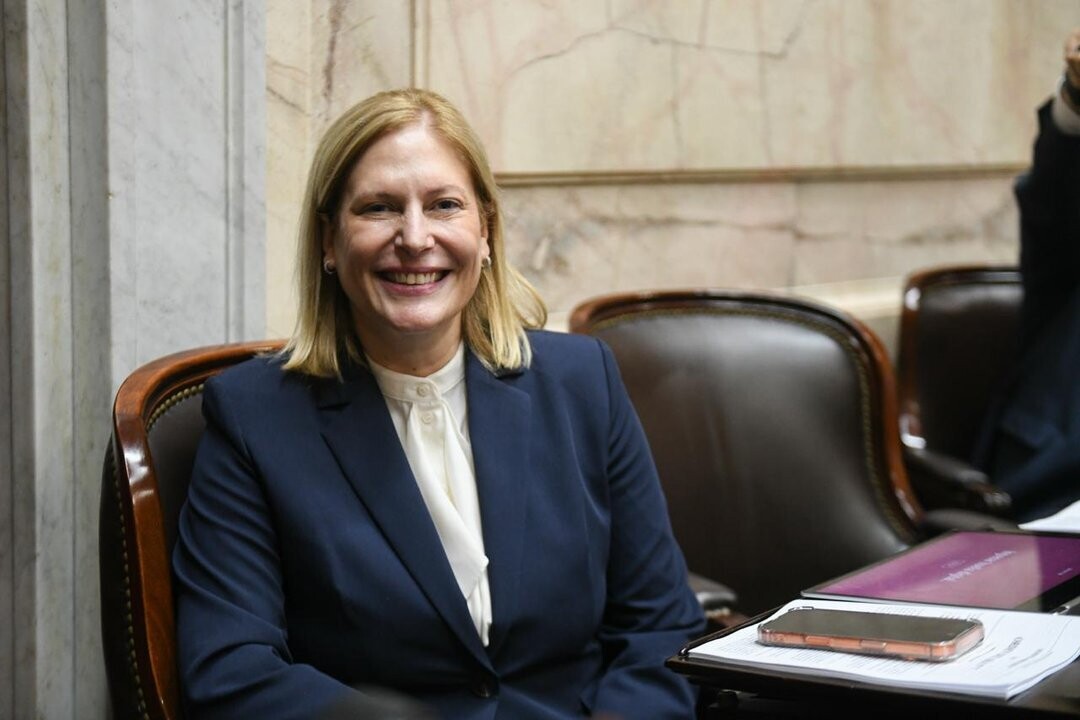
Buenos Aires, April 14 (NA) – Following the resounding defeat of the 'Clean Slate' project in the Senate last May amidst hypotheses of secret conspiracies between the ruling party and Peronism, the president of the 'United Provinces' bloc, Gisela Scaglia, presented a new bill to prevent persons convicted of double conformity for serious crimes from accessing national elective offices. The initiative, accessed by the Argentine News Agency, establishes disqualification when there is a conviction confirmed by an appellate court, even without a final sentence, and it remains in effect during the sentence and for up to ten years after. The bill amends the Organic Law of Political Parties and expands the scope of crimes or causes of ineligibility that disqualify a person from being a candidate. As specified in the text presented, those with confirmed convictions for corruption, fraud against the State, money laundering, abuse, human trafficking, drug trafficking, crimes against life, physical integrity, and the constitutional order will not be able to run. It also incorporates as a cause of ineligibility and disqualification for delinquent child support payers, extending the criterion of responsibility beyond serious criminal offenses. The Electoral Justice will verify all these requirements when formalizing candidacies, and the National Reincidence Registry will maintain an updated public record of sentences covered by the law. 'Argentina is not starting from scratch, but it needs clearer rules to regain trust,' stated Scaglia. 'This shows that it is possible, now it's Argentina's turn,' she added. For the president of the Unidos inter-bloc, 'on this issue, there are no gray areas.' 'Institutions are defended with clear rules and politics must lead by example,' she emphasized. The initiative revives a social demand for ethics and public integrity that has been promoted for years by the 'Clean Slate' movement, led by Ignacio Marra, which managed to gather more than 490,000 signatures from citizens. The bill is based on Article 16 of the National Constitution, which establishes the principle of suitability, Article 37, which guarantees political rights, and Article 36, which establishes disqualification for those who commit serious crimes against the State. In the bill's justification, Scaglia states that 'in a representative democracy, those who aspire to hold elective public office must not only meet the legal requirements to be elected, but also demonstrate an unequivocal commitment to legality, public integrity, and respect for fundamental rights.' 'In this context, it is necessary to highlight that the right to be elected is not absolute, but admits reasonable regulations when the suitability for the exercise of public functions is at stake,' she points out. In countries like Brazil, Italy, and Spain, there are 'Clean Slate' norms similar to the one proposed by Scaglia. 'These experiences show that the protection of institutional quality is a legitimate objective that justifies reasonable restrictions on access to public office,' indicates the opposition deputy. Furthermore, she points out that 'the requirement of a conviction confirmed by an appellate court guarantees due process and prevents the political use of the penal system.' Regarding the disqualification of delinquent child support payers, that is, 'those who deliberately fail to fulfill the basic duty to provide for their own children or persons under their charge,' Scaglia explains that 'it is not merely a private matter, but a conduct that reflects a deficit of responsibility incompatible with the exercise of public functions.' 'It is reasonable to demand that those who aspire to represent the citizenry, first and foremost, comply with the most basic and inescapable obligations imposed by the law. We first sanctioned it as law and then incorporated it into the Provincial Constitution as state policy. Indeed, someone who does not fulfill the essential duty of ensuring the subsistence of their children can hardly be considered fit to assume public responsibilities that involve making decisions for the benefit of society as a whole,' she insists. Scaglia's bill also carries the signatures of her peers from United Provinces, María Inés Zigarán, Carolina Basualdo, and José Nuñez.__IP__Last May, against all odds, the 'Clean Slate' initiative, agreed upon by the ruling party and the PRO, which had been passed by the Chamber of Deputies, sank in the Senate with 35 negative votes and 36 affirmative ones (37 were required for approval).#AgenciaNA'In Santa Fe we did it.' 'This is my contribution to a discussion that we all need to have.'