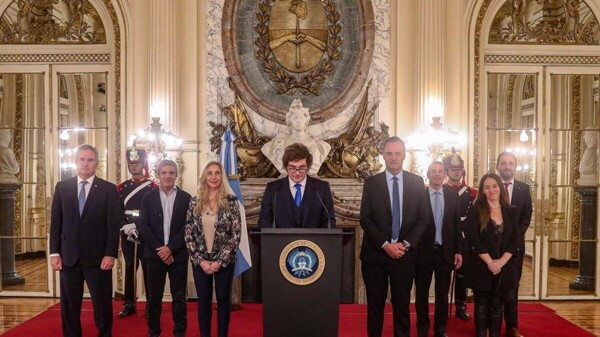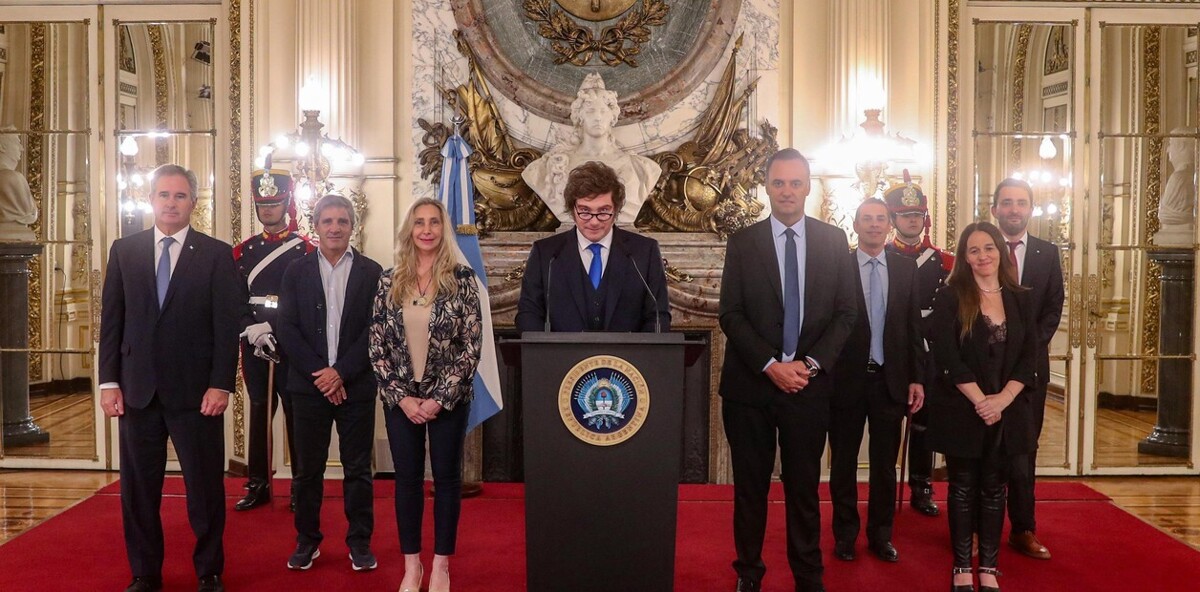
In a national address from the Casa Rosada, the president presented the judicial setback for the plaintiffs as a "historic verdict" and stated that the Government managed to turn an outcome that seemed virtually impossible. The decision celebrated by the libertarian administration was issued by the U.S. Court of Appeals for the Second Circuit, which overturned the $16.1 billion conviction from 2023. President Javier Milei used the judicial relief in the YPF case to turn it into a high-voltage political message against Kirchnerism, particularly against Cristina Fernández de Kirchner and Axel Kicillof, whom he held responsible for pushing the country into a "suicidal adventure" with the 2012 expropriation. The Government sought to close the episode not only as a judicial victory but also as a political validation of its economic program and its criticism of the Kirchnerist era. According to the ruling, the plaintiffs' claims for breach of contract do not hold under Argentine law, a criterion that overturned a case that had become a major threat to public finances. Based on this decision, Milei stated that the legal battle and the signal left by the expropriation meant a loss of at least 12 years of investments for Argentina, impacting growth, employment, and poverty. According to the judicial and financial reconstruction, the disputed amount was approaching $18 billion with interest, and the subsequent order to deliver YPF shares to cover part of the sentence was also lifted. Against this backdrop, Milei sought to claim the result with a speech aimed at both the external and domestic fronts. The signal was meant to be twofold: to celebrate that Argentina avoided an extraordinarily large sentence and, at the same time, to use this relief to reaffirm that the cost of that expropriation, according to the official reading, still casts a shadow over the present. From the Kirchnerist sphere, Kicillof came out to dispute the official appropriation of the victory and stated that the ruling validated precisely the arguments his space had been defending for years about the legality of the expropriation and the inadmissibility of the claim as accepted in the first instance. This counterpoint shows that, even with the immediate economic relief of neutralizing a multi-billion dollar sentence, the dispute over the political interpretation of the case is just beginning. In this context, Milei took a step further and announced that he has already sent a bill to Congress to modify the expropriation law, with the declared intention of preventing a similar decision from again placing the country before a decade of litigation and asset risk. Before the recording, various journalistic reports reported on a toast in the Casa Rosada, a sign of triumph that the ruling party did not want to hide. However, the judicial decision does not completely close the political controversy. The official message aimed to reorder the case within the classic libertarian narrative: legal security, unrestricted defense of private property, and frontal questioning of any state intervention that, according to the presidential vision, alters market rules and scares away capital. The staging also had a political reading. Milei appeared in the message accompanied by Karina Milei, Manuel Adorni, and part of the economic and legal team that intervened in the case strategy. He said the country had rid itself of a "sword of Damocles" and attributed the result to the "legal, political, and diplomatic skill" of his team. "These characters from our past plunged us into a suicidal adventure," he said explicitly naming Cristina Fernández de Kirchner and Axel Kicillof, and maintained that a defeat would have cost the country an impossible amount to absorb during the economic recovery stage. The President also insisted on an idea with strong ideological content: "expropriating is wrong, because stealing is wrong." In his official speech, he especially recognized María Ibarzabal Murphy, Sebastián Amerio, Santiago Castro Videla, Pablo Comadira, Juan Ignacio Stampalija, Luis Caputo, Pablo Quirno, and Ambassador Alec Oxenford, to whom he attributed a decisive role in obtaining the verdict. But the central point of his message was the charge against those who promoted nationalization.