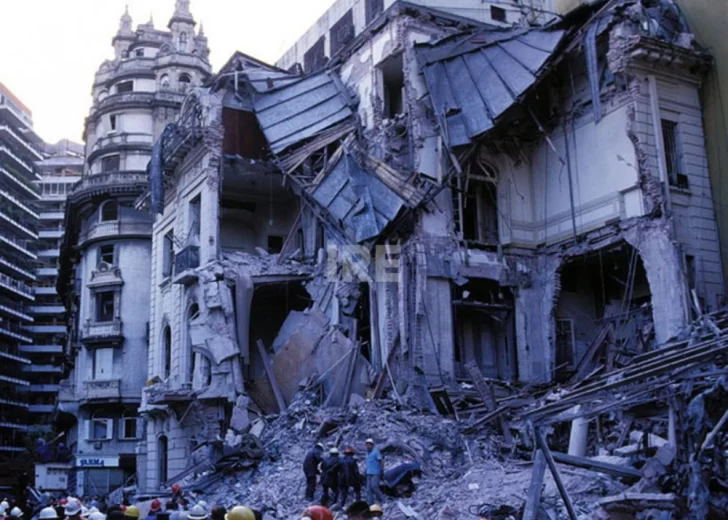
Internationally, the red notices from Interpol regarding several Iranian suspects in the AMIA bombing remain in effect, a fact that directly contradicts Tehran's narrative, which continues to deny all responsibility and denounces a supposed campaign against it. In this context, the threat published from Tehran reopens a historically unsettling reflection for Argentina. In 2024, the Federal Chamber of Criminal Cassation held Iran and Hezbollah responsible for the attacks against the AMIA and the Israeli Embassy, ratifying a long-standing line of Argentine justice regarding the involvement of structures linked to the Iranian regime. That this warning arrived precisely on the anniversary of the attack on the Israeli Embassy and with the AMIA four months from a new anniversary deepens the perception that, after two attacks, Iran is once again speaking to Argentina in the language of political intimidation and covert threat. To this scenario is added a recent precedent: in June 2025, amidst the regional war, Argentina evacuated its diplomatic personnel from Tehran for security reasons, while the Iranian embassy in Buenos Aires remained operational. The coincidence between the current threat and the date of the attack against the Israeli diplomatic headquarters on Argentine soil reinforces the symbolic and political weight of the Iranian message. The hardening of Tehran's rhetoric came after the statements by Milei in New York, where he affirmed that Iran is an “enemy” of Argentina and recalled that the country suffered “two bombs,” in reference to the attacks against the Israeli Embassy and the AMIA. This is not just any rhetorical crossfire between governments, but a message issued by a regime judicially implicated in the two worst terrorist attacks suffered on Argentine soil. Buenos Aires - March 17, 2026 - Total News Agency - TNA - The Iranian regime has once again launched a high-voltage political threat against Argentina and directly targeted President Javier Milei, accusing him of having crossed an “unforgivable red line” with his open criticism of Tehran and his strategic alignment with the United States and Israel. In the editorial titled “Milei, Quo Vadis?”, the Iranian medium maintained that the libertarian administration has aligned itself with the “U.S.-Zionist axis,” accused Argentina of instrumenting a policy of “Iranophobia,” and even went so far as to describe the country as a sort of regional platform against Iranian security. The tone of the text was not limited to ideological disqualification. This narrative construction, common in the regime's propaganda, seeks to present Argentina not only as a diplomatic adversary but as an actor incorporated into a supposed hostile architecture pushed by Washington and Jerusalem. Faced with this picture, the Argentine judicial background is impossible to overlook. It also slipped in more delicate accusations by suggesting that Argentine companies linked to sectors close to Israel would participate in monitoring tasks, information transfer, and covert activities in areas near Iranian borders. The warning was published in an editorial in the Tehran Times, a medium aligned with the political apparatus of the Islamic Republic, which stated that Iran “cannot remain indifferent” to the stance of the current Argentine government and will have to design a “proportional response” to this enmity. The escalation takes on particular gravity because it occurs exactly on the anniversary of the terrorist attack against the Israeli Embassy in Buenos Aires, perpetrated on March 17, 1992, which left 29 dead and more than 200 injured, according to the Israeli diplomatic representation itself in Argentina. That attack, which marked one of the darkest episodes in recent Argentine history, was followed a little over two years later by the attack against the AMIA, committed on July 18, 1994, with 85 fatal victims and more than 300 injured. That move made evident that the deterioration of bilateral relations had already entered a concrete risk zone even before this new verbal onslaught from the regime.