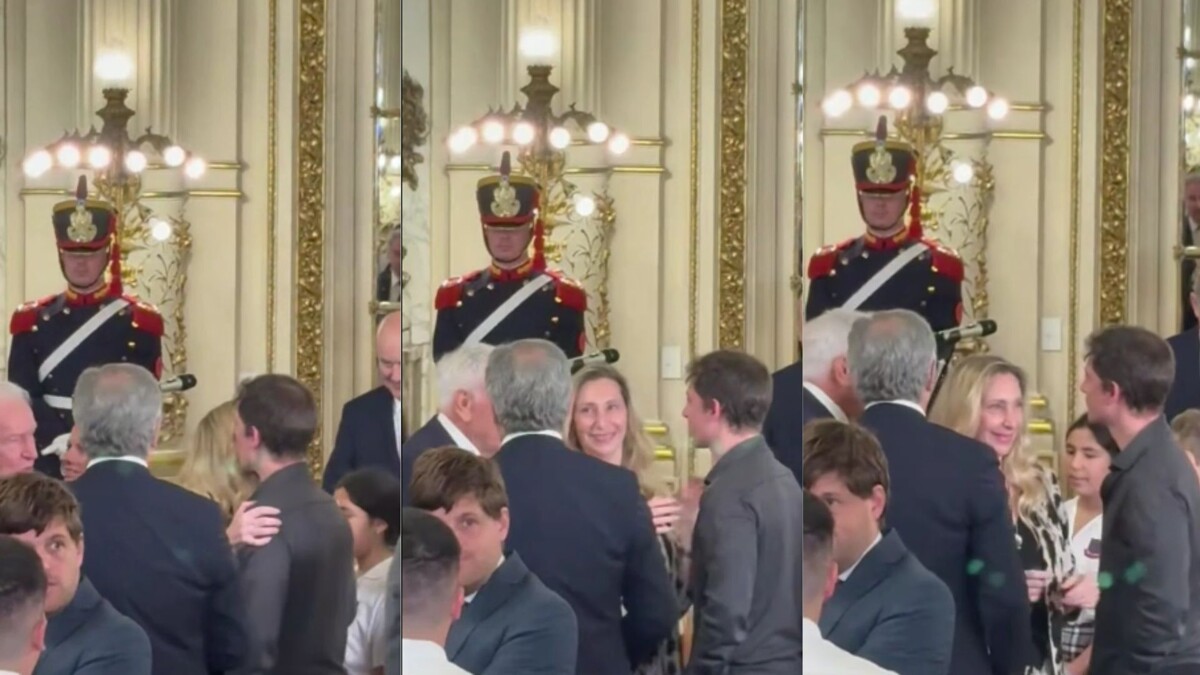
The decision was made directly by the President and announced without several key figures in the ruling party being aware, which caused surprise even within the President's own inner circle. This episode particularly affected Santiago Caputo and his collaborator in the judicial area, Sebastián Amerio, who held the second line in the ministry and aspired to continue to have influence in that portfolio. The experience was short-lived: Franco ended up leaving the post months later, which exposed the growing weight of Karina Milei in the government's political architecture. This process became even clearer when the Executive branch reorganized the cabinet. Manuel Adorni, presidential spokesperson and a leader close to Karina Milei, took over as Chief of Cabinet, while the Ministry of the Interior was handed to Diego Santilli, a PRO leader with direct access to the President and a good relationship with Minister of Economy Luis Caputo. In this context of realignments, the appointment of Juan Bautista Mahiques as Minister of Justice, replacing Mariano Cúneo Libarona, further shook the ruling party. The relationship with Vice President Victoria Villarruel also deteriorated; she had been a key figure in the presidential ticket but was progressively pushed out of the inner circle of decision-making even before taking office. In the first months of the administration, the dynamics of power were structured around the so-called "Iron Triangle," composed of Javier Milei, Karina Milei, and political advisor Santiago Caputo, considered one of the architects of the libertarian electoral strategy. However, that structure began to show cracks over time. Tensions between Caputo and the Secretary-General of the Presidency deepened. Without public appearances or frequent contact with the press, the official built a closed circle of decisions that relies on her direct relationship with the President. The President tried to contain the dispute by including then-Chief of Cabinet Guillermo Franco in coordination meetings at the Olivos Residence, with the aim of balancing positions. According to political sources, Amerio was informed of the changes while participating in a Council of the Magistrature meeting, and had to abruptly leave after receiving the news. The replacement also triggered a new movement within the judicial area: the position held by Amerio will be assumed by lawyer Santiago Viola, identified with the political sector close to Karina Milei. The tension was evident during Mahiques' swearing-in ceremony at the Casa Rosada, where the greeting between Caputo and the Secretary-General was described by witnesses as cold and distant. Several collaborators close to Javier Milei during the campaign were sidelined or completely out of the government once the libertarian administration was in place. At the same time, ARCA data indicates that February's tax collection recorded a real year-on-year drop of 9.7%. The situation is causing concern among governors, many of whom are observing signs of deterioration in the presidential image linked to job losses and the stagnation of wages' purchasing power. In parallel, the international scenario also introduces uncertainty. The recent appointment of Juan Bautista Mahiques as Minister of Justice of Javier Milei's government not only reconfigured the judicial board but also uncovered a complex web of internal disputes within the libertarian power summit, where the central figure seems to be Karina Milei, Secretary-General of the Presidency and the main political strategist of the ruling party. From the start of her term, Karina Milei consolidated a unique power structure within the administration. In judicial circles, it is remembered that Mahiques had professional ties with Argentine football leaders, including Pablo Toviggino, treasurer of the AFA and a close ally of the organization's president Claudio "Chiqui" Tapia. Both leaders are under judicial investigation for alleged irregularities linked to the handling of pension contributions of Argentine Football Association employees, as well as suspicions of evasion for amounts that, according to judicial estimates, would exceed 19,000 million pesos. After taking office, Mahiques publicly denied having a personal relationship with Toviggino, although versions of previous contacts in professional settings persist in the courts of Comodoro Py. The controversy intensified when the new minister ordered the removal of the head of the General Inspectorate of Justice, Daniel Vítolo, an official who had pushed for a review of the AFA's financial statements and was considering the appointment of overseers to supervise the entity's institutional functioning. While internal disputes shake the ruling party, the economy adds pressure on the government. Those who frequent the halls of Balcarce 50 agree that her influence has grown steadily since the electoral campaign to become a determining factor in the definition of names and strategies. This construction of power had early consequences. The military escalation in the Middle East and the possibility of a larger-scale conflict are keeping global markets on alert, a factor that could further complicate the economic stability of emerging countries like Argentina. In this context, Mahiques' appointment appears as an episode that reveals something deeper: a silent struggle for political control within the libertarian government, where strategic decisions seem to be increasingly concentrated in a small circle that revolves around Karina Milei and the President himself. According to a source from the Casa Rosada, the Kremlin Magician is indignant, furious, and some even say that the anger reaches the President. The figure of the new minister also raises questions within the so-called "Red Circle". Private consulting firms estimate that annual inflation could reach 26.1%, more than double the official forecast included in the national budget.