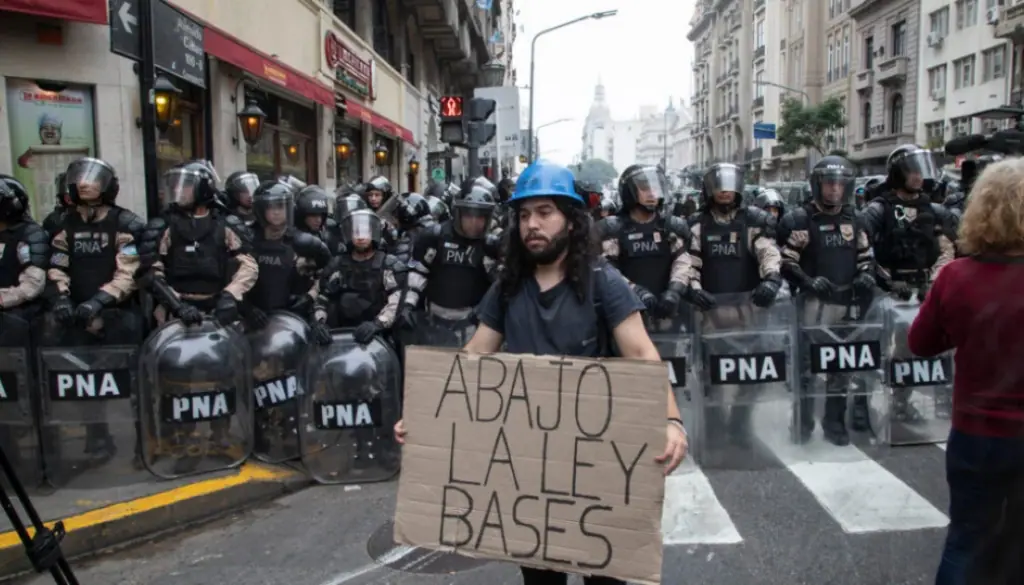
Two years later, the trial against five of these protesters begins, who had been detained for a day in Madariaga, and were accused of resisting authority. They framed it as necessary, stating it is a collective struggle, that it cannot be resolved through a plea bargain, but that it is necessary to demonstrate the injustice and that the government built a case and took it to trial without having evidence. It is also important to highlight that the comrades made the political decision to take the case to trial, because instead of signing other types of agreements for alternative exits, the comrades' position was to go to trial. We have to prevent that from becoming established as a logic because the police tend to justify their actions. It is the first trial against fighters in this government, so it will be a landmark case on how the criminalization of protest, exercised by the far-right, is applied—and what results it has. So, it is a collective struggle because the outcome of this trial points to it serving us all collectively. When you go to the files, the accusations are not there, that is to say, names of a bunch of people were published who do not even appear as accused. There is a much more aggressive position on the part of this government regarding the criminalization of protest, it seeks to install an idea of fear, that if you protest or intend to put up any resistance to the measures and the loss of rights, you will end up with a criminal case. Firstly, what is striking in this case is that even when there is not enough evidence, the case goes to trial. And in addition, there is the endorsement that the Minister of Security and the government give to the violence exerted by the police and to the behavior that the police has within the framework of the Anti-Terrorist Law. To give a current example, the detainees of February 11, 2026, the Minister of Security released headlines with names and surnames and photos of a bunch of people. When we go to the file and the evidence, despite having hours and hours of footage from different media, there is not a single recording that says or shows them doing what they are accused of. Also, it was a relatively peaceful demonstration, where there was no conflict and no situation of violence, except for the police who, hours before the arrests, which took place at approximately 22:40, had arrived on motorcycles at the square. This was in the framework of the "United by Culture" Festival, which had to be called off due to police repression. This also happened in July 2024, where a bunch of comrades were detained for 4 or 5 days. -What political implications does this prosecution have in the context of the counter-reforms being carried out by the national government?-Regarding the political implications, it is the first case to reach trial in the framework of the detentions and the criminalization of protest of the Milei era. It also means not losing ground in the popular field, which are demonstrations and the power to petition the authorities and to claim when our rights are being violated. We believe it is fundamental that the comrades are acquitted, not only because of the absence of evidence in the file, but because politically it is very symbolic and it is very important to be able to show that we have backing and we have organization to give this fight. It is also one of the first times where the organization of the comrades' defense is framed within the Federal Network for Human Rights. On the other hand, among the 14 people who were detained, there were photographers, they were not only protesters, but there were also comrades who were performing another type of role within the demonstration. -What were the procedures of the repressive forces and the justice system in the construction of this case? The arrests are carried out by the Federal Police. A comrade even, accused of throwing stones, appears in a footage playing a melodic flute as a form of protest against the police. -In relation to the previous question, what novelties in relation to previous criminalization facts does what happened with the detainees during the mobilizations against the Bases Law suppose? We have been working on the criminalization of protest for years and we have defended comrades who had cases in different governments. Let it be known that, if one goes to a demonstration, there is a group and a network of organizations and people who are accompanying us to be able to guarantee that we can make resistance against this government and its measures. -What expectations do CADeP have for this process, and what political consequences do they consider that the outcome of this trial will have? Jurisprudentially speaking, there are no elements to condemn the comrades, the only evidence cannot be a police testimony. It is good to be able to value it because it implies a collective construction, which is what this government is trying to destroy. Because he would be committing a conduct punishable by sanction. -What would you like to add? I think it is important that we managed to build, with a bunch of organizations, a legal guard, to accompany cases of criminalization of protest. In our country, the police cannot detain you for absolutely anything, certain requirements must be met. In addition, the prosecution has no evidence, except for police testimonies. The construction of the case is fundamentally based on the testimonies of the police who were in charge of the arrests of each of the prosecuted individuals. We interviewed Peloso to understand what repressive novelties are perceived from this case, and what importance it has for the future of popular struggles in the country. -What are the particularities of the caption with which they take to trial the five people detained for the mobilization against the Bases Law?–The most relevant data regarding this specific case is the fact that it is one of the few cases with the caption of "Resistance to Authority" that reaches trial. So a police officer cannot tell you that he actually detained you because you shouted at him and annoyed him with something you said. The collective is what will give us the way out, and in CADeP we always say that fights are won in the street. The police started to repress without having any reason to do so. They say that they proceeded to detain them because they saw them throwing stones or bottles, or they hurled insults and kicked the police. Basically, the accusation states that within the framework of the operation of February 2, they would have thrown stones, bottles, and hurled insults at the police personnel. We are a group of organizations from different spaces and with different interests that we organize to be able to guarantee a legal guard, to be able to guarantee that when comrades are detained in the framework of a demonstration, someone can go to advise them. Interview with lawyer Silvia Pelozo from CADeP - Anti-repression Coordinator for the People's Rights. By Juliana Díaz Lozano | Footprints of the South. Lawyer Silvia Pelozo, along with Martín Alerete, Marcela Dal Santo and Alexis Panella, are part of CADeP and constitute the defense of the protesters. In that context, we believe that it is fundamental to achieve the acquittal of the comrades because beyond the fact that it is completely unjust and it is a case where there is no evidence at all, it has to do with weighing and valuing the collective struggle that it means to give this battle. However, as I said, there is not a single filmic proof of that. That day the square was militarized, because it is one of the first times that Bullrich begins to propose that one could not go down to the street, that one could not cut off traffic circulation. That they have lawyers who understand about the theme and who understand about the defense of human rights. Or you can end up eating the garrón of being detained for a day or two, right? The case involves Carlos Denuble, Pedro Esquivel, Joaquín Arrua, Joaquín Gould and Astor Galan Vizgarra. We observe that now the way to approach these issues is much more aggressive. That is to say, you are asking the same person who, by your account, is committing a crime or is performing an action that does not correspond, to explain that he did not commit it. So it is an arbitrary detention, which was not justified within the framework of the law. During the demonstration of February 2, 2024, the repressive forces detained 14 people in the framework of one of the first applications of Patricia Bullrich's Security Protocol.