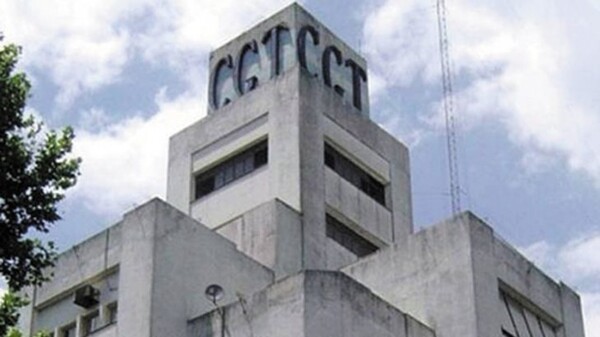
The Argentine General Confederation of Labor (CGT) opened a judicial front on Monday against the labor reform law passed in the Senate on Friday, doing so with a gesture read in the union world as urgent and defensive: it filed papers requesting the declaration of the norm's 'unconstitutionality' before the Labor and Administrative Courts, even before the text was promulgated by the Executive Branch. For traditional unionism, the reform not only alters the rules of the labor market: it threatens to dismantle the financing and resource retention mechanisms that today sustain union structures, service networks, and, above all, power. Led by a triumvirate, the central union decided to advance the move and place the conflict in the hands of the Justice at a moment when its main leaders feel the reform touches the heart of union power: the circuit of mandatory contributions, the financing and control of social works, and a revenue architecture that for decades functioned as a backbone of influence, negotiation, and political survival. The filing was led by the co-general secretaries Jorge Sola (from the Insurance union), Cristian Jerónimo (from the Glass union), and Octavio Argüello (from the Truck Drivers' union), who arrived at the judicial headquarters on Talcahuano Street with a message of institutionality to the outside and alarm to the inside. Presenting the proposal before promulgation exposes the union leadership's fear that, once in motion, it will be very difficult to reverse facts accomplished: changes in collective bargaining agreements, new negotiation modalities, limits on withholdings, reordering of contributions, and a potential shift away from the classic union model. At the courthouse doors, the central leaders added a political diagnosis. Sola stated that the filing 'fulfills what we have been saying since we began this process of rejecting the law.' Jerónimo, for his part, hardened the tone: he asserted that 'today many sectors are already starting to question why they supported the Government and this law,' and affirmed that the reform 'has no beneficial impact on the lives of workers.' That is why they accelerate, judicialize, and seek to stop what they consider a structural blow. The first is the strictly legal one, involving two courts and a claim aimed at the integral constitutionality of the norm. In the same message, he pointed to the Executive's economic line and described it as a project 'for a few' and of 'financial speculation,' with direct criticism of the absence —in his view— of a plan to boost production and employment. Argüello deepened this line and crossed the President over his speech on Sunday before the Legislative Assembly. But the CGT's move to the courts has already sent a clear signal at the start of the legislative year: unionism feels that the reform not only changes rules for companies and workers; it changes the board of its own power. And that is why the Government interprets the move for what it is: the reaction of a system that, when touched in the pocket and in the control of its historical levers, clings to the last line of defense it has when it loses the political vote: judicial restraint. The Truck Drivers' leader closed with a historical comparison: he warned that Argentina 'has had these policies before and they have already failed,' and said it is a 'model for 20%' while 'the rest of us are all outside.' Behind those phrases, the conflict is ordered in two overlapping planes. In a data point he sought to install as proof of deterioration, he claimed that '270,000 jobs have been lost' and considered 'total insanity' the presidential assertion about the drop in unemployment. In that plane, desperation is not measured only in speeches: it is measured in the cashbox. 'We are here to exercise our right to petition.' He described the presentation as 'a big lie, a show,' and questioned how Milei plans to create more jobs. The dispute over 'the cashboxes' —union dues, withholdings, and the enormous mass of money circulating through the social works system— appears as the real engine of the rush. The timing is not accidental. Buenos Aires - March 2, 2026 - Total News Agency - TNA -.