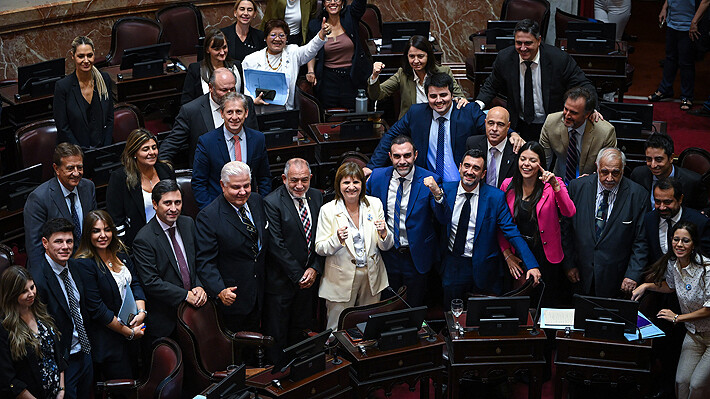
As an official proponent, he presented the Labor Assistance Fund as a tool to provide predictability for both employers and employees in the event of potential layoffs. In this framework, the ruling party insisted on an argument it repeated throughout the discussion: if the cost of hiring is lowered and incentives for litigation are curtailed, formal employment is accelerated and part of the economy is 'whitewashed.' Chubut lawmaker Andrea Cristina also stated that updating legislation is key to improving competitiveness and predictability. The conclusion of the discussion escalated into a political confrontation. Along these lines, Godoy emphasized the weight of SMEs and linked the reform with the RIMI (Incentive Regime for Medium-Sized Investments), presented as a complement to the RIGI (Incentive Regime for Large Investments), which the Casa Rosada seeks to use to boost a larger-scale investment cycle. The opposition, in contrast, argued that the law flexibilizes, precarious, and opens an inevitable judicial front. The former Chaco governor, Jorge Capitanich, warned that the project, instead of creating jobs, could function as a 'subsidy' to increase unemployment due to the cheaper cost of dismissals and the impact on labor negotiation. In the same vein, the Santa Fe lawmaker Marcelo Lewandowski affirmed that the reform 'does not modernize, it precarious,' and the Pampean lawmaker Daniel Pablo Bensusán stressed that labor rights cannot be cut by law without straining the principles of progressivity and non-regressivity. Among the most questioned points are the changes to the compensation regime and the creation of the Labor Assistance Fund, the suppression of the ultra-activity of collective agreements, the restriction of union protections, the limitation of the right to strike, the repeal of professional statutes, and measures affecting the financing of INCAA, a section that amplified the rejection of cultural and union sectors. In the chamber, Chaco Senator Juan Cruz Godoy, of La Libertad Avanza, defended the reform as the result of a 'democratic process of debate and negotiation' and argued that the project seeks to reduce labor litigation through new definitions on salary and benefits. He also questioned the accelerated process and warned that the reform 'conspires against the legal security' that the government itself claims to want to offer investors, by proposing — in his interpretation — provisions that would clash with constitutional principles. Senator Ana Markso stated that from Peronism they reject the reform for considering it 'enslaving' and 'flexibilizing,' while the Fuegian Cristina López anticipated her vote in defense of her province's industry and spoke of 'fear and anguish' in the world of work. The head of the Justicialist bloc, José Mayans, harshly attacked the project, defining it as an 'anti-worker' rule and predicting judicial conflict, while Bullrich responded with a frontal defense of the officialist course: she stated that in previous administrations, in the name of worker protection, thousands were pushed into informality, and argued that the reform sends a signal of growth after years of stagnation. With the sanction consummated, the immediate scenario is crossed by two parallel realities: on the one hand, the government that celebrates a high-impact legislative victory; on the other, unions and the opposition that anticipate social resistance and judicialization. From PRO, meanwhile, the Pampean Victoria Huala valued the elimination of article 44 and defended the reform as a sign of support for SMEs and 'real employment.' After the approval, she gathered the libertarian senators for a celebratory photo and urged her bloc in a session closure charged with political euphoria, presented behind closed doors as a management milestone for the Milei administration. The finally approved text incorporated a key modification that had been previously applied in the Chamber of Deputies: the elimination of the controversial article 44, which proposed cuts to salary payments during certain leaves for accidents or serious illnesses. In between, millions of workers and employers are looking at the fine print, trying to understand — without slogans — how, in daily life, the way of hiring, negotiating, and sustaining employment in Argentina in 2026 changes. The final vote confirmed the anticipated outcome: 42 in favor, 28 against, and two abstentions, corresponding to Natalia Gadan and José Carambia. The parliamentary treatment came after another high-voltage institutional discussion: the recent sanction of lowering the age of criminal responsibility to 14, an antecedent that marked the political climate of the sessions and pushed the ruling party to sustain that the package of changes responds to an 'order' and 'modernization' agenda that, in its narrative, seeks to unblock investment and formal employment. In the Upper House, the head of the La Libertad Avanza bloc, Patricia Bullrich, had a central role in negotiations to align support with dialogist sectors and became the visible face of the celebration. Buenos Aires - February 28, 2026 - Total News Agency - TNA - With a comfortable majority built between the ruling party and allied blocs, the Senate turned into law the labor reform promoted by the government of Javier Milei, in a day marked by protests in the vicinity of the Congress and a debate that exposed, without nuances, the clash of views on the productive model and the role of the State. Suppressing that point was, in fact, a key to unblocking votes, in a context where the opposition had pointed to that article as a symbol of adjustment on the worker. Even without that chapter, the sanctioned law includes provisions that have sparked strong criticism from the opposition front. Senator Mariano Recalder ratified the rejection of the Justicialist bloc by stating that the text returned to the Senate 'is practically the same' as the one originally approved, and qualified it as a 'monstrous law' for the number of norms it modifies and for its content.