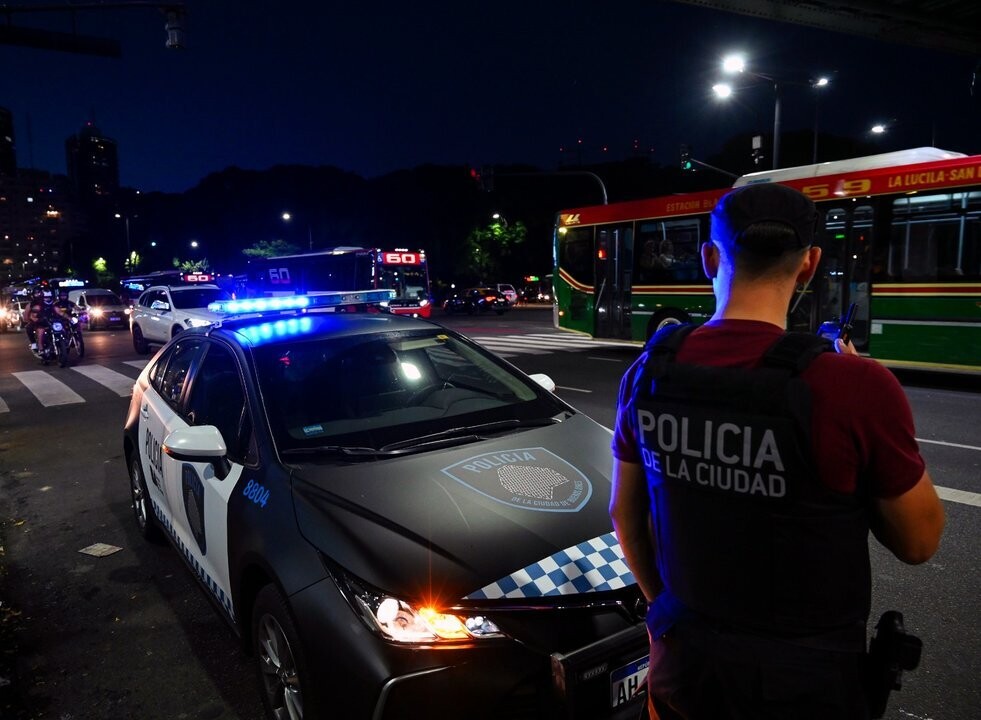
Buenos Aires, February 23 (NA) -- The city of Buenos Aires recorded a decrease in all crimes during 2025, and in cases of homicides, car theft, and armed robberies, the lowest rates since official records began were reached. This was learned by the Argentine News Agency after reviewing the 'Map of Crime' reports for the city corresponding to last year. In this sense, homicides reached their lowest level in 31 years, while also falling by 3% compared to 2024. With 78 cases and a rate of 2.5 per 100,000 inhabitants, the City ranked as the second safest capital in the Americas, behind Ottawa (Canada), as indicated in the survey. Car theft fell by 54% compared to 2024 and recorded the lowest number of cases since 2002, including the COVID-19 pandemic period. Since 2002, this type of crime has decreased by 92%. Armed robbery fell by 34% in 2025, also below the pandemic records. Since its peak in 2016, this crime has decreased by 71%. Total robberies fell by 27% last year, with the fewest cases in the last 25 years, not counting the pandemic period. Petty thefts fell by 21% compared to 2024, and motorcycle thefts fell by 3% in the same period. "Homicides: reached the lowest level in the last 31 years and reached a rate of 2.5 per 100,000 inhabitants." 'We have the Pacification Patrol that relieved the Federal Police and the National Gendarmerie and we managed to lower crime statistics such as homicides and robberies, in addition to the fight against drug trafficking and street-level drug dealing,' stated Giménez. Meanwhile, the City's Security Secretary, Maximiliano Piñeiro, assured that there was 'a strong decrease in car theft, even with statistics compared to those of the pandemic.' What is the Map of Crime? The Map of Crime was established by law 5.688, which created the Comprehensive Public Security System of the Autonomous City of Buenos Aires and the City Police. It began to be developed in 2017, making this the ninth year it has been presented. Even fewer cases were produced than in the pandemic years. Armed robberies fell by 71% since 2016, when 19,554 were recorded. 'Car theft: it was the crime that fell the most, as in 2025 it fell by 54% compared to 2024. Last year there were 524 car thefts, while in 2024 there were 1,140. This modality is at its lowest level since 2002 (92% less) when the maximum of 6,667 occurred. Even fewer car thefts were recorded than in the pandemic years.' 'Motorcycle thefts: they had a decrease of 3% in 2025 compared to 2024. Last year there were 5,587 cases, while in 2024 there were 5,758. Motorcycle thefts are 51% below their historical peak, which occurred in 2018, when 11,271 were produced.' 'Petty thefts: petty thefts, or the taking of goods without the use of violence, had a decrease of 21% compared to 2024, with 49,641 cases in 2025 and 62,771 in 2024. In the case of petty thefts, filing a complaint is fundamental for the registration of this type of crime and the implementation of policies to combat it.' Public security policies of the City applied to combat personal crime. The city government emphasized that more than 2,500 personnel were added to reinforce security on the streets; nearly 500 vehicles were incorporated, including 120 patrol cars, 175 motorcycles, 130 vans, 60 quads, transport units, and several unidentifiable vehicles for prevention brigades. In addition, the 'Access Control Patrol' to the City was created and night patrols in areas with higher criminal activity were reinforced. More than 7,000 high-tech vests were added and vests with cups were distributed for female personnel. The decrease compared to the 2014 peak (197) represents 60%, so it is the lowest amount since 1995. The 2025 homicide rate of 2.5 per 100,000 inhabitants in the City is below the rate for the entire country (3.7) and the province of Buenos Aires (4.34). The main cause of intentional homicides was 'brawl' or 'revenge'. With 21 cases, it represents 27% of the total, while 14 of these homicides occurred 'during a robbery' (18%), 10 were due to 'violence or intra-family conflict' (13%), and 8 were femicides (10%). Of the 78 homicides in 2025, 24 occurred in vulnerable neighborhoods and 54 in the rest of the City, while in 31 cases they were committed with firearms and in 27 with sharp weapons. 'Total robberies: they had a decrease of 27% in 2025 compared to 2024 and reached the lowest level since 2000, not counting 2020 and 2021, when the Coronavirus pandemic occurred. The decrease in total robberies from its historical peak, in 2008, was 43%. In 2025 there were 50,069 total robberies and in 2024 68,392 were recorded. Last year, 36,512 arrests were made for all crimes, which represents 3% more than in 2024, when there were 35,544.' 'Armed robberies: armed robbery is considered to be all those committed with firearms, sharp weapons, or any blunt object. Armed robberies decreased by 34% in 2025 compared to 2024, while last year 5,566 armed robberies were recorded compared to 8,445 in 2024. This type of robbery is at its lowest level since records began, in 2016. All this impacts on organized crime such as 'trapitos' (street-level extortion), street-level drug dealing, and robberies or thefts. This index keeps the city of Buenos Aires as the second capital in America with the fewest homicides after Ottawa (Canada). In 2025, homicides were 78, representing a 3% decrease compared to 2024, when 80 occurred. Also with more resources and more investment in security cameras, patrol cars'. 'All that combo of order has a derivative in the security numbers that is very important,' explained Macri in statements to the press. For his part, the city's Security Minister, Horacio Giménez, pointed out that there is a constant fight against street-level drug dealing. 'The changes began to be noticed when emphasis was placed on public order with the action in evictions of squatted houses, 'manteros' (street vendors). In addition, the change of uniform for the entire force was carried out. Likewise, 1,200 cameras were added to the Video Surveillance System, reaching a total of 17,000, which are controlled by the Urban Monitoring Center in Chacarita. This is added to the action of the Digital Ring and the installation of 400 Safe Points. Regarding evictions, 600 properties illegally occupied were returned to their rightful owners. Regarding 'manteros' and illegal fairs, 18,000 people who traded in the public space were evicted and 639 illegally occupied blocks were freed. In addition, operations against the so-called 'trapitos' were increased, both at sporting events and at concerts. The head of the city government, Jorge Macri, highlighted the decrease in the statistics of all crimes and stated: 'We maintain a political decision to enforce the law, with a system that is increasingly firm, with measures that we were able to deepen more.'