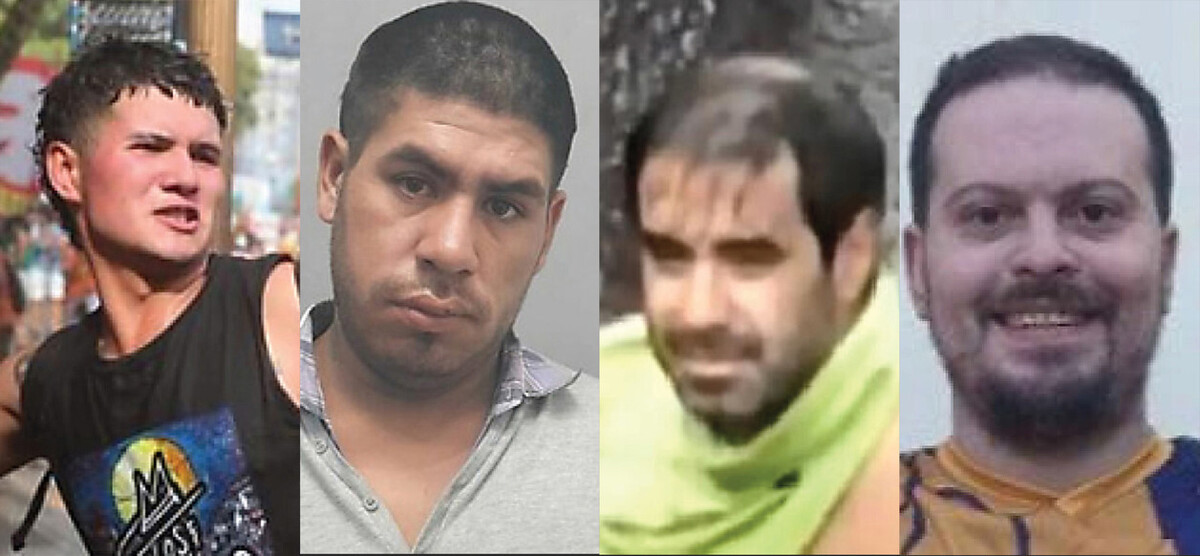
The national government has reactivated the political and judicial agenda following the serious incidents during the protest against the labor reform near the Congress, and has released the identities of four protesters identified as protagonists of the most violent acts, including the preparation and launching of Molotov cocktails and attacks with stones and blunt objects against police officers.
According to the official statement, the identification was made by crossing databases and analyzing images captured by various media channels and coverages, which recorded the moment a group set up a sort of "trench" and made homemade incendiary explosives in the middle of the public street. "We have identified them, we are going to look for them, and we are going to put them in prison. Impunity is over," officials stated.
In parallel, the Ministry of Security has advanced with a criminal complaint that toughens the qualification of the facts and seeks to sustain that it was not a mere street disorder, but an attack directed against the institutional functioning. The complaint was filed by the director of Normativity and Legislation of the ministry, Manuel Franco, who requested arrests and the application of penalties "proportional to the severity" of the episodes. The destruction of public goods was also reported, including sidewalks and urban elements, with the purpose of obtaining projectiles and attacking the deployed forces.
In the political arena, the ruling coalition seeks to capitalize on the hardening of the security approach to sustain that the protest derived from an operation planned by violent groups, while critical sectors denounce that social conflict is being used to criminalize protest.
The fourth implicated, Patricio Hernán Castellán, was identified in images from journalistic coverage and went viral for statements made by shouting in the middle of the protest. The episode that triggered the official reaction occurred during the concentration in front of the Congress while the legislative debate on the labor reform was advancing, an initiative that the Executive considers key to "modernize" the current regime, reduce litigation and promote formal employment, but which faces the rejection of trade union centers and opposition sectors that denounce precariousness and loss of rights.
In the political sphere, it was emphasized that he would have promoted calls against the labor project and disseminated expressions of strong criticism against President Javier Milei in previous posts, a point that the ruling coalition included to sustain that the facts had a destabilizing intention.
In the case of Denis Alejandro Figueredo, he was located in the same sector and was pointed out as a participant in stone attacks against the police line. The third accused, Federico Alberto Mazzagalli, was presented by the Government as a key gear in the core of the "trench", despite the fact that in his public profiles he defines himself with slogans linked to non-violence.
Minister of Security, Alejandra Monteoliva, announced that those identified were Matías Enzo Roldán, Federico Alberto Mazzagalli, Patricio Hernán Castellán and Denis Alejandro Figueredo. Arrests were also reported in preventive controls at train stations. For their recognition, researchers highlighted a visible tattoo on the left arm that would have allowed them to contrast their identity with records and television footage. On the street, the day led to clashes when a group of protesters attacked with stones and homemade explosives, and the forces responded with tear gas and dispersal operations, according to consistent reconstructions by different media. The official balance of the day included injured police officers and dozens of detainees, both during the incidents and during the de-escalation.