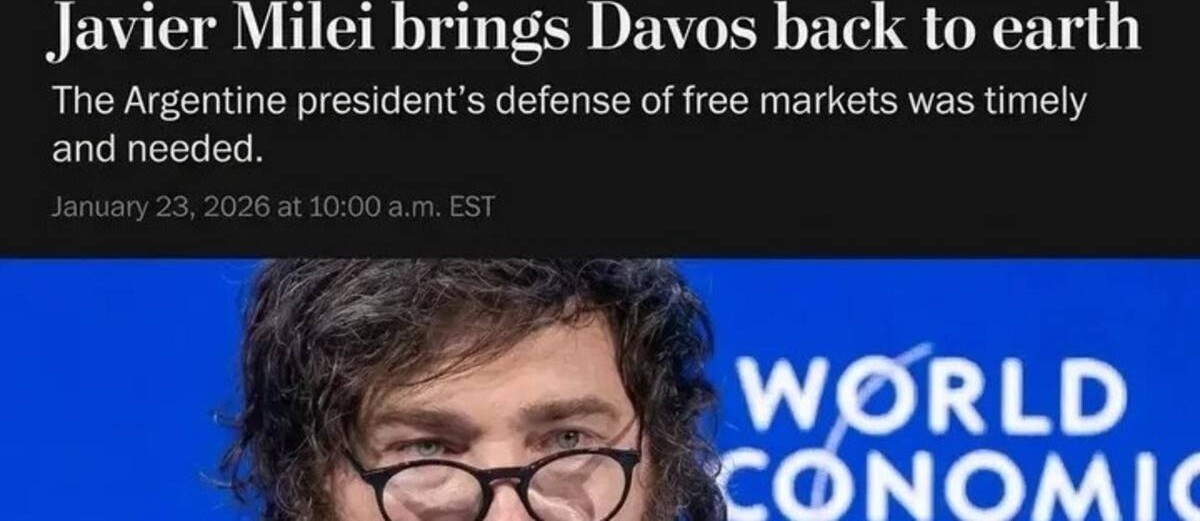
According to The Washington Post, this posture of self-limitation of political power distinguishes the Argentine leader from other heads of state and explains in part why his message had a more direct impact on a forum traditionally dominated by technical and consensual speeches. The publication of the American newspaper comes at a time when the Milei administration seeks to consolidate the results of its liberal economic agenda within the country and on the international stage. The newspaper also mentions economic growth figures estimated at around 4.5% for 2025, with projections anticipating an increase of approximately 4% for 2026. The editorial text does not limit itself to an economic analysis but also addresses the geopolitical positioning of the Argentine leader. The publication highlights that Argentina received the current government with a monthly inflation of around 25% and high levels of poverty, and that the measures implemented since December 2023 have led to tangible benefits. Buenos Aires, January 24, 2025 - Total News Agency - TNA - The prestigious American newspaper The Washington Post dedicated a front-page editorial to the management of Argentine President Javier Milei and his participation in the World Economic Forum held this week in Davos, Switzerland, describing his defense of the free market as 'timely and necessary' in a global context marked by the debate on the role of the State and the economy. According to the editorial, the Argentine president supported his presentation with references to classical and contemporary economists such as Murray Rothbard, Adam Smith, and Israel Kirzner, and maintained that the free market is not only the most productive system but 'the only just system' to ensure human freedom and economic prosperity. The article from the American media, which was also disseminated by the Office of the Nation President through its official channels in English, places special emphasis on the economic achievements that, according to the editorial, reinforce the validity of Milei's speech. The economic figures cited in the editorial, although they reflect projections and official estimates, coincide with the data recently disseminated on the evolution of various macroeconomic indicators, including those related to inflation, fiscal deficit, and economic growth after the reforms implemented by the national government. International analysts consulted by various media interpret that the backing of a global medium like The Washington Post—with a long tradition in the coverage of economic and political topics—contributes to reinforcing the perception that the liberal policies applied in Argentina are beginning to show signs of economic stabilization and recovery, although they warn about the structural challenges the country still faces. In Davos, the Argentine president summarized this approach by stating that 'the most responsible thing politicians can do is to stop bothering those who are creating a better world,' pointing to the need to limit state intervention to boost private initiative and value creation. While he underscores ideological affinity with conservative sectors of the United States and with figures like former President Donald Trump, the newspaper draws substantial differences between both leaders, particularly regarding free trade. Unlike the protectionist approach that has been attributed to Trump at some stages of his political career, The Washington Post highlights that Milei actively promotes the elimination of trade barriers and advocates for a framework of economic openness that includes trade relations even with China, recognizing that country's importance in global trade. The editorial also highlights an element it considers singular in Milei's political vision: his discourse on the reduction of the State's role and political power in economic life. The analysis of the newspaper's editorial board emphasizes that Milei's intervention not only contrasted with the traditional interventions of other world leaders but also represented an 'economics class' centered on capitalism principles that resonated among the forum attendees. In its piece titled 'Javier Milei brings Davos back to earth,' the newspaper acknowledges that while most leaders take the opportunity to address global issues or devise collective solutions to international problems, Milei chose to vigorously defend the free market from an ideological perspective as the engine of economic development and individual freedom. Among these challenges is the technical debate on official poverty figures, whose comparison in some independent studies shows variations compared to the official figures disseminated by the Argentine Executive. Sources consulted: The Washington Post. Among the most relevant milestones highlighted by The Washington Post are: the conversion of a fiscal deficit close to 15% of GDP into a surplus, a significant slowdown in monthly inflation to levels around 2.8%, and a drastic reduction in poverty that, according to official estimates disseminated by the Executive, would have gone from almost 60% to near 30% in recent years.