Argentina, Buenos Aires — Argentina's Chamber of Deputies is far from achieving gender parity, as women will only make up 41% of its body this year. This represents a setback, as with the assumption of the legislators elected in the October elections, five women who held seats until December were lost.
A survey by the Noticias Argentinas agency reveals that until December there were 110 women, but from this year there will be 105, meaning there will be almost 5% fewer female legislators, thus failing the goal set by the law passed six years ago.
One of the reasons women have fewer seats than in 2023 is that 70% of the lists were headed by men, according to legislative sources told the Noticias Argentinas agency.
Recent history The Gender Parity Law was approved in 2017 and establishes that lists for the Chamber of Deputies must be composed of a man and a woman on an alternating basis.
Most provinces elect between 3 and 5 seats—with the exception of Buenos Aires, CABA, Santa Fe, and Córdoba—and they are generally distributed between La Libertad Avanza (LLA) and Unión por la Patria or some provincial party.
Since the law was passed, four elections have been held—in 2019, 2021, 2023, and the most recent in 2025—but on no occasion has the 50% mark been reached, and it is estimated that it will not be possible to achieve for another four years, parliamentary sources estimated to the Noticias Argentinas agency.
Another significant fact is that only one woman heads one of the majority blocs, which is Provincias Unidas, where the santafesina Gisela Scaglia was put in charge of that 22-member inter-bloc.
The ruling bloc doubled the number of women, going from 20 to 39 thanks to the electoral growth it had in 2025, but that percentage does not reach half of its bloc of 95 legislators because it represents 41% of the total of that political force.
In contrast, Unión por la Patria had 45 deputies until December but will now have 42, which represents 45.2% of the total members of that bloc, which has 93 legislators.
More numbers In contrast, in the inter-blocs of Fuerzas del Cambio (made up of PRO, UCR, MID, and Por Santa Cruz) and Unidos (Provincias Unidas, Coalición Cívica, and Encuentro Federal), women do not reach 30% of their members.
Only on the left, with 4 deputies, women represent half of their bloc, while there are three women who have their own single-party blocs: Natalia De La Sota (Defendamos Córdoba), Marcela Pagano (Coherencia), and Karina Maureira (La Neuquinidad).
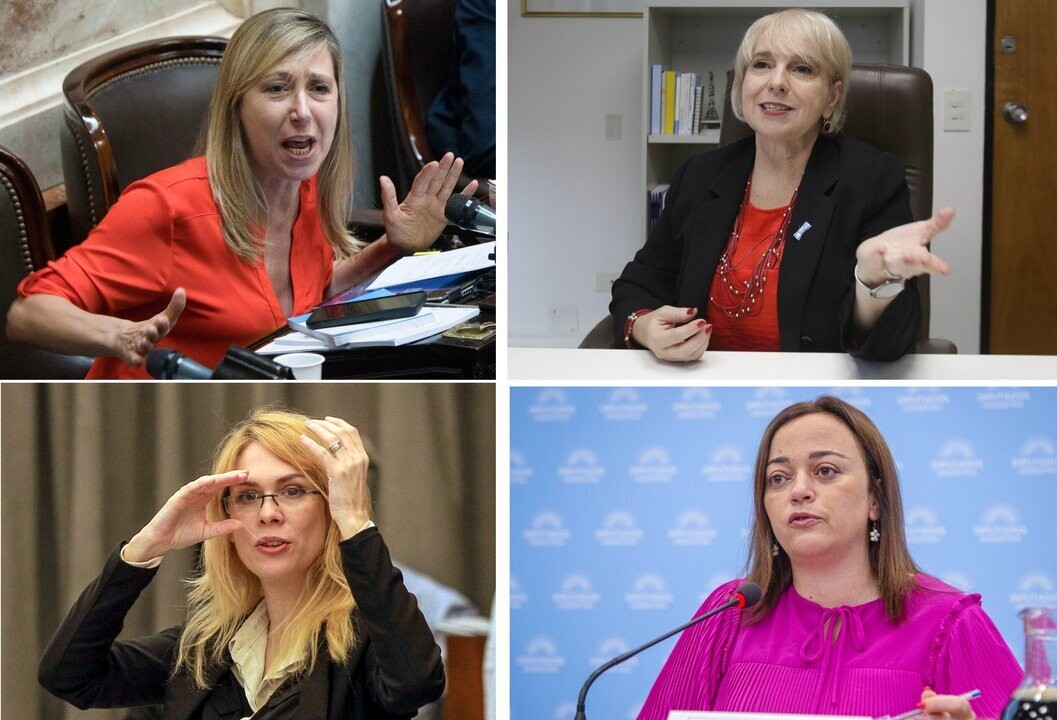
The women with a high profile in the Chamber of Deputies are the ruling party's Silvana Guidici, Sabrina Ajmechet, Juliana Santillán, and Leila Lemoine; the peronists Cecilia Moreau, Victoria Tolosa Paz, Sabrina Selva, Paula Penacca, and Julia Strada; the santafesina Scaglia, the radicals Karina Banfi and Pamela Verasay, and from the left, Romina del Pla and Miriam Bregman.
Silvana Guidici, one of the main swords of the ruling coalition.