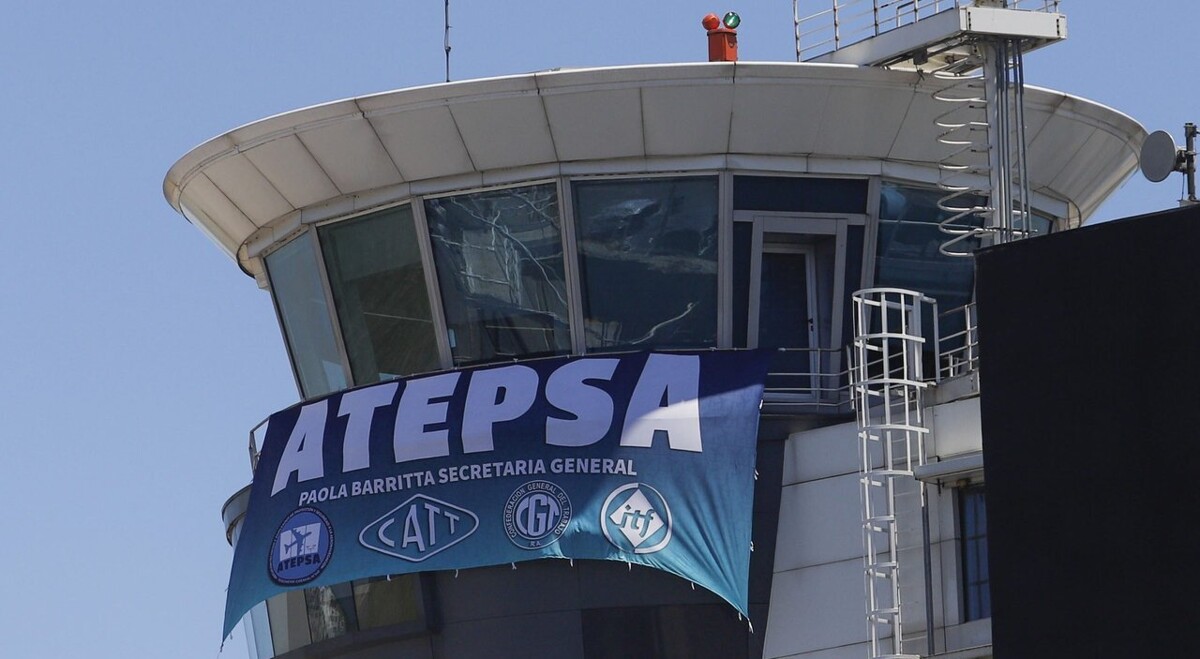
Buenos Aires, January 15 (NA) -- This Friday, the deadline for the mandatory conciliation issued by the Secretariat of Labor in the conflict between the Government and the union representing air traffic controllers expires. The administrative truce established on December 23rd allowed for the neutralization of the Association of Technicians and Employees for the Protection and Security of Air Navigation's (ATEPSA) strike actions. However, the resolution of the collective bargaining dispute with the Argentine Air Navigation Company (EANA) has not yet been reached. According to sector sources, a new meeting is scheduled for tomorrow, while the possibility of an extension is anticipated, given the union's threat to call new strike actions in the short term. 'In the framework of the labor conflict between the Argentine Air Navigation Company (EANA) and the Association of Technicians and Employees for the Protection and Security of Air Navigation (ATEPSA), and with the expiration of the mandatory conciliation previously issued by the Secretariat of Labor, a new hearing will be held this Friday, January 16th, with the possibility of extending it for another 5 business days,' sources indicate. They state that, 'despite the union's permanent intransigent stance, EANA is working non-stop to unblock the conflict with the aim of guaranteeing normal flight operations during the peak summer season.' And they conclude: 'EANA reiterates its willingness to engage in dialogue and continue negotiating to reach a solution, as it considers that ATEPSA's belligerent position does not seek better working conditions, but to cause harm.' The possibility of an extension is provided for by current regulations, which allow the labor authority to grant an additional five business-day extension at the request of the state-owned company. The conflict was suspended after a transitional agreement that included a 15% salary increase distributed in four installments. In November, the union resumed its actions with nine days of focused strikes on cargo flights and the complete paralysis of technical training and infrastructure maintenance. Finally, in December, a protest plan was initiated that affected passenger flights for two days, which led to the current mandatory conciliation that is in effect until this Friday. The conflict has transcended the labor sphere and has moved to federal courts, where two main axes are being investigated: a suspected administrative fraud and an investigation into operational safety failures. On one hand, justice is examining the validity of a collective bargaining agreement from late 2023, analyzing the responsibility of Gabriela Logatto (former President of EANA) and Paola Barritta (General Secretary of ATEPSA) in the alleged creation of a document that established anticipated salary increases for 2024, which does not appear in the company's official records. On the other hand, EANA filed criminal complaints against the union for actions that allegedly endangered flight safety, including the placement of union elements in control towers that could have interfered with visibility and technical operations. The expiration of the mandatory conciliation places the Government in a strategic dilemma. Last July, on the eve of winter vacations, an initial mandatory conciliation was issued to deactivate a protest scheme that threatened the winter break. Subsequently, in August. This mechanism seeks to exhaust dialogue instances before the union, led by its General Secretary Paola Barritta, regains the power to hold assemblies or strikes that would compromise passenger flow during the peak season. The union has already carried out a series of strike actions. While the economic core maintains its austerity stance, the operationality of air transport depends on the management capacity of a human resource that is, by its technical nature, irreplaceable. Air traffic controllers hold a power of action that, if reactivated, would compromise the stability of civil and commercial aviation throughout the entire Argentine territory.