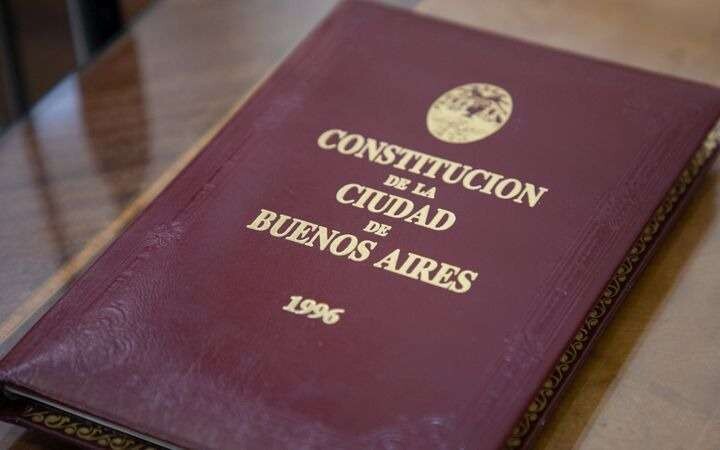
On October 1, 1996, the Autonomous City of Buenos Aires (CABA) enacted its constitution. In it, specifically in Article 106 of Title Five, it states: “It corresponds to the Judicial Power of the City the knowledge and decision of all causes that refer to points governed by this Constitution, by the agreements that the City celebrates, by the Codes of fondo and by the national and local laws and norms, as well as to organize voluntary mediation in accordance with the law that regulates it.” The constitution also establishes that “the city of Buenos Aires will have a regime of autonomous government, with its own powers of legislation and jurisdiction, and its head of government will be elected directly by the people of the city. A law will guarantee the interests of the Nation, while the city of Buenos Aires is the capital of the Nation. Within the framework of what is provided for in this article, the National Congress will call the inhabitants of the city of Buenos Aires so that, through the representatives they elect for that purpose, they dictate the Statute of Organization of their institutions.” Finally, in the transitory provisions it was resolved: “Until the powers arising from the new autonomy regime of the city of Buenos Aires are constituted, the Congress will exercise exclusive legislation over its territory, under the same terms as until the sanction of the present. The head of government will be elected during the year one thousand nine hundred ninety-five. It exercises this competence, without prejudice to the trial by jury that the law establishes.” Finally, on March 5, 1998, Law 7 CABA was enacted, establishing the composition of the Judicial Power and its competences in matters of jurisdiction, as the Jurisdiction was granted by the CN and by the Autonomous City itself. As we can observe, the Autonomous City of Buenos Aires, to date and since October 1, 1996, has the hierarchy of a “PROVINCE” but the CAFIERO Law prevents its full exercise. Has politics put its “tail” (like the devil), Plato maintained that: “...the only citizen who dedicated himself to the art of politics was Socrates, and he ended up dying precisely for that reason, so what I constantly say is not to please, but seeks the greater good and not the greater pleasure...”. This led a Senator for the Province of Buenos Aires to tie the hands of the recently provincialized City, an attitude he did not have with Tierra del Fuego? Look at how Law 24588 is titled “Law that guarantees the interests of the National State in the City of Buenos Aires”, the title only contradicts the precepts of the CN in terms of interferences that Senator Cafiero, as a Constituent, knew well and in what concerns the full competence in the matter of Justice, the law in crisis says: “Article 8 The National Ordinary Justice of the City of Buenos Aires will maintain its current jurisdiction and competence, continuing to be in charge of the National Judicial Power”. If the Cafiero Law is a National Law, I wonder and I transfer the concern: “How has the Autonomous City of Buenos Aires not yet raised before the CSJN the unconstitutionality of Law 24588 given that the matter brought before the Supreme Court would be of Original Competence?”. In the SAIJ records there are records of declarations of incompetence as dictated by Judges of CABA in specific causes: “SENTENCE, Autonomous City of Buenos Aires, CRIMINAL, CONTRAVENTIONAL AND OF OFFENSES Court No. 14, CITY OF BUENOS AIRES, AUTONOMOUS CITY OF BUENOS AIRES, August 30, 2016, Id SAIJ: NV15324”. SYNTHESIS: “In the framework of a cause that investigates the crime of aggravated injuries by the bond, generated by a father to his minor daughter, the Buenos Aires justice declares itself competent despite the fact that the criminal figure is among those understood by the national ordinary justice.” Under these conditions the Federal Government, guarantees to each province the enjoyment and exercise of its institutions.” Likewise, art. 5 of the National Constitution says: “Each province will dictate for itself a Constitution under the representative republican system, according to the principles, declarations and guarantees of the National Constitution; and that ensures its administration of justice, its municipal regime, and primary education.” The law provided for in the second and third paragraphs of art. 129 CN and 106 CCABA violating the republican form of government.” You will ask yourselves if this issue should concern us? And the only answer is “YES”, first to the inhabitants residing in the Autonomous City of Buenos Aires, second to the members of the Executive and Legislative Powers of CABA, who do not express the reasons why they have not gone to the CSJN, in the exercise of their functions and with normative support to petition for the inhabitants of the City where they exercise the functions for which they asked us for the vote. Finally for the Citizens who are covered by the effects of the “LEVINAS” case (among others) after the intervention of the CSJN which, manifestly has expressed the capacity of the Autonomous City of Buenos Aires to understand in issues that must be attended by the Justice of the City in competent matters in non-federal issues and of competence of Local Justice. The so-called Cafiero Law is a drag (person or thing that delays, hinders or stops something -RAE-) of the past, deserves its repeal and to begin to transfer to the CABA the organisms that are still under National Jurisdiction. The Senators and Deputies, at the National level, the members of the Local Legislative Power, the Head of Government, all elected by CABA, through the Prosecutor's Office, must undertake the task, if they, who represent the will of all, do not do it, then it is worth asking what they are for.