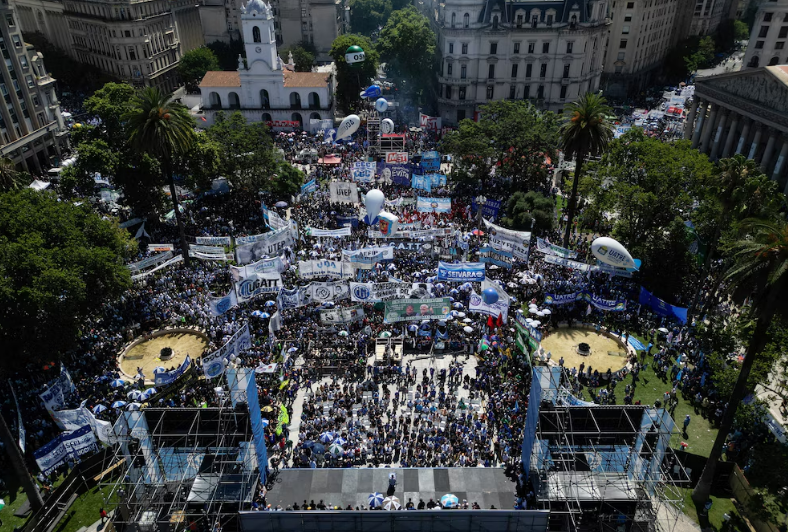
The Argentine General Confederation of Labor (CGT) held a rally in Plaza de Mayo to protest the labor reform project initiated by President Javier Milei. The statement read during the event claims that the project aims to impose a model of labor relations that deepens precariousness, informality, and inequality, benefiting large employers at the expense of the working majority. The CGT document states that “this project neither updates labor law nor will it create new jobs: it promotes precarious contracts, cheaper dismissals, extended work hours, and fragmented wages.” Furthermore, “it limits union action, expands the employer's disciplinary power, atomizes union organization, modifies conditions for collective bargaining, and ultimately, violates union freedom and the effective exercise of representation.” The Government seeks to approve the labor reform before December 30th during extraordinary sessions. The CGT warned that if the reform advances in the Senate, there will be a national strike. Meanwhile, an independent column made up of union workers, social organizations, human rights groups, students, and left-wing parties entered Plaza de Mayo to hold their own event and demand the CGT to call for a “general strike now.” The document read during the CGT's event in Plaza de Mayo asserts that the labor reform pushed by Javier Milei responds to an ideological matrix that reduces labor to an adjustment variable, denying its character as a human right. It points out that the project ignores the protections guaranteed by the National Constitution, current legislation, and international treaties ratified by the Argentine State. The first to speak was Octavio Argüello, who warned that the Government's refusal to listen to the demands of the labor movement could lead to a national strike. The reform also flexibilizes the vacation regime, allowing for its splitting and enjoyment outside the legal period. “It is a lie that jobs are created at the cost of removing rights,” he stated, calling on workers to organize and take to the streets to defend the labor achievements won after years of union struggle. The CGT also warns that under the deceptive discourse of “modernization” and “competitiveness,” the Government seeks to advance over individual and collective rights, weaken collective bargaining, and attack trade union organizations. Regarding dismissals, the reform cuts the calculation base for severance pay and creates a Labor Dismissal Fund financed by employers, with caps and installment payments, which would replace the current scheme. The event held by the CGT in Plaza de Mayo concluded after the reading of a document that denounced the regressive nature of the project. The project proposes a comprehensive flexibilization of working conditions. Among its central points is the creation of a “time bank,” which would allow extending the daily workday without paying overtime, to be compensated later with rest. In terms of wages, it eliminates payment in cash or check and enables payment through bank accounts or e-wallets, even in foreign currency, in addition to increasing the percentage of the salary that can be paid in kind.