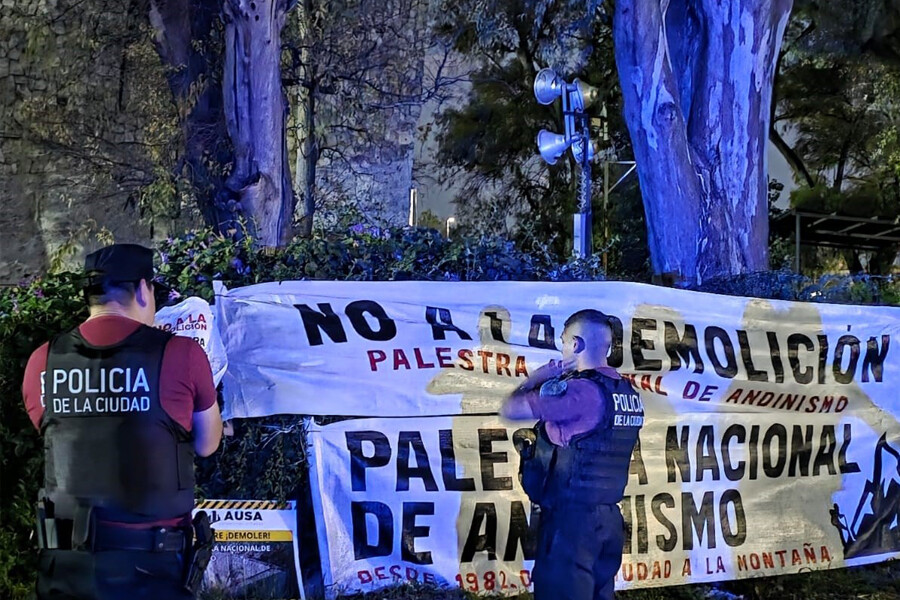
Historically, this was the main training space for climbers, mountaineers, and specialized units in high-altitude rescue operations. The National Mountaineering and Climbing Wall, located in Núñez, began to be demolished yesterday. The Wall was a space for community and gathering. Therefore, they are demolishing the wall without having the environmental impact study approved. The Wall is not a conventional sports wall. Generations of climbers learned techniques and values based on cooperation, trust, and care for one another there. Its demolition exposes a fundamental dispute over the city model being projected. While neighbors and athletes demand its preservation and designation as a cultural heritage, the authorities' response is to send in the DOU group (the specialized tactical unit for urban operations within the City Police, focused on crowd and riot control). The case reveals a recurring tension: the subordination of public, cultural, and sports assets to projects that prioritize land profitability. Although private interests (AUSA) argue they are building a 'replica' in Villa Soldati, the proposed engineering, already under development, is literally useless and does not, in any way, meet the needs of climbers. A session on the land rights was held with the City Government. This takes place within the framework of an ambitious urban project promoted by the Government of the City of Buenos Aires together with private developers. Its permanence allowed for the consolidation of a collective identity that is now threatened by decisions made without the real participation of those who inhabit and use the space. This means that if this construction were to be completed, it would basically put at risk the athletes who dare to use it. Schools, young people, and security forces have historically used the site as a space for inclusion, training, and physical education. The disappearance of the Wall means a setback to the collective right to sports, culture, and public space. As the demolition begins, there are no technicians, engineers, or managerial staff left for its direction. In this context, the historic climbing wall, the largest in Latin America, is disappearing despite its unique value and 43 years of continuous public use since 1982. When its permits were requested, no one has come forward, and they do not have a single construction permit. 'Once again, the Government of the City of Buenos Aires, in favor of the real estate business, is trampling on the rights of the neighbors,' it was stated. It is built as a faithful replica of the mountain with natural stone and forms that imitate it. The specialists assigned to the safety of the future wall have been ignored. Esteban, a user of the National Wall, left us his testimony: 'the wall that until recently was part of CENARD, was de-commissioned by order of Scioli.' There were numerous irregularities in the environmental impact study, because the study does not include the land of the wall, but the work does. This allows for training in traditional climbing techniques that are impossible to replicate in other urban structures. Its sporting importance is indisputable: it is an infrastructure that cannot be moved or rebuilt without losing its essence. The conflict goes beyond sports. A report was made to the Legislature of the city, which has not issued a statement. The project includes the expansion of the Labruna Bridge (River) and the reconfiguration of the adjacent area to CeNARD and the former Federal Shooting Range, an area disputed by real estate interests. And currently there are 20 armed officers from the D.O.U group (infantry, dependent on the Government of the City).