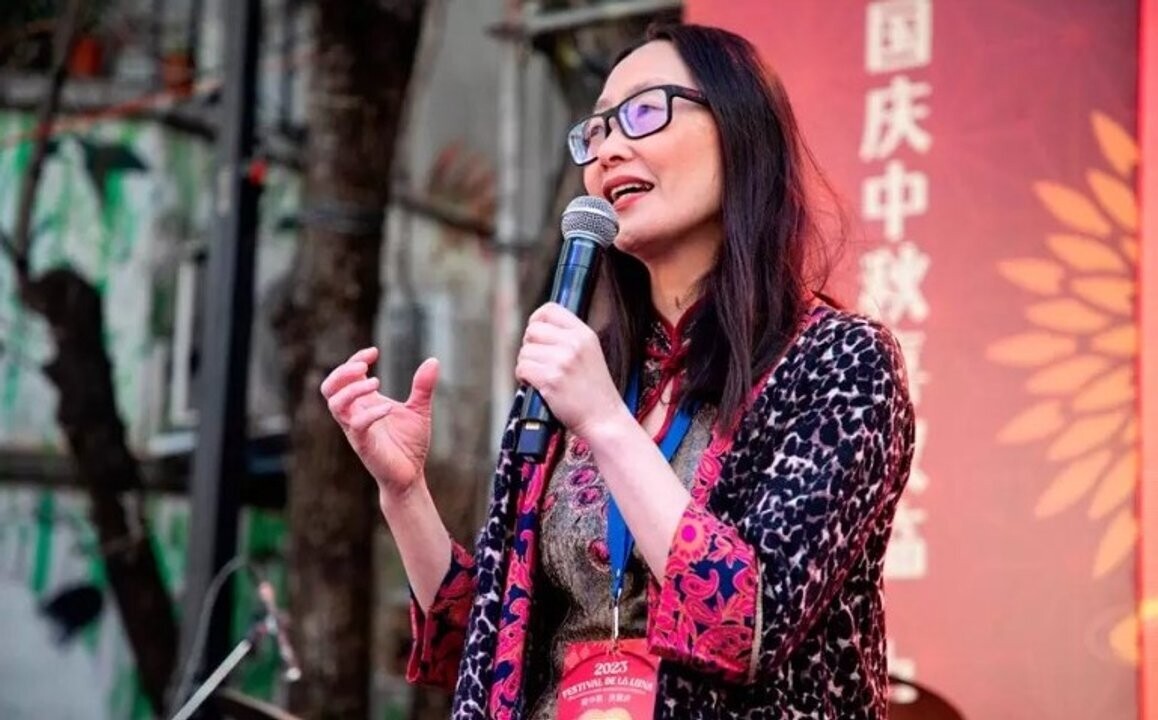
Women in China are highly valued. I became convinced of this while living in the country from the age of 13. When I founded the association, many Chinese people asked me, 'How did you manage if you're not a millionaire?' In China, it's often believed that the right to leadership comes only with a certain economic status. We have a wonderful country, with great freedom of thought and a more relaxed attitude towards mandates. It was this freedom that allowed me to more clearly appreciate the principles that China gave me: respect for others, collective love, and discipline. These are stricter values, but they gave me a foundation to move with freedom, without being carried away by easy speeches. I believe there is great interest from both sides to get closer, but in terms of concrete actions, China is much more active. Argentina also has the intention, but I don't see a clear plan or a sustained agenda. We work with the Argentina-China Chamber of Production, Industry, and Commerce, which makes a great effort to show how to approach China effectively. After the trade war with the United States, they had to seek out new markets with awareness. And if you are a woman, it's even more complicated. Women tend to be in the background, not with less power, but in a different role. This is something that is changing, but very slowly. At the end of the interview, she expressed her desire for Argentines to learn a little more about China... and for Chinese people to also learn a little more about Argentina. Some are assigned Spanish, others Russian. Regarding Argentines, she states that the business sector is, without a doubt, the most active in wanting to get closer to China. They say 'I like Chinese food,' but they don't go much further. In the academic sphere, there is another search, and a real interest in understanding China is noticeable. Franco Ascenso admits that there is a growing interest among Argentines in learning the Mandarin language, and they are teaching it from empathy, using phonetics before characters, and building trust before making demands. 'We teach a foreign language from here, with a local logic. That is a very important step in our method: to make speaking Chinese easy.' He highlights that 'we were the first to dare to say: we are going to teach phonetics in the Latin alphabet during level one and up to the middle of level two. The characters are in the books, but we don't teach them explicitly at the beginning.' They come to learn Chinese, generally, people from companies 'fishing' for future opportunities. 'They don't know well what might appear, but if it does arrive, they want to be more or less prepared with the language, with the form, with the cultural behaviors,' he explains. 'Laboral' is more than an office worker. She distinguishes that 'laboral' is not only understood as an office; it could be an artist, an entrepreneur, someone who wants to move in an environment where the language and culture give them an advantage. According to Ana, 'they come voluntarily from the age of 14 or 15 onwards, but the bulk is people between 20 and 40 years old.' As they learn the language, they lose their fear. 'Because fear builds a wall of beliefs: that Chinese is difficult, that China is impossible, that learning Chinese is unattainable,' she exemplifies. 'When they start to tear down that wall, the first thing they achieve is confidence.' Argentina and China: a cultural dialogue through education and economics. Ana Kuose, founder of the Argentina-China Cultural Association (ACCA), talks about her mission of building a bridge between the two cultures. She emphasizes that despite China becoming Argentina's main trading partner, cultural understanding still lags behind. Ana shares her experience of living in China from age 13, noting how the value placed on women in Chinese society gave her confidence. She also talks about her method of teaching Chinese in Argentina, which is based on phonetics and building trust rather than memorizing characters. According to her, Argentine businesspeople are actively interested in China, but mostly at the level of food, while the academic circle shows a deeper interest. Ana expresses her hope for a closer cultural exchange between the two countries.