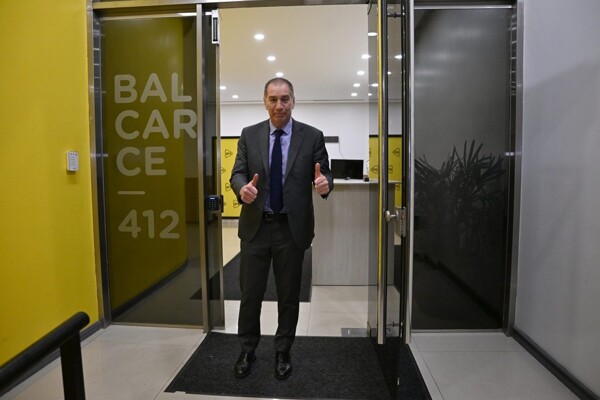
Buenos Aires, December 4, 2025 – Total News Agency-TNA – Former President Cristina Fernández de Kirchner once again heightened her judicial tension by challenging the resolution of the Federal Oral Court No. 2, which redefined the visitation regime of her house arrest after a photograph was published on her social networks showing her meeting with nine economists in her department at San José 1111.
The magistrate also warned that if Cristina Kirchner insists on failing to comply with these guidelines, the Justice system can immediately review the house arrest modality and even replace it with detention in a penitentiary establishment. That same scheme was transferred to her house arrest, where she continued to receive large groups until the Justice system intervened to curb these abuses.
It is also revealed that Cristina Kirchner is considering moving to another property, such as a country house or her residence in El Calafate, although she fears losing the possibility of returning to her Constitución apartment, as that property is on the list of assets whose seizure the prosecutor's office requests in the Vialidad case.
In the TNA newsroom, it is recalled that the former head of state maintained a lifestyle similar to the one she maintains in detention: she did not leave her home, was not seen out for walks, did not dine outside her residence, and was never known for social activities with friends, beyond political meetings with subordinates.
According to close sources, she would also complain about living with 'little light' and that the visit restrictions affect her mood, omitting that they were a direct consequence of her decision to use house arrest as a stage for massive political meetings.
While the defense prepares new appeals before the Chamber of Cassation to try to flexibilize the regime, the Justice system has established that house arrest is an exceptional modality that requires strict compliance.
That image, published at the decision of the convicted person herself, revealed an unauthorized group meeting that explicitly violated the conditions established for her detention, which led to more reasonably strict measures imposed by Judge Jorge Gorini.
According to the ruling, visits must now be limited to a maximum of two hours, can only take place twice a week, and cannot include more than three people at a time.
Beyond her claims about the lack of sun, what has been exposed is a repeated pattern: Cristina Kirchner seeks to maintain, even in detention, the same prerogatives and dynamics she exercised when she was in power.
Recent decisions aim to prevent the former president from continuing to distort this benefit through group meetings that contradict the purpose of her sentence and the current legal regime.
That patrimonial calculation seems to weigh more than the supposed difficulties with light or space mentioned by the convicted person herself.
The restrictions were a direct consequence of the political use of the detention regime, as the former president reproduced within her home the same scheme of massive meetings and party operationality she maintained for years when she was free.
In this context, the former head of state added a new line of complaints by stating that her situation is aggravated by 'lack of sun,' which would lead her to request judicial authorization to access the building's terrace with the aim of sunbathing and getting vitamin D. However, this claim has surprised even those who have known her for decades: Cristina Fernández de Kirchner has never been characterized for engaging in outdoor activities, nor for sunbathing nor for developing habits related to sun exposure.
Her public appearances for over twenty years show a consistent pattern of an indoor life, centered on political meetings in enclosed spaces and without recreational activities outside that realm and even less so with friends, as she grows distant from them.
The contradiction between her personal history and the sudden concern for the sun is pointed out by sources close to the case.