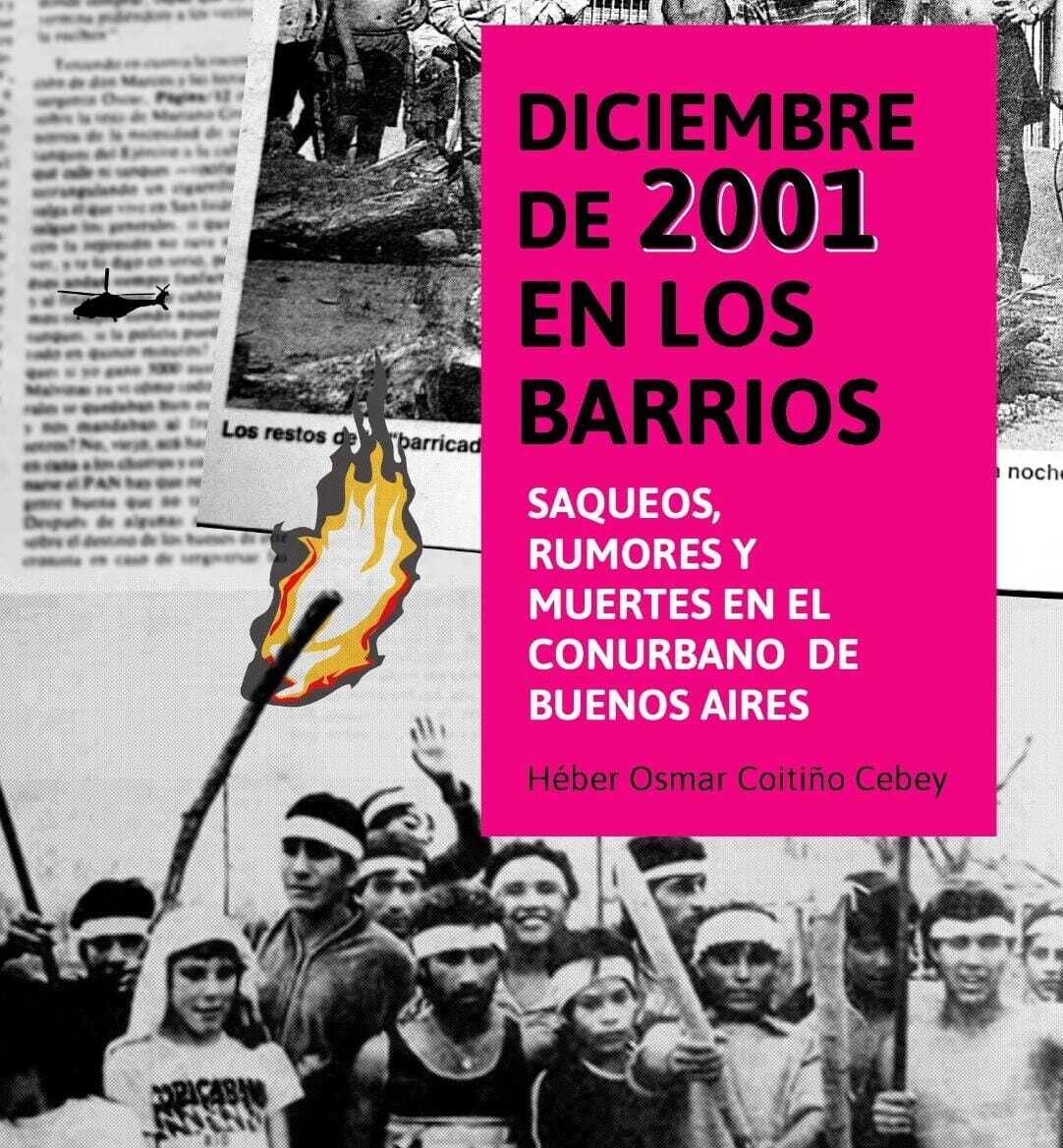
This story is told from the perspective of those who have not been victorious, those who have been forgotten and are left swallowing earth and saliva. Héber Osmar Coitiño Cebey, the author, approved his thesis to become a Licensed Historian from UNDAV. The work has the particularity of addressing the events that occurred in the neighborhoods of the Greater Buenos Aires. On a new anniversary of the 2001 crisis, on Friday, November 14, the book by Héber Osmar Coitiño Cebey was presented at the La Casa de Cláypole theater with a panel where analyses were presented that allowed the audience to ask questions and reflect on an event of great importance in Argentine history. As stated in the prologue by Jorgelina Matusevicius and Nicolás Salas, “Looking back at where we come from, examining our history, reviewing our collective actions is a necessary exercise to build the future we dream of for the exploited and oppressed. This history is built against the grain from the voices of those who have not been victorious, those who are forgotten, left swallowing earth and saliva.” The book will soon be presented at the ATE Brown-Pres. Perón headquarters in Adrogué on Friday, December 12 at 5:30 PM and on Saturday, the 13th, at 5:00 PM at the Roque Dalton Cultural Center in Florencio Varela. The research began with school projects at EES N°43 in Florencio Varela and EES N°14 in Cláypole as part of the Youth and Memory Program, which can be found on YouTube as “Bonfires and Barricades of December 2001” and “2001 Crisis in Cláypole”. One of these works was used to open the event; in that episode, interviews with then-mayor of Varela, Julio Pereyra, and a police officer from the Buenos Aires province are recorded, which provide crucial information to try to understand what happened during the days of December 2001. It contains numerous testimonies from people affected by the political turmoil that led to supermarket lootings and rumors of lootings in homes in almost all neighborhoods of the conurbation; about how partisan interests affected the situation, the role of the police, and a chapter dedicated to understanding the mechanism of psychological warfare. Héber's book is an extremely important contribution to deciphering how history moves from above and below, in different social layers, in a class struggle that is difficult for most of society to see, but that affects them and leaves marks and scars that are difficult to forget and heal.