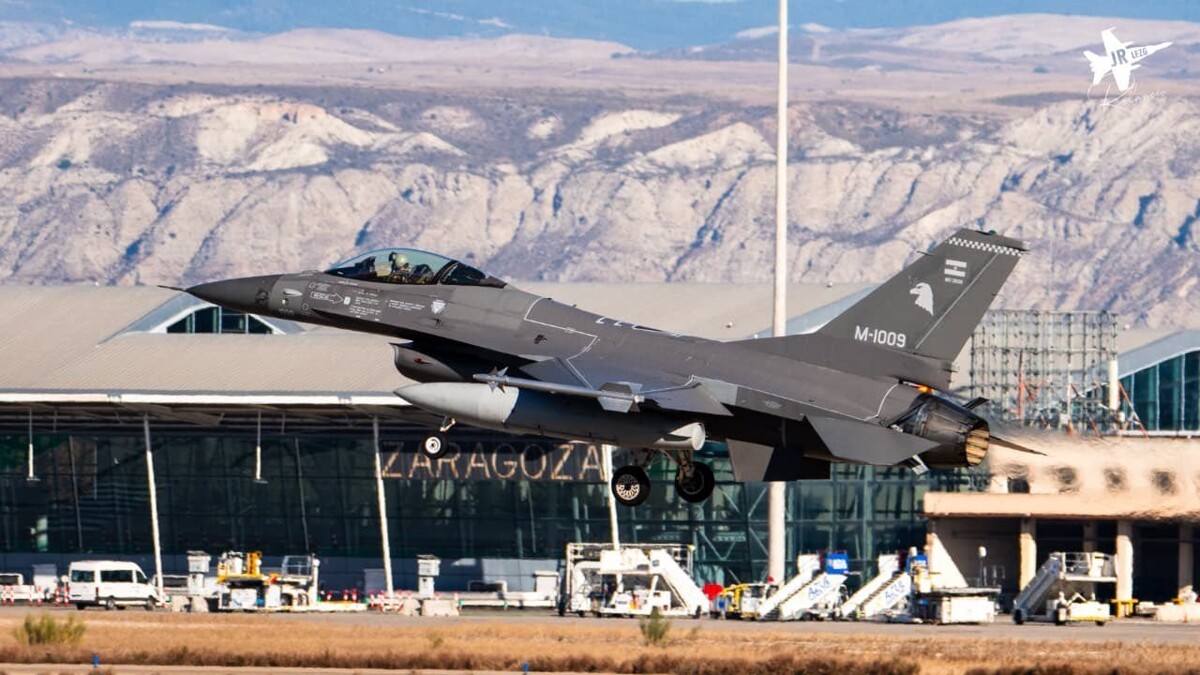
Buenos Aires, November 28 (NA) -- The first batch of F-16 A/B MLU Fighting Falcon fighter jets purchased by Argentina from Denmark is on its way to the country and is expected to arrive next week, confirmed high-ranking sources from the Ministry of Defense and the Condor Building. After the official arrival of the first logistical components at the beginning of this month, the date marked in red on the official calendar is next Friday, December 5th, when the first six aircraft will touch down on Argentine soil, completing a complex transatlantic ferry operation from Denmark. This milestone not only marks the most significant material re-equipment since the Falklands War but also symbolizes a doctrinal change: Argentina regains, after the retirement of the Mirage in 2015, its supersonic interception capability, according to what the Argentine News Agency was able to gather. The transfer process has entered its critical phase. The route, supervised by American and Danish pilots along with the first Argentine-licensed aviators, includes stops in Scotland, Iceland, the United States, and possibly a technical stop in the region before the final landing. The F-16 A/B Block 15 MLU (Mid-Life Update) are fourth-generation combat aircraft, used but modernized to the "Tape 6.5" standard, very similar to the one currently used by NATO air forces in Europe, which makes them operationally convenient for our country. They are equipped with an AN/APG-66(V)2 radar, capable of tracking multiple targets simultaneously from over 100 km away, but the key point of the agreement with the U.S. is the weapons package. It includes AIM-120 AMRAAM missiles (medium range, active radar-guided) and AIM-9 Sidewinders (short range, infrared), as well as guided bombs for air-to-ground attacks. The overall operation is structured in two parallel contracts totaling an approximate investment of 650 million dollars, largely financed by the United States through the FMF (Foreign Military Financing) program. The aircraft, provided by Denmark, cost approximately 340 million dollars for 24 operational aircraft and 1 block for spare parts/ground training, while the armaments, provided by the United States, consist of a package estimated at 310 million dollars that includes the missiles, reconnaissance pods, and electronic warfare systems. With the arrival of the first six units next week, the "Intensive Training" phase will begin. It is expected that throughout 2026, Argentine pilots will accumulate flight hours under the tutelage of allied instructors, with the objective of achieving Initial Operational Capability (IOC) by the end of the following year. With the arrival of the F-16s, Argentina achieves parity with Chile, as the Argentine F-16 MLUs are very similar to the F-16 MLUs operated by the FACh (Chilean Air Force), achieving an immediate technical balance in the Andes. However, Argentina is at a technological disadvantage compared to Brazil, as the Gripen E/F used by the Brazilian Air Force is one generation ahead (Generation 4.5++). For Argentina in 2025, they represent the most intelligent purchase possible: real capability today, at an affordable price. The aircraft will be based at the Tandil base, historically the home of the Mirage. Last month, on November 5th, the FAA Logistics Department formally received the first support package at the Skrydstrup Air Base in Denmark. This shipment, managed through the digital Material Management (MATMAN) system, included sensitive spare parts, test benches, and specific tools that are already in the renovated hangars of the VI Air Brigade in Tandil. The six pioneer units (a mix of single-seat A and two-seat B for training) are carrying out a staggered itinerary that includes in-flight refueling and technical stops. Although Argentina and Brazil are strategic partners and not a conflict hypothesis, this asymmetry is not considered critical. Regarding the position against illicit flights, for example drug trafficking or incursions by low-performance aircraft, the F-16 is more than capable, according to specialists. In summary, the F-16s are not the most modern aircraft, but they are the most combat-tested in history.