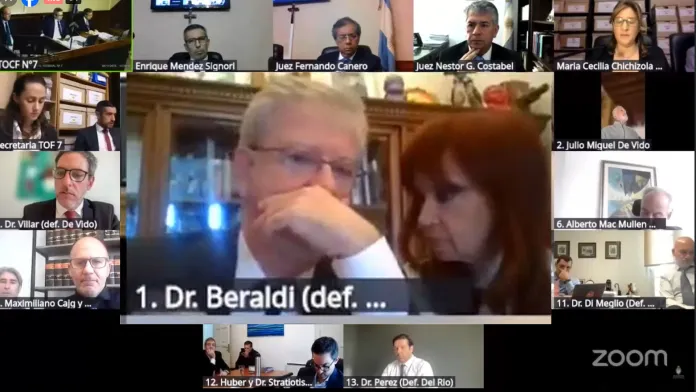
The Oral Federal Court No. 7 (TOF 7) has ruled that the oral trial for the 'Notebooks for Bribes' case will be held twice a week, on Tuesdays and Thursdays, partially complying with a request from the Federal Chamber of Criminal Cassation, which had asked for three sessions per week to expedite the process. According to judicial sources, the hearings will take place in the ground-floor courtroom of the Palace of Justice (Talcahuano 550), with the main accused, their defense, judges, the prosecution, complainants, and the public attending in person. Other participants—accused, witnesses, and the general public—will join via the Zoom platform. The TOF 7 announced that it will add a Tuesday session to the already established Thursday session to try to expedite the proceedings. However, this format has been controversial. The virtual format has faced criticism, as in previous hearings some accused participated from inappropriate locations, raising questions about the in-person control of the process. Criminal law specialists warn that even with two weekly sessions, the pace is modest given the magnitude of the case. The physical presence of the main accused in the courtroom, in contrast to the majority of the 86 accused participating remotely, raises questions about procedural equality and proper judicial immediacy. With 86 accused, complex logistics, and a hybrid hearing format, the question remains whether the process will move at the speed required by the gravity of the case or will continue to be bogged down in a routine of delays and extended procedures. The court itself admitted that its structure is 'overwhelmed' due to the volume of accumulated cases. In the last 90 days, 29 new cases have been added to the TOF 7, which has worsened its operational condition and prompted a request to be exempt from the case lottery, a request that was denied. The hybrid in-person/virtual format was officially adopted by the court, despite the Cassation Chamber having criticized that the telematic format and a weekly frequency compromised the reasonableness of the process. The first hearing session managed to cover only one-fifth of the material, which generated criticism for the slowness of the proceedings. Although the move to two weekly sessions can be seen as a step towards greater efficiency, the hybrid format persists as a source of concern and suggests a pending transition to a truly in-person and also more dynamic trial.