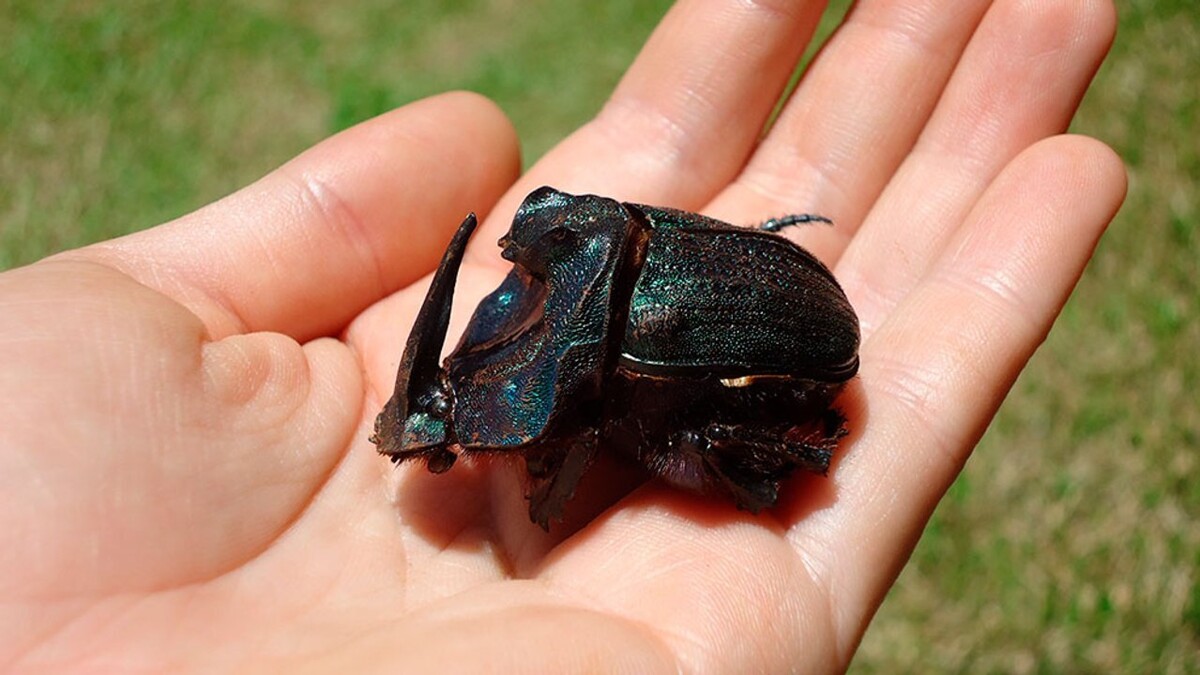
A research team from MACNBR-CONICET analyzed over 5,000 Coprinisphaera, which are fossilized brood balls from the subfamily Scarabaeinae, found in paleosols from various formations in Argentina: Tafí del Valle (Tucumán), Cerro Azul (La Pampa), Punta San Andrés (Buenos Aires), La Pava and Sarmiento (Chubut), and Pinturas (Santa Cruz), as well as in Uruguay, Chile, and Ecuador.
«Essentially, a brood ball is a spherical portion of food (dung or carrion) containing an egg, coated with a wall of soil material. Adults build this wall to protect and ensure the successful development of their offspring,» explains Liliana F. Cantil, a Ph.D. in Biology.
«Scarab beetles of the subfamily Scarabaeinae used the dung provided by large herbivores. Over time, there was such a significant increase in the diversity and abundance of coprophagous species that it led to intense competition for resources, which resulted in what is known as ecological niche displacement,» Cantil adds.
Buenos Aires, November 26 (NA) – The evolutionary history of scarab beetles of the subfamily Scarabaeinae, popularly known as «dung beetles,» has been rewritten thanks to a study by the National Council for Scientific and Technical Research (CONICET) and the Argentine Museum of Natural Sciences «Bernardino Rivadavia» (MACNBR).
The study, published in the journal Palaeontology and accessed by the Argentine News Agency, revealed that in some of these insects, the transition from a diet based on excrement (coprophagy) to consuming carcasses (necrophagy) occurred tens of millions of years earlier than was previously thought, debunking a widely accepted hypothesis about the evolution of their feeding habits.
«The previous hypothesis held that the transition of these beetles to necrophagy was due to a scarcity of herbivore dung during the mass extinction of the Late Pleistocene megafauna (around 129,000 years ago). Our work, based on fossil evidence found in Argentina, Chile, Uruguay, and Ecuador, refutes this hypothesis, as the fossil traces analyzed reveal that some species of the subfamily Scarabaeinae were already feeding on carrion over 37 million years ago (Middle-Late Eocene),» detailed Liliana F. Cantil, lead author of the work.
Researchers from CONICET explain that the appearance of grasslands in Patagonia about 45 million years ago provided the right conditions for the settlement of large herbivores. «And for that period, the oldest records of necrophagy appear, indicating that some of the species present at that time shifted from using dung to using carrion, changing their feeding habits,» they added.
«This approach allows us to understand not only when certain behaviors emerged, but also why they were evolutionarily successful,» highlights Cantil.
«The subfamily Scarabaeinae includes more than six thousand species. When the larva hatches, it consumes the food deposited by its parents, which provides the necessary nutrients for it to develop to the adult stage,» explains Cantil.
What Cantil and her colleagues did was refine the attribution of Coprinisphaera, differentiating the fossil brood balls built by coprophagous producers from those of necrophagous producers.
«To do this, we first studied the nesting behavior of modern coprophagous and necrophagous Scarabaeinae beetles in the field and found morphological characters that allowed this distinction,» indicates the CONICET researcher.
The recently published research constitutes a key contribution to the study of the evolution of Scarabaeinae beetles by reformulating the origin of necrophagy as an early adaptive innovation.
«Through the detailed analysis of thousands of fossil traces and associated paleosols, we were able to reconstruct the ecological and adaptive changes these insects experienced over millions of years, revealing how they responded to climate variations, competition for resources, and transformations in ecosystems. Their evolutionary flexibility, shown in our research through fossil evidence, explains why they continue to occupy fundamental roles in ecosystems today, acting as environmental engineers by contributing to nutrient recycling and soil aeration».
Currently, they are present in most terrestrial ecosystems and exhibit fascinating morphological, ecological, and behavioral complexity.