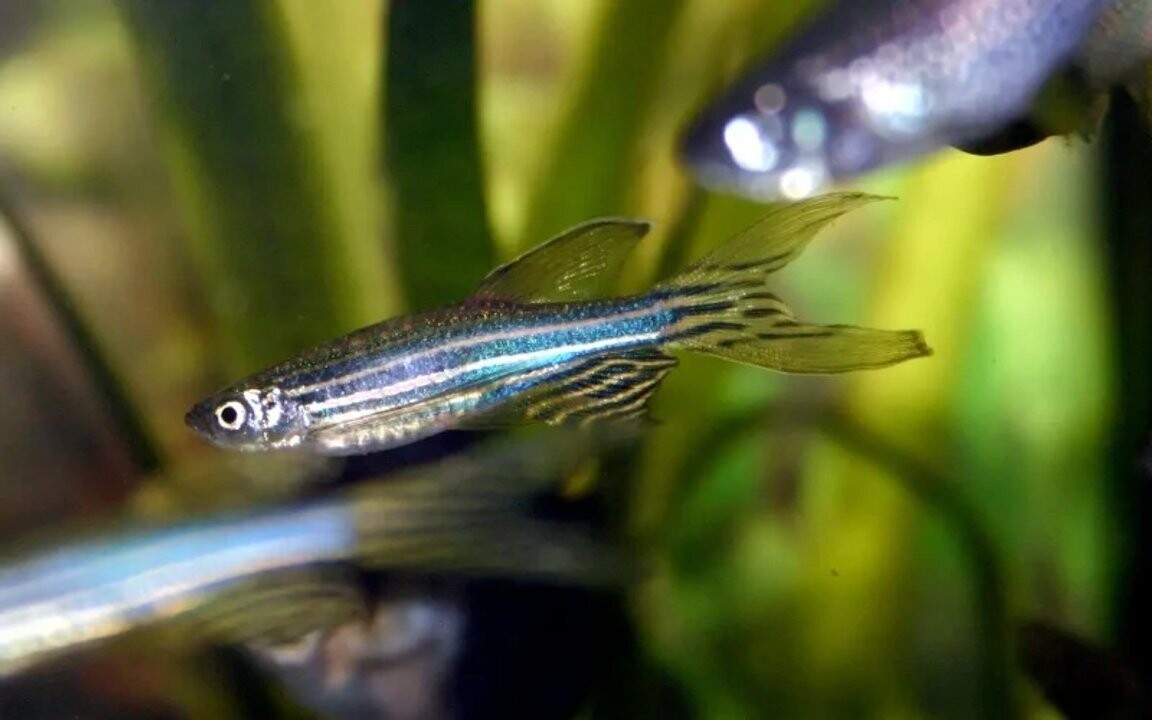
Scientists from the National Council for Scientific and Technical Research (CONICET) have unraveled how the 'zebrafish' fully recovers a damaged organ in seven days. The study, published in the Journal of Theoretical Biology, could open the door to expanding the limits of tissue regeneration in humans.
According to physicist Natalia Lavalle, who participated in the research at the Institute of Liquids and Biological Systems (IFLYSIB, CONICET-UNLP), understanding how some organisms can repair and restore a damaged organ is the first fundamental step to knowing if this is a characteristic that humans once had but lost through evolution, and if it still persists in our DNA and can be recovered in some way.
The zebrafish, a tropical species native to Asia, has the amazing ability to regenerate parts of the body such as the heart, brain, or fins. In this case, the study focused on the possibility of regenerating neuromasts, sensory organs that serve to detect movement and vibrations.
'For their function, we could say they are similar to our inner ear, and this is very interesting because humans cannot recover hearing if there is any damage there. Our research helps to understand how the regenerative response is activated, and most importantly, when and why it stops,' explains Lavalle.
Humans can regenerate skin or the liver to some extent, meaning we retain some regenerative properties, but mostly the organism chooses another biological repair process: scarring. CONICET explains that the zebrafish case is attractive because it shares a large percentage of DNA similarities with ours.
The research consisted of two parts: an experimental one, where zebrafish larvae were intervened with a laser, and a theoretical one, with the development of computational models that could reproduce and explain what was observed in the laboratory.
'The first tests showed that the animal has the property of recovering the damaged organ by up to 90% in both functionality and size within a week,' asserts Lavalle.
In this way, once the scientists had the information from the laboratory, they recreated the entire process to see it in detail and answer the questions: what signals are involved, when do the cells begin to divide, how do they know what exact shape and size to give the organ, where they have to be located, and for how long they continue to proliferate.
After multiple simulations, the research team found that the most accurate mechanism by which the zebrafish would be regenerating its neuromast is one based on 'counting neighbors,' which consists of detecting nearby cells of the same type.
'Basically, we saw that tissue damage triggers a proliferative response that only stops when the dividing cells realize they are surrounded by a certain number of identical neighbors, specifically when they touch three others,' says Chara.
'We call it a local detection signal, and it goes in line with the simplest of biology: cells function and orient themselves in close relation to their environment, and naturally tend to return to those conditions.'
'Many of the molecular mechanisms that operate in this animal have been identified in other species, including our own. When they notice that something has changed, they begin to divide until they return to the comfort that being membrane-to-membrane with the same number of cells as before the damage gave them,' details Lavalle.