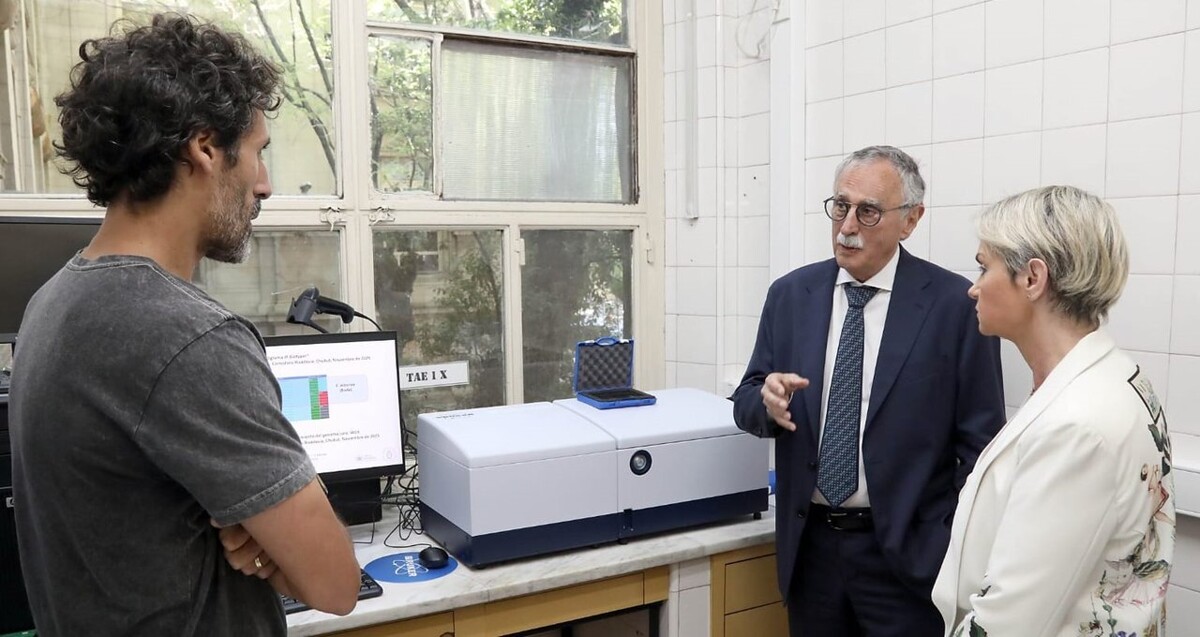
The Ministry of Health, in conjunction with the Secretariat of Innovation, Science, and Technology, has incorporated a Fourier-transform infrared (FTIR) spectrometer. This device allows for more precise identification of microbial variants, thereby improving the work of analysis and epidemiological monitoring.
This new equipment, the only one of its kind in the country, required an investment of 120 million pesos and is now operational at the National Institute of Infectious Diseases (INEI) of the National Administration of Laboratories and Health Institutes (ANLIS) Malbrán.
According to the Argentine News agency, Fourier-transform infrared (FTIR) spectrometry is an analytical technique that works by detecting signals in the infrared range, from which a chemical profile is generated for each microorganism.
Without resorting to complex or expensive genomic techniques, it allows for the comparison of isolates of the same species in just a few hours, speeding up the process of obtaining results.
In turn, the Minister of Health of the Nation, Mario Lugones, thanked the Secretariat of Innovation, Science, and Technology, led by Darío Genua, the body that financed the acquisition of this new technology. He highlighted that the new spectrometer aims to "improve work at ANLIS Malbrán and shorten response times in the event of possible health alerts".
Meanwhile, the director of ANLIS Malbrán, Claudia Perandones, emphasized that "the incorporation of this new tool represents a significant advance in the early detection, control, and prevention of infections, strengthening the national capacity for microbiological surveillance".